
Ever heard a sharp, ticking sound coming from your engine, especially when you first start it up on a cool morning? That noise might be more than just your car warming up—it could be the first cry for help from a failing header gasket, a surprisingly common issue for vehicles here in Sun City, AZ.
A header gasket leak happens when the seal between your engine’s cylinder head and the exhaust manifold cracks or fails. When it does, hot, toxic exhaust gases can escape before they ever make it into your exhaust system, leading to poor engine performance, loud noises, and even potential safety hazards.
What Is a Header Gasket and Why Does It Fail?
Think of a header gasket as the seal on a high-pressure thermos. Its job is simple but absolutely critical: create a perfect, airtight seal. But instead of keeping your coffee hot, this gasket contains and directs incredibly hot exhaust gases from your engine’s cylinders safely into the exhaust system.
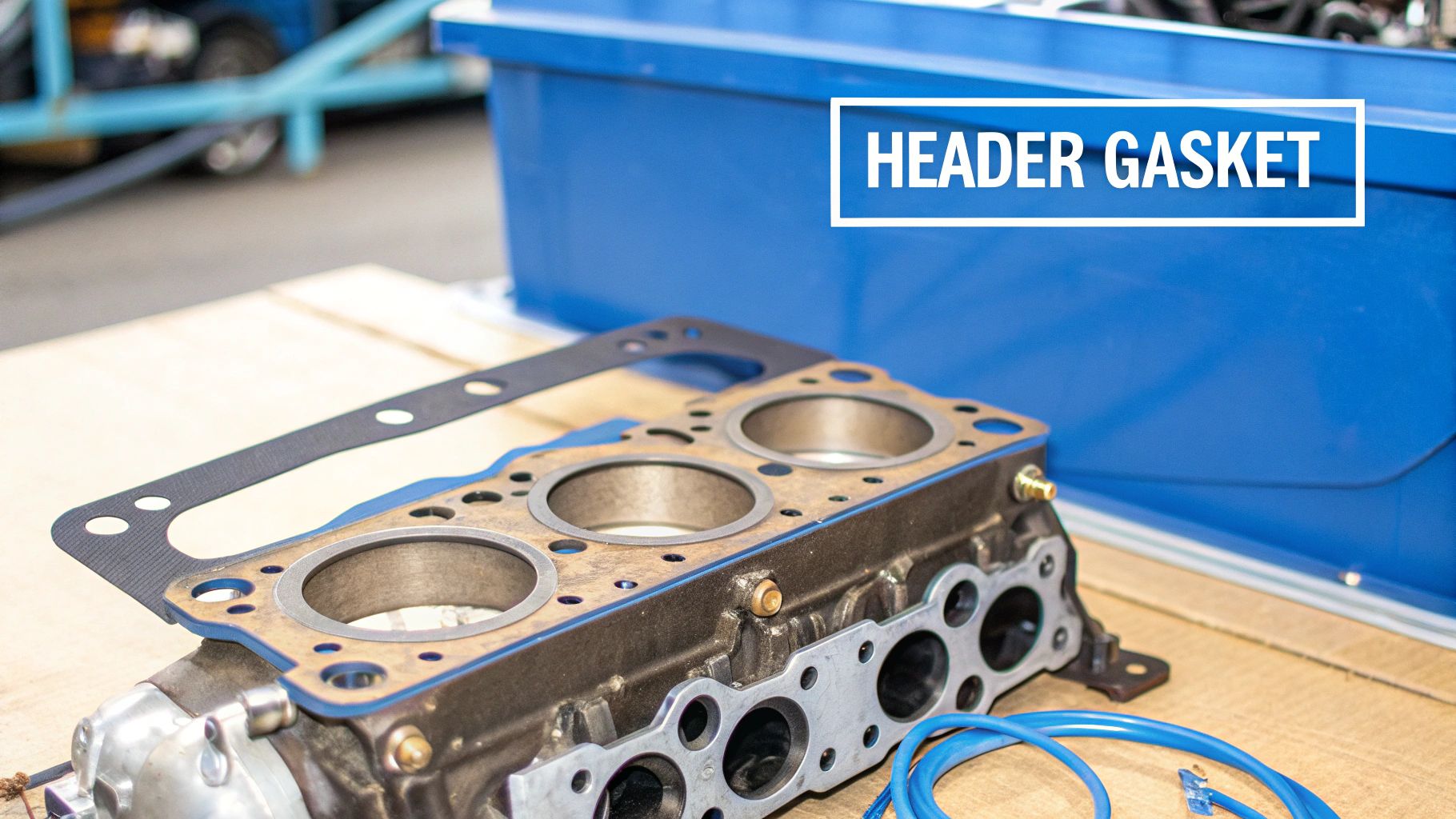
This small but mighty part ensures your engine can “breathe” correctly and keeps dangerous fumes from leaking where they shouldn’t.
The Role of a Header Gasket
This gasket is sandwiched right between two heavy-duty metal parts—the engine’s cylinder head and the exhaust manifold (often just called the header). It’s specifically built to handle extreme temperatures and intense pressure spikes every single time your engine fires.
When that seal is solid, your vehicle runs quietly, efficiently, and safely. But the moment it fails, it can set off a chain reaction of problems that need professional attention. A leak throws off the delicate balance of pressure your engine needs to perform at its best. A bad gasket is just one of many issues that can spiral into bigger problems, which is why knowing the warning signs of engine trouble is so important for every driver.
Why Arizona’s Climate Is So Tough on Gaskets
Living in Arizona means our vehicles are up against a unique set of challenges. The constant, extreme heat cycles are especially punishing on engine components.
- Constant Expansion and Contraction: Every single day, your engine goes from the ambient air temperature to operating temperatures of several hundred degrees. The heavy metal of the engine block and exhaust manifold expands as it heats up and shrinks as it cools down.
- Material Stress: This constant movement puts an incredible amount of stress on the header gasket, which is squeezed tightly between these two shifting surfaces. After thousands of these cycles, the gasket material can turn brittle, start to crack, or simply lose its ability to maintain a tight seal.
In our Sun City, AZ auto repair shop, we see firsthand how the intense desert heat accelerates wear and tear on engine components like gaskets. What might be a minor issue in a milder climate can become a significant problem much faster here.
This relentless thermal stress is one of the main reasons header gaskets give out. Eventually, a tiny gap can form, creating the start of a leak that will only get worse the longer it’s ignored.
Common Symptoms of a Failing Header Gasket
A failing header gasket rarely keeps quiet. Your car has ways of telling you something’s wrong, and a bad gasket is one of the more vocal problems you can run into. If you learn to recognize these signs, you can catch a header gasket leak early on, saving yourself from a much bigger, more expensive headache down the road. It’s all about listening to what your car is trying to tell you.

Many drivers in Sun City first pick up on a problem because of strange new engine sounds. These noises are usually loudest during a cold start, right before the engine’s metal parts have had a chance to heat up and expand.
Noises Ticking and Hissing from the Engine
The most common sign is a very specific sound coming from the engine bay. It’s so important to pay attention to any new or weird noises—they’re often the first clue that your engine needs help.
- A Loud Ticking Noise: This is the classic symptom. When the gasket fails, hot exhaust gas escapes in tiny, high-pressure puffs with every pulse of the engine. This creates a rhythmic ticking or tapping sound that often speeds up as you accelerate and might quiet down once the engine gets hot and the metal expands, sometimes temporarily sealing the gap.
- A Hissing or Whooshing Sound: A bigger leak can graduate from a tick to a constant hiss. That’s the sound of exhaust gas streaming out of a larger crack or gap in the gasket.
Think of these sounds as the first alarm bell. If you ignore them, the leak will only get worse, leading to more serious and dangerous problems.
Reduced Performance and Fuel Economy
A header gasket leak messes with how your engine breathes, which directly hits its power and efficiency. The whole system is engineered to maintain a precise amount of backpressure to work right.
When exhaust escapes before it should, that delicate balance is thrown completely off. This can confuse your engine’s oxygen sensors, causing them to signal for the wrong air-fuel mixture. The end result is a noticeable drop in your car’s performance. You might feel like it’s sluggish when you hit the gas, or that you’re suddenly making more trips to the pump than usual.
A properly sealed exhaust system is essential for engine performance. Even a small leak can rob your engine of power and send your fuel economy plummeting, costing you money with every mile you drive in the Sun City area.
Dangerous Odors and Visible Signs
The most alarming symptoms are the ones you can see and smell. These usually point to a more severe leak and can create real safety risks.
- Exhaust Fumes in the Cabin: This is a major red flag. If you can smell raw exhaust inside your car, it means toxic gases like carbon monoxide are getting into the passenger area. This is a serious health hazard that needs immediate, professional attention.
- Black Soot Around the Manifold: A quick look under the hood can sometimes reveal the problem. Search for black, soot-like stains on the cylinder head right where the exhaust manifold bolts on. That soot is a dead giveaway that exhaust is leaking out and coating the engine components.
- Engine Overheating: A bad enough leak can act like a blowtorch, blasting super-hot gases onto nearby parts and jacking up the temperatures under your hood. This extra heat can contribute to engine overheating issues. If you see that temperature gauge climbing, it’s critical to understand all the potential causes of a car overheating and get your vehicle inspected right away.
To make it easier to spot the trouble, we’ve put together a quick checklist.
Header Gasket Leak Symptom Checklist
This table breaks down the common signs of a leaking header gasket, helping you quickly identify what those sights, sounds, and smells might mean for your vehicle.
| Symptom | What It Means | Severity Level |
|---|---|---|
| Loud Ticking from Engine | Small puffs of exhaust are escaping through a small leak in the gasket. | Moderate |
| Hissing or Whooshing Sound | A larger, more continuous stream of exhaust is escaping. | High |
| Sluggish Acceleration | The engine’s backpressure is off, affecting power and performance. | Moderate |
| Worse Fuel Economy | O2 sensors are getting bad readings, causing an inefficient air-fuel mix. | Moderate |
| Smell of Exhaust in Cabin | Toxic fumes are entering the passenger area. A serious safety risk. | Critical |
| Black Soot Near Manifold | Visible evidence of exhaust gas leaking onto the engine block. | High |
| Engine Temperature Rising | Hot exhaust is heating nearby components, contributing to overheating. | High |
If you notice one or more of these symptoms, especially the more severe ones, it’s a good idea to get your vehicle checked by a professional as soon as possible.
Why Header Gaskets Fail in the Arizona Climate
While a header gasket is built to take an incredible amount of stress, it’s not invincible—especially not out here in the Arizona desert. The unique conditions we have in Sun City create a perfect storm of factors that can dramatically shorten the life of this critical part.
The main culprit? Our region’s extreme temperature swings. Just think about your car sitting overnight; by morning, the engine is cool. Then you fire it up and drive through a scorching afternoon, where engine temperatures can easily soar. This cycle repeats, day in and day out.
The Constant Battle of Thermal Expansion
This relentless heating and cooling forces the heavy cast iron of the engine block and the tough steel of the exhaust manifold to expand and contract at slightly different rates. The header gasket is caught right in the middle of this constant push and pull.
Every time your engine heats up and cools down, it’s like a tiny, slow-motion tug-of-war is happening right where the gasket sits. Over thousands of cycles, this stress can cause the gasket material to become brittle, compress unevenly, and eventually crack.
This non-stop thermal stress is, by far, the most common reason we see cars come in for header gasket repairs in Sun City. It’s the same kind of stress that takes a toll on your vehicle’s cooling system, tires, and battery. You can learn more in our guide on how Arizona heat affects your vehicle.
Other Common Causes of Failure
Beyond just the climate, a few other things can lead to a header gasket leak. Often, these issues work together, speeding up the gasket’s eventual failure.
- Age and Mileage: Like any part on your car, header gaskets just wear out. After 80,000 to 100,000 miles, the material has endured millions of heat cycles and pressure pulses, and its ability to hold a perfect seal naturally starts to degrade.
- Engine Overheating: If your engine overheats for any reason, it can cause the metal surfaces of the cylinder head or exhaust manifold to warp. Even a tiny, microscopic warp is enough to create a gap the gasket can no longer fill, leading to an immediate and often significant leak.
- Loose or Broken Manifold Bolts: The bolts holding the manifold tight are also fighting the same thermal stress. Over time, they can stretch, loosen up, or even snap completely. When a bolt gives out, it creates uneven pressure, squeezing one part of the gasket too hard while leaving another part loose enough to leak.
This combination of intense heat and mechanical stress is why leakage issues are such a persistent challenge. Globally, the exhaust gasket market is estimated to ship over 200 million units every year. As engines get smaller and more powerful, the demands on these gaskets only increase, pushing manufacturers to find more resilient materials to keep up with the pressure. You can read more research on these automotive exhaust gasket trends.
The Hidden Dangers of Ignoring a Leak
That faint ticking from under the hood might just seem like a minor annoyance, but ignoring a header gasket leak is a bit like spotting a small crack in a dam. You know it’s not going to fix itself, and it’s a recipe for a much bigger, more dangerous disaster down the road.
What starts as a tiny exhaust leak can quickly snowball, triggering a chain reaction of damage that puts both your car and your safety on the line.
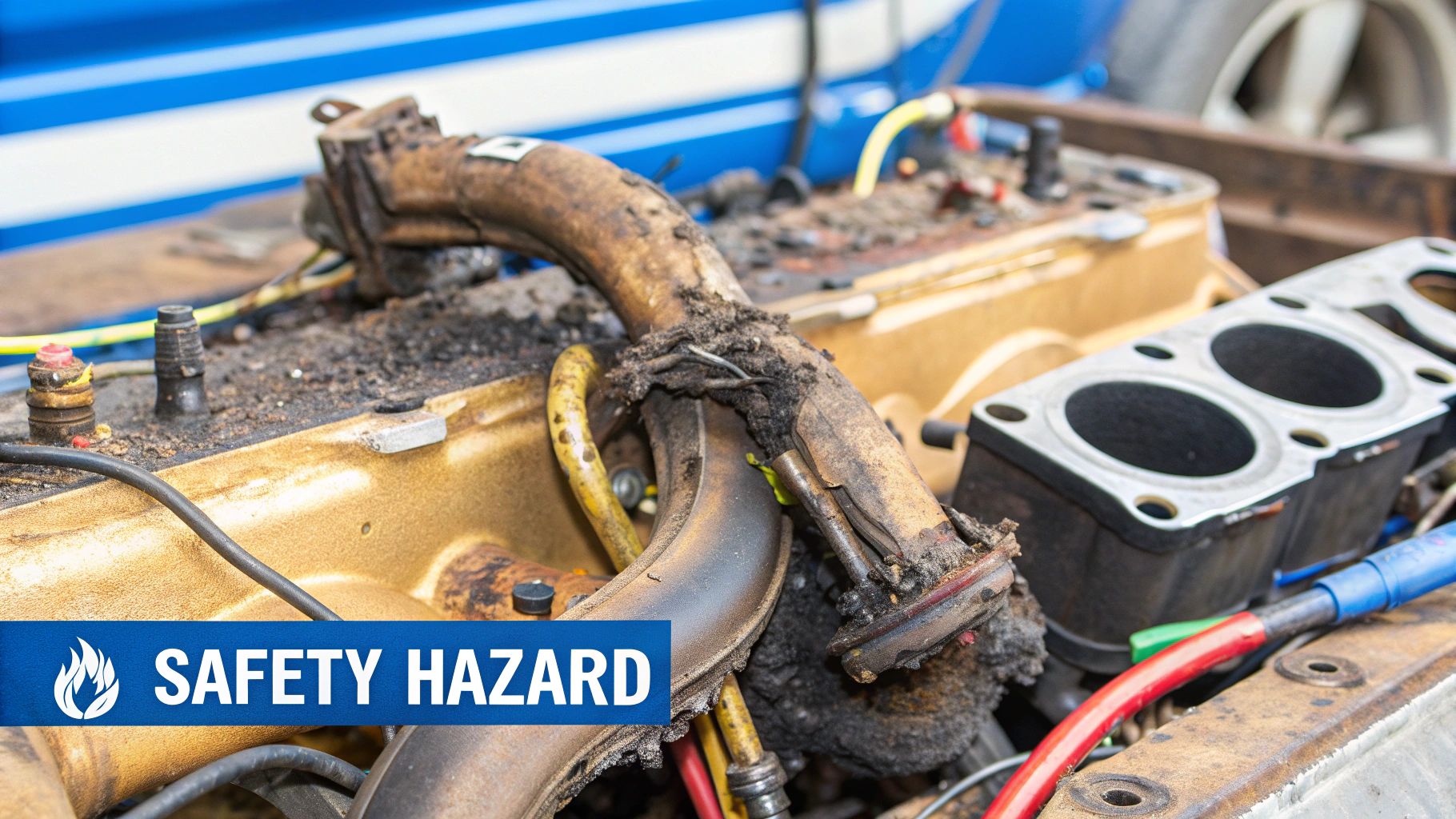
Putting off the repair can turn what should be a straightforward fix into a seriously complex and expensive problem. And believe me, the consequences go way beyond just bad gas mileage or a noisy engine.
Damage to Nearby Components and Fire Risk
Think of the escaping exhaust gas as a miniature blowtorch aimed right at the most sensitive parts of your engine. These superheated gases can easily hit temperatures over 1,200°F.
That intense heat will melt plastic wire looms, fry spark plug wires, and cook the delicate sensors sitting near the exhaust manifold. This often leads to a cascade of bizarre electrical problems that become a real nightmare to diagnose. Even worse, if those hot gases hit a small oil leak or another flammable fluid, you’ve got a serious fire hazard brewing under the hood.
Failed Emissions and Burnt Exhaust Valves
Here in Maricopa County, a failed emissions test can get your car taken right off the road. A header gasket leak is a classic reason for failure because it lets unmetered oxygen sneak into the exhaust stream. This completely throws off the O2 sensors, which triggers a check engine light and an automatic fail at the testing station.
“Ignoring a header gasket leak doesn’t just affect performance; it directly compromises engine health. The disruption in exhaust backpressure can lead to burnt exhaust valves, a severe type of damage that often requires extensive and expensive cylinder head repairs.”
That change in backpressure means the valves can’t cool down properly. They overheat, warp, and eventually stop sealing the cylinder. When that happens, you get a permanent loss of compression—a catastrophic engine failure. Understanding these serious outcomes is key to recognizing the signs that your vehicle needs immediate attention.
A Serious Health and Safety Hazard
Maybe the scariest part of all this is the risk to you and your passengers. A significant leak can let toxic exhaust fumes—including the odorless, colorless, and deadly carbon monoxide (CO)—creep into your car’s cabin through the vents.
Exposure to carbon monoxide can cause headaches, dizziness, and nausea. In high enough concentrations, it can be fatal. This isn’t something to mess around with. Keeping those exhaust gases sealed up isn’t just about passing an emissions test; it’s about keeping everyone in the car safe.
How Professionals Diagnose and Repair Header Gasket Leaks
When you think you’ve got a header gasket leak, the smartest and safest move is to bring your vehicle to a professional auto repair shop here in Sun City, AZ. While the symptoms might seem obvious, actually pinpointing the exact source of an exhaust leak takes a careful eye and some specialized tools. A DIY approach can quickly turn into a frustrating guessing game that doesn’t fully fix the problem.
At Pete Nelson Automotive, our ASE-certified technicians don’t guess. We have a tried-and-true diagnostic method to confirm the issue before we even think about picking up a wrench. This approach ensures we get it right the first time, which ultimately saves you both time and money.
Our Diagnostic Process
We always start with a thorough visual inspection. Our technicians get under the hood and look for the classic tell-tale signs, like black soot streaks around the exhaust manifold or visible cracks in the old gasket. We also check every single manifold bolt for looseness, corrosion, or breaks—a very common reason for these gaskets to fail in the first place.
But a quick look-over doesn’t always catch everything. A hairline crack or a leak that only shows up when the engine is hot can be tricky to spot. That’s when we bring in the advanced tools.
- Smoke Machine Test: This is one of our most reliable methods. We pump a dense, non-toxic smoke into the exhaust system. If there’s a leak, smoke will billow out from the compromised gasket, making even the tiniest breach impossible to miss.
- Acoustic Diagnostics: Using a tool that’s basically a doctor’s stethoscope for cars, our technicians can listen for the distinct ticking or hissing sound of escaping exhaust gases. This lets us zero in on the exact location of the leak along the manifold.
These professional tools take all the guesswork out of the equation. Getting an accurate diagnosis is a huge part of modern auto care. If you want to learn more about how we use technology to troubleshoot, check out our guide to car computer diagnostics.
The Professional Repair Method
Once we’ve confirmed the leak, we get to work on the repair. The infographic below gives you a good look at our meticulous process for replacing a header gasket the right way.
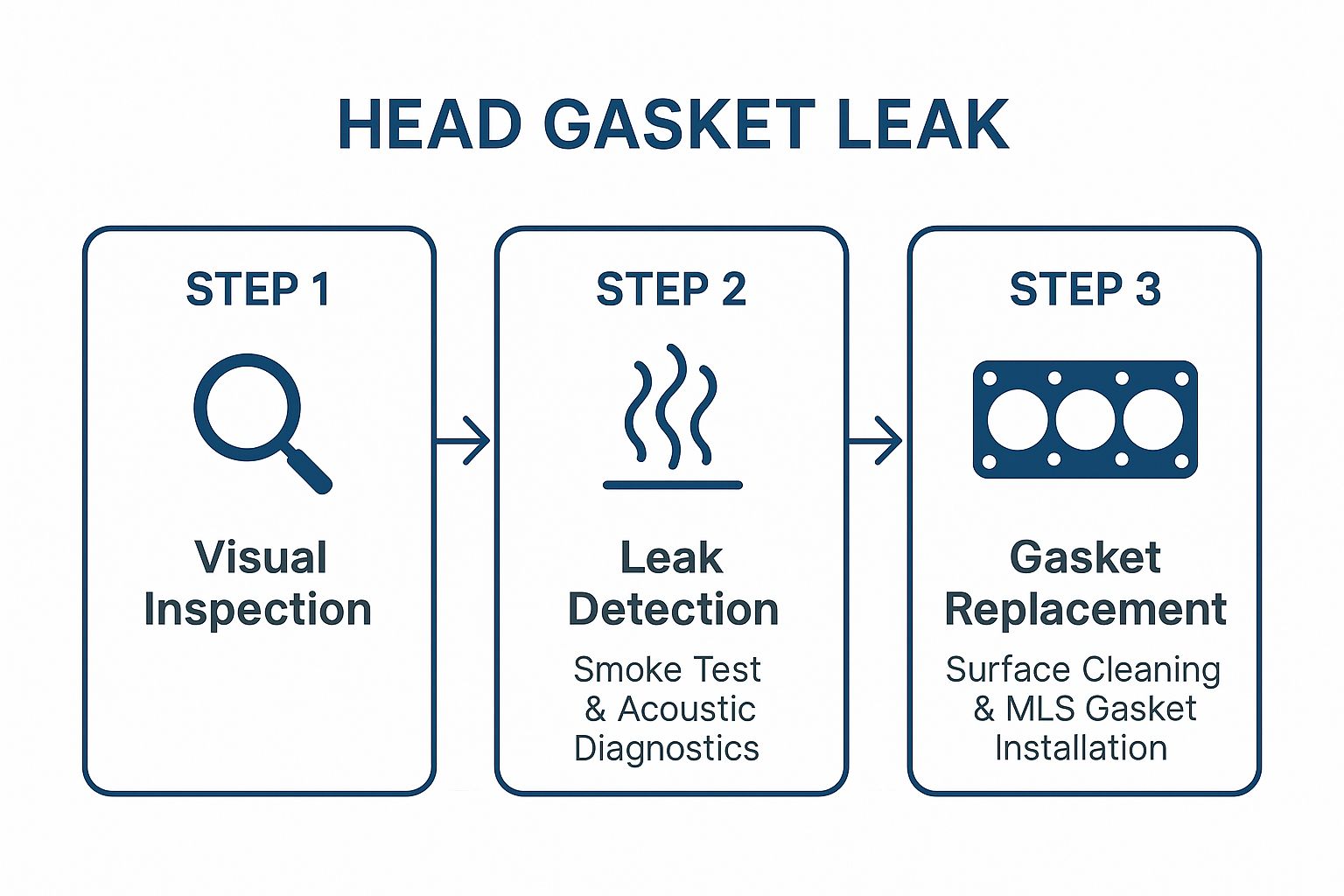
As you can see, a proper repair is about so much more than just swapping in a new part. It’s about restoring the whole sealing surface back to factory specifications.
Crucial Step: Surface Preparation
Simply slapping a new gasket onto a dirty or warped surface is a surefire way to end up with another leak down the road. We take the time to meticulously clean both the cylinder head and the manifold mating surfaces, scraping away every bit of old gasket material, carbon buildup, and rust. Then, we use a precision straightedge to check both surfaces for any warping caused by extreme heat. If we find any, the manifold has to be resurfaced or replaced to guarantee a perfect seal.
We insist on using high-quality, Multi-Layer Steel (MLS) gaskets. They are vastly superior to the older composite types, offering much greater durability and resistance to the punishing heat cycles we see here in Arizona. Finally, we install brand-new bolts and tighten them to the manufacturer’s exact torque specs, following a specific sequence to apply even pressure across the entire gasket for a lasting, leak-free seal.
What Does a Header Gasket Repair Cost in Sun City, AZ?
At Pete Nelson Automotive, we believe in being upfront with our customers, especially when it comes to cost. Understanding the price of a header gasket leak repair helps you feel more in control, and we respect that. The final price tag is a mix of a few key factors specific to your vehicle.
The biggest factor is your car’s make and model. Some engines are packed into the bay so tightly that accessing the exhaust manifold is a real puzzle, often requiring other parts to be removed first. A job that’s straightforward on one vehicle could take hours longer on another.
Factors That Shape the Final Price
Another major variable is the condition of the surrounding components. After years of baking in the Arizona heat, exhaust manifold bolts can become incredibly brittle. It’s common for them to snap during removal, and extracting a broken bolt is a delicate operation that adds time and complexity to the job.
Here’s a quick rundown of what affects the cost:
- Vehicle Design: How difficult is it to access the exhaust manifold and bolts?
- Extent of Damage: Are there snapped bolts that need to be carefully drilled out?
- Component Warping: Has the heat warped the manifold surface? If so, it will need to be professionally resurfaced or replaced.
- Parts Quality: We use high-quality MLS gaskets and new bolts to ensure the repair lasts, which is factored into the price.
The only way to provide an honest, accurate quote is to get your vehicle into our shop for a thorough inspection. We need to assess the situation firsthand to give you a fair price for your car’s specific needs and provide the best auto repair in Sun City AZ.
We’ll give you a clear, detailed estimate before any work begins. Ready to find out what your repair will entail?
Don’t Ignore the Signs—Trust the Experts at Pete Nelson Automotive
That strange ticking noise you heard this morning, or the slight lag in performance you felt on the way to work—those little warnings can be easy to dismiss. But when it comes to a potential header gasket leak, they’re your car’s way of asking for help before a small problem turns into a catastrophic one.
Ignoring the signs isn’t just risking serious engine damage; you’re also dealing with potential carbon monoxide exposure, which is a major safety concern. Here at Pete Nelson Automotive, we’re more than just mechanics. We’re your neighbors, committed to keeping our fellow Sun City drivers safe. Our goal is to make sure your vehicle is dependable and safe for you and your family.
Frequently Asked Questions About Header Gasket Leaks
Hearing you might have a header gasket leak can bring up a lot of questions. To help you feel more confident about what’s going on under the hood, our expert team in Sun City put together answers to a few common questions.
Can I drive my car with a leaking header gasket?
Technically, your car might still run, but we strongly advise against it. Driving with a known header gasket leak risks serious damage to other engine components from the escaping super-hot exhaust, and it creates a potential fire hazard. Most importantly, dangerous carbon monoxide fumes could enter your car’s cabin, posing a serious health risk.
How long does a header gasket replacement take?
The time required can vary quite a bit, typically taking anywhere from a few hours to a full day of work. The biggest factor is your vehicle’s engine design and how accessible the exhaust manifold is. If our technicians encounter challenges like broken bolts or a warped manifold that needs resurfacing, the repair will naturally take longer to complete correctly.
Will a leaking header gasket turn on my check engine light?
Yes, a leaking header gasket will often trigger the check engine light. The leak allows unmetered air into the exhaust stream, which confuses the oxygen sensors. This sends a false reading to your car’s computer, disrupting the air-fuel mixture and activating the warning light. A professional computer diagnostic test is the best way to confirm the cause.
Is a header gasket the same thing as a head gasket?
That’s a great question, and the answer is no—they are two very different parts with very different jobs. A header gasket seals the connection between the cylinder head and the exhaust manifold to contain exhaust gases. A head gasket is a much more critical seal between the cylinder head and the engine block, responsible for containing combustion pressure and keeping oil and coolant separate.
If you suspect something’s not right with your car, don’t wait for it to get worse. Let our team take a look and give you the peace of mind you deserve. Call 623-974-4723 or visit Pete Nelson Automotive to schedule your appointment today.
Pete Nelson Automotive
This Offer Will Expire 12-31-2026
Pete Nelson Automotive is pleased to offer you

"Get Ready for the Holidays"
A $215.00 Value for Only $159.95 (+tax)
Lube, Oil, & Filter Change, Up to 5 quarts of Engine oil
Inspect and top off all fluid levels, Includes up to 5 Quarts of 5w30 synthetic blend oil, additional charge for synthetic oil.
Travel Evaluation
Set Air Pressures and Tire Rotation if needed.
Battery, Alternator and Starter Electrical Test
Load test battery, Alternator output and Starting amps.
Full Brake Evaluation
Includes check brake system on four wheels, checking and testing brake fluid condition.
So Call 623-974-4723 today and make an appointment for this exclusive Special!
*Most Cars, Vans, Motor homes, 4×4’s, Diesels, and some foreign cars may be higher. You must bring this letter at time of service and allow 2 hours to complete.



