
Cruising down Bell Road, you hit the gas to merge, but instead of a smooth burst of power, your car hesitates, stumbles, and struggles to pick up speed. Here in Sun City, AZ, where we rely on our vehicles every day, unexpected engine trouble can be more than just an inconvenience; it’s a real concern for your safety and budget. Often, these mysterious performance issues point to a small but critical component: the fuel pressure sensor.
This sensor is your engine’s fuel delivery manager, constantly telling the vehicle’s computer how much gasoline to send. When it starts to fail, it sends misleading information, causing a chain reaction of problems that range from frustrating to potentially damaging. At Pete Nelson Automotive, our ASE-certified technicians have seen firsthand how a failing sensor can mimic other, more expensive problems.
This guide will break down the most common fuel pressure sensor symptoms we see in our Sun City auto repair shop. We’ll explain what each sign means and what you should do next to get a reliable diagnosis, helping you avoid a breakdown on a hot Arizona afternoon. Understanding these warning signs is the first step to keeping your car running smoothly and efficiently.
1. Check Engine Light (CEL) Illumination
Of all the fuel pressure sensor symptoms, the most common and often first sign of trouble is the sudden appearance of the check engine light (CEL) on your dashboard. This little amber icon is your vehicle’s primary way of telling you that its onboard computer, the Engine Control Module (ECM), has detected a problem. When the fuel pressure sensor sends data that is too high, too low, or completely nonsensical, the ECM flags it as a fault.
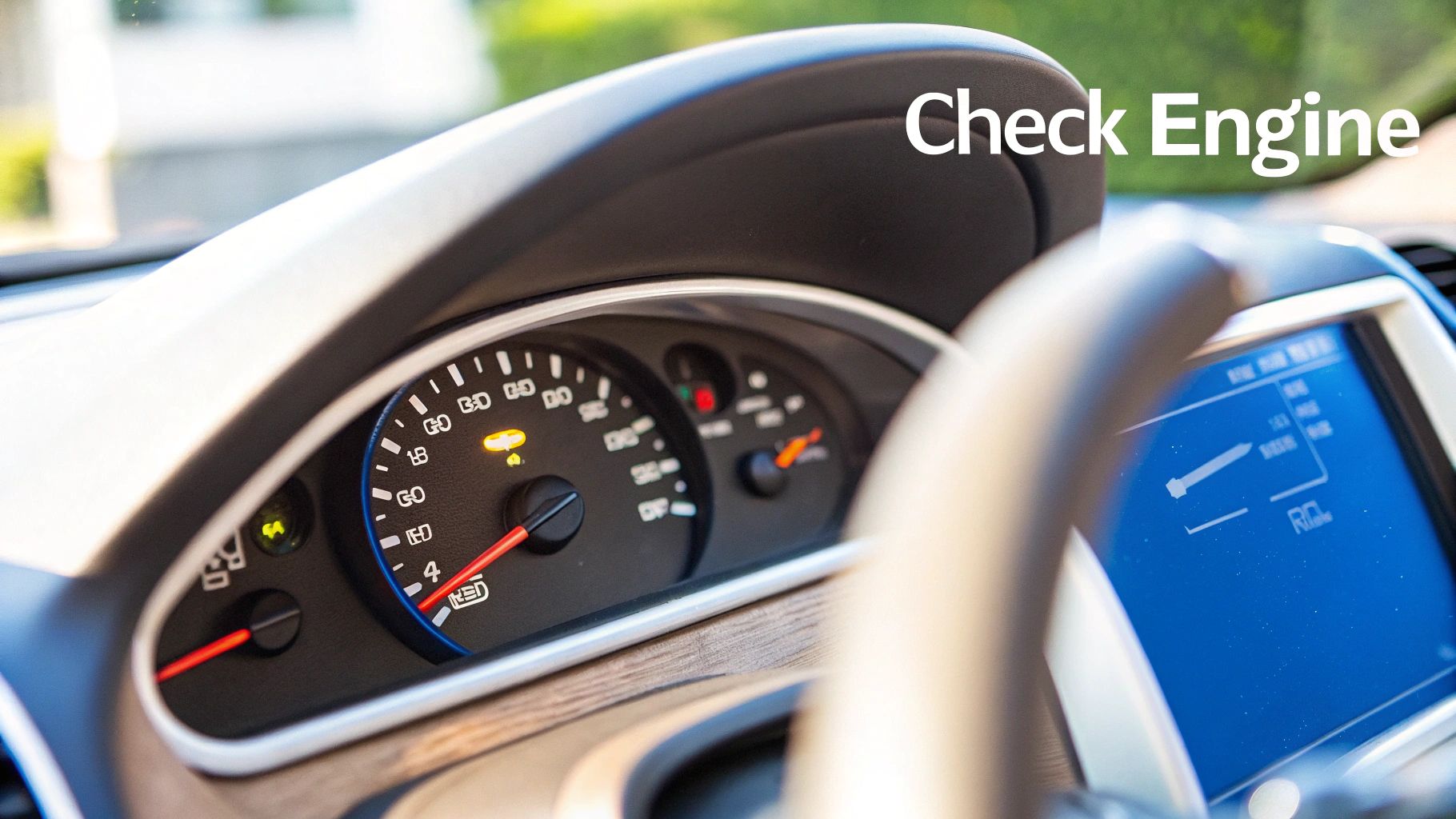
This triggers the CEL and stores a specific Diagnostic Trouble Code (DTC) in the computer’s memory. These codes act like a breadcrumb trail for technicians, pointing them directly to the source of the issue. A professional scan tool can read these codes to identify the problem quickly and accurately.
What the Codes Mean
For a failing fuel pressure sensor, you might see codes such as:
- P0190: Fuel Rail Pressure Sensor Circuit Malfunction
- P0191: Fuel Rail Pressure Sensor Circuit Range/Performance
- P0192: Fuel Rail Pressure Sensor Circuit Low Input
- P0193: Fuel Rail Pressure Sensor Circuit High Input
Each code provides specific details about how the sensor is failing, whether it’s an electrical issue or an out-of-spec pressure reading. For example, drivers of Ford F-150s or Honda Civics often report a P0191 code as the first indicator of a sensor problem, long before other drivability issues become noticeable. Ignoring this warning can lead to more significant engine problems down the road.
Actionable Advice
While it’s tempting to ignore the light and hope it goes away, that’s never a good idea. A glowing CEL is a call to action.
Pro Tip: Promptly addressing a check engine light can prevent a minor sensor issue from escalating into a costly repair involving the fuel pump or catalytic converter.
We strongly recommend having the codes read within 24 to 48 hours. You can better assist your technician by noting when the light appeared. Did it come on while idling in Sun City traffic, accelerating onto the highway, or right after starting the car? This context helps pinpoint the exact failure condition. For a deeper dive into what this warning light signifies, check out our other auto repair blog posts.
2. Engine Hesitation and Poor Acceleration
Another one of the most common fuel pressure sensor symptoms is a noticeable decline in your vehicle’s performance, specifically when you try to accelerate. If your car hesitates, stumbles, or feels sluggish when you press the gas pedal, the fuel pressure sensor could be the culprit. This occurs because the sensor is feeding incorrect data to the Engine Control Module (ECM), leading to an imbalanced air-fuel mixture.
When the ECM thinks fuel pressure is lower than it actually is, it may command the fuel pump to work harder, delivering too much fuel. Conversely, if it reads the pressure as too high, it might cut back on fuel delivery. Either scenario starves the engine of the precise amount of fuel it needs to accelerate smoothly, causing that frustrating lag.
What the Symptoms Feel Like
This issue often becomes most apparent under specific driving conditions that demand more power from the engine. You might experience:
- Lagging Acceleration: A delayed response when you press the gas pedal, especially from a complete stop.
- Stumbling or Sputtering: The engine feels like it’s struggling or about to stall when you try to speed up.
- Poor Performance Under Load: The hesitation is more pronounced when climbing hills, towing a trailer, or merging onto the highway.
For example, owners of Dodge Ram 1500 trucks often report a distinct hesitation when merging onto a busy highway, while some Chevrolet Silverado models exhibit poor acceleration when carrying a heavy load. This isn’t just an inconvenience; it can be a serious safety issue in traffic.
Actionable Advice
If your car feels like it’s lost its get-up-and-go, it’s time to investigate. Don’t let a minor annoyance turn into a major problem.
Pro Tip: Document when the hesitation happens. Is it during a cold start in the morning, after the engine is warm, or only when the AC is running? This information is invaluable for a technician during diagnosis.
We recommend paying close attention to the conditions that trigger the problem. A professional diagnosis at our Sun City shop will involve checking the fuel pressure with a dedicated gauge to confirm if the sensor’s readings match the actual pressure in the fuel rail. To better understand how various components affect your vehicle’s responsiveness, you can find more information about our expert auto repair services.
3. Rough Idling and Engine Stalling
Another highly disruptive fuel pressure sensor symptom is an unstable engine idle or, in more severe cases, complete engine stalling. Your engine needs a precise, steady supply of fuel to maintain a smooth idle. When the fuel pressure sensor provides faulty data to the Engine Control Module (ECM), this delicate balance is thrown off, leading to noticeable performance issues, especially when your vehicle is stationary.
This problem occurs because the ECM relies on the sensor’s readings to command the fuel pump and injectors. If the sensor incorrectly reports low pressure, the ECM may try to overcompensate, causing a rich fuel mixture. Conversely, a false high-pressure reading can lead to a lean mixture. Both scenarios disrupt the ideal air-fuel ratio needed for a stable idle, resulting in rough vibrations, shaking, or sudden shutdowns. This can be particularly unnerving and dangerous at traffic lights or during low-speed maneuvers in Sun City.
How It Manifests in Daily Driving
A failing sensor can make your engine’s idle feel erratic and unpredictable. You might feel a shudder or vibration through the steering wheel and chassis while stopped. The RPM needle on your tachometer may fluctuate erratically instead of holding steady.
Common scenarios we see at the shop include:
- Nissan Altima: Drivers often report sudden stalling at red lights, only for the car to restart without issue, pointing to an intermittent sensor failure.
- Volkswagen Jetta: A classic sign is a persistently rough idle accompanied by a P0190 or similar fuel-rail pressure code.
- Hyundai Elantra: Owners may experience intermittent stalling that becomes more frequent over time as the sensor degrades completely.
Actionable Advice
If your car is stalling or idling roughly, it’s a clear sign that it needs immediate attention. Continuing to drive a vehicle that stalls frequently is a safety risk.
Pro Tip: Document when the rough idling or stalling occurs. Does it happen when the engine is cold, after it’s warmed up, or when the A/C is running? This information is invaluable for our technicians during diagnostic troubleshooting.
We recommend having a professional technician test the fuel pressure while the engine is running and compare it to the readings from the sensor itself. An accurate diagnosis at an auto repair shop in Sun City, AZ will prevent you from replacing parts unnecessarily.
4. Difficulty Starting and Extended Cranking Time
One of the most frustrating fuel pressure sensor symptoms is when your vehicle refuses to start promptly. You turn the key, and instead of the engine firing up right away, you hear it crank for several seconds before it finally roars to life, or in some cases, it may not start at all. This extended cranking time is a classic sign that the fuel system isn’t being properly prepared for ignition.
The Engine Control Module (ECM) relies on the fuel pressure sensor to confirm the system has reached the correct pressure needed for a successful start. If the sensor sends a false low-pressure or no-pressure signal, the ECM may not command the fuel pump to deliver enough fuel, or it may delay the fuel injectors from firing. This starves the engine of the initial burst of fuel it needs to ignite.
Why It Happens
This symptom can be particularly noticeable in specific conditions, pointing directly to a sensor issue:
- Cold Starts: In colder weather, fuel doesn’t vaporize as easily, so precise fuel pressure is even more critical. A faulty sensor reading can make a cold start impossible. Owners of vehicles like a Ford Escape or Mazda CX-5 might notice this issue primarily on chilly Sun City mornings.
- After Sitting Overnight: When a car sits, residual fuel pressure can drop. A healthy system quickly rebuilds this pressure during startup. A failing sensor might incorrectly report that pressure is still adequate, leading to a Subaru Outback having a delayed start after being parked overnight.
Actionable Advice
If you’re dealing with hard starting, don’t just assume it’s a weak battery. A systematic check can help isolate the cause.
Pro Tip: Documenting when the starting issue occurs (e.g., only on cold mornings, after the car has been sitting for hours) provides valuable diagnostic information for your technician.
We recommend a professional diagnostic approach to avoid replacing the wrong parts. When you bring your vehicle in, our technicians will verify fuel pressure during cranking to see if it builds to the manufacturer’s specification. This helps us confirm if the problem is the sensor, the fuel pump, or another related component. We pride ourselves on accurate engine diagnostics here in Sun City.
5. Fuel Economy Deterioration
One of the most frustrating fuel pressure sensor symptoms is a noticeable and often sudden drop in your vehicle’s fuel economy. If you find yourself visiting the gas station in Sun City more frequently than usual despite your driving habits remaining the same, a faulty sensor could be the culprit. The ECM relies on accurate data from this sensor to calculate the precise amount of fuel needed for combustion. When the sensor provides incorrect readings, this delicate balance is disrupted.
If the sensor incorrectly signals low pressure, the ECM will overcompensate by commanding the fuel pump to work harder and telling the injectors to spray more fuel into the cylinders. This creates a “rich” fuel mixture, meaning there’s too much gasoline and not enough air. The excess, unburned fuel is wasted and sent out through the exhaust system, causing your miles per gallon (MPG) to plummet.
Real-World Examples
This isn’t a minor dip in efficiency; the change can be quite dramatic. We’ve seen cases where a Jeep Wrangler, typically getting around 22 MPG, drops to as low as 15 MPG due to a failing sensor. Similarly, Toyota Corolla owners have reported a fuel economy reduction of nearly 30% before the sensor was replaced. A Ford Fusion exhibiting a P0192 code (Fuel Rail Pressure Sensor Circuit Low Input) will almost always be accompanied by poor fuel mileage.
Actionable Advice
If your wallet is feeling lighter due to extra fuel stops, it’s time to investigate.
Pro Tip: Before suspecting a faulty sensor, rule out simpler causes like underinflated tires, a dirty air filter, or significant changes in your daily commute, such as more stop-and-go city driving.
To confirm if your fuel economy has truly dropped, start tracking it manually over two or three fill-ups. Note the miles driven and divide by the gallons used. If you confirm a consistent decline, it’s a strong indicator of an underlying issue. A professional diagnostic scan can then confirm if fuel system codes are present. You can always check our specials page for deals on maintenance services that can also improve efficiency.
6. Erratic Fuel Pressure Gauge Readings
Beyond hard failures that trigger a check engine light, one of the more subtle fuel pressure sensor symptoms is an erratic reading on a fuel pressure gauge. If your vehicle is equipped with a dashboard gauge, you might notice the needle bouncing inconsistently. More often, this symptom is discovered by a technician using a professional diagnostic scanner, which reveals fluctuating or illogical pressure data in real time.
This erratic behavior means the sensor is sending unstable signals to the Engine Control Module (ECM). The ECM relies on consistent data to make precise fuel delivery adjustments. When the readings spike and drop randomly, the computer cannot maintain the correct air-fuel mixture, leading to the drivability problems discussed earlier.
What Erratic Readings Look Like
An intermittent sensor failure can be tricky to diagnose without the right tools. Technicians might observe:
- A Subaru Legacy showing fuel pressure bouncing between 40 and 65 PSI at idle when it should be stable.
- On a diagnostic scan tool, a Hyundai Santa Fe could display pressure readings that jump around without any corresponding change in engine speed or load.
- A Kia Sportage might exhibit fluctuating pressure during light, steady acceleration, causing a slight but noticeable surging sensation.
These inconsistencies point directly to a sensor that is failing internally, often due to electrical degradation or internal component wear.
Actionable Advice
If you suspect erratic fuel pressure, a professional diagnosis is necessary to confirm the root cause.
Pro Tip: Documenting when you notice performance issues, such as hesitation when driving through Sun City or stalling after a cold start, can help our technicians correlate the problem with live data from the sensor.
Our team at Pete Nelson Automotive uses advanced diagnostic scanners to monitor the fuel pressure sensor’s voltage output in real-time. This data-driven approach allows us to confidently identify a faulty sensor and prevent unnecessary replacement of more expensive parts like the fuel pump. A complete fuel system analysis is key to getting it right the first time.
7. Excessive Fuel Consumption and Engine Flooding
One of the most severe fuel pressure sensor symptoms is a dramatic increase in fuel consumption, often accompanied by engine flooding. In this scenario, a completely failed sensor sends signals to the Engine Control Module (ECM) that indicate extremely low or no fuel pressure. In response, the ECM commands the fuel injectors to stay open for far too long, attempting to compensate for the perceived fuel shortage. This floods the cylinders with an excessive amount of raw gasoline.

This condition is not only inefficient but also dangerous for your engine. The raw fuel can wash lubricating oil off the cylinder walls, leading to increased wear. You’ll notice a potent gasoline smell, and in some cases, you may even see white smoke from the exhaust from incomplete combustion.
What Engine Flooding Looks Like
Engine flooding from a bad fuel pressure sensor is a critical failure that requires immediate attention. It can manifest in several ways:
- No-Start Condition: The engine cranks but refuses to start because the spark plugs are saturated with fuel.
- Strong Gasoline Odor: An overpowering smell of raw fuel will be noticeable inside and outside the vehicle.
- Poor Performance: If the engine does manage to start, it will run extremely rough, misfire, and likely stall.
For instance, owners of high-performance vehicles like a Dodge Charger might experience a sudden no-start condition after the sensor fails, completely flooding the engine.
Actionable Advice
If you suspect your engine is flooded due to a faulty sensor, your immediate actions are crucial to prevent catastrophic engine damage.
Pro Tip: Never attempt to keep driving a vehicle with a suspected flooding issue. The excess raw fuel can permanently damage your catalytic converter, a very expensive component to replace.
We urge you to STOP driving immediately and have the vehicle towed to a professional repair shop. Do not try to repeatedly start the engine, as this can worsen the situation. A technician will need to diagnose the sensor, replace it, and inspect for related damage, such as fuel-contaminated engine oil.
Frequently Asked Questions (FAQ)
1. Can I drive my car with a bad fuel pressure sensor?
While you might be able to drive a short distance, it’s not recommended. A faulty sensor can cause engine stalling, poor acceleration, and increased fuel consumption, which can be unsafe and lead to more expensive damage to your catalytic converter or other engine components. It’s best to get it checked by a professional right away.
2. How much does it cost to replace a fuel pressure sensor in Sun City, AZ?
The cost can vary widely depending on your vehicle’s make and model and the sensor’s location. Generally, the part itself is relatively affordable, but labor costs depend on how difficult it is to access. At Pete Nelson Automotive, we can provide a clear estimate after a proper diagnosis.
3. What’s the difference between a bad fuel pump and a bad fuel pressure sensor?
The symptoms can be very similar, which is why a professional diagnosis is crucial. A bad fuel pump fails to generate enough pressure, while a bad sensor incorrectly reports the pressure. Our technicians use specialized tools to measure the actual fuel pressure and compare it to the sensor’s readings to pinpoint the exact cause.
4. How long does a fuel pressure sensor last?
Fuel pressure sensors are designed to last for a long time, often over 100,000 miles. However, factors like fuel quality, driving conditions here in Arizona, and electrical issues can cause them to fail prematurely. There’s no set replacement interval; they are typically replaced only when they fail.
Trust the Experts at Pete Nelson Automotive
Navigating the signs of a failing fuel pressure sensor can feel complex, but understanding them is your first line of defense against more significant engine troubles. From the check engine light and frustrating hesitation to severe issues like stalling and poor fuel economy, these signs are your car’s way of asking for help. Ignoring them can turn a small fix into a major, expensive repair.
The most important takeaway is to treat these fuel pressure sensor symptoms not as an inconvenience, but as an urgent call for a professional diagnostic check. At Pete Nelson Automotive, our ASE-certified technicians have the expertise and advanced tools to accurately diagnose the problem, saving you time and money. We’re proud to be the trusted local auto repair expert for drivers in Sun City, AZ.
Don’t let a small sensor issue sideline your vehicle. Call 623-974-4723 or visit Pete Nelson Automotive to schedule your appointment today.
Pete Nelson Automotive
This Offer Will Expire 12-31-2026
Pete Nelson Automotive is pleased to offer you
"Get Ready for the Holidays"
A $215.00 Value for Only $159.95 (+tax)
Lube, Oil, & Filter Change, Up to 5 quarts of Engine oil
Inspect and top off all fluid levels, Includes up to 5 Quarts of 5w30 synthetic blend oil, additional charge for synthetic oil.
Travel Evaluation
Set Air Pressures and Tire Rotation if needed.
Battery, Alternator and Starter Electrical Test
Load test battery, Alternator output and Starting amps.
Full Brake Evaluation
Includes check brake system on four wheels, checking and testing brake fluid condition.
So Call 623-974-4723 today and make an appointment for this exclusive Special!
*Most Cars, Vans, Motor homes, 4×4’s, Diesels, and some foreign cars may be higher. You must bring this letter at time of service and allow 2 hours to complete.



