Driving through Sun City on a beautiful Arizona day, the last thing you want to see in your rearview mirror is a thick cloud of black smoke trailing your car. It’s an unsettling sight that can make any driver’s stomach drop. So, what does it mean? In short, black smoke from your exhaust means your engine is burning too much fuel and not getting enough air—a clear signal that something is off balance under the hood.
Why Is My Car Blowing Black Smoke?
That sudden plume of dark smoke you see when you hit the gas is more than just ugly—it’s your car’s way of crying for help.
Think of your engine like a perfectly tuned barbecue grill. When you have the right amount of charcoal (fuel) and the vents are wide open for airflow (oxygen), you get a clean, hot, efficient flame. But what happens if you choke off the air vents and keep piling on charcoal? You get a sputtering fire and tons of thick, sooty smoke.
That’s exactly what’s happening inside your engine. For optimal performance, it needs a very specific mixture of air and fuel. When that mixture becomes “fuel-rich,” it means there’s way too much gasoline and not nearly enough oxygen to burn it all up during combustion. Those leftover, unburned fuel particles get shoved out the exhaust system, creating the dark, sooty smoke you’re seeing.
Understanding the Air-Fuel Ratio
This imbalance, known as a rich air-fuel ratio, is the root cause of the problem. It doesn’t just look bad; it’s actively harming your vehicle and your wallet. An engine running rich will quickly lead to:
- Terrible Fuel Economy: Your engine is literally dumping unburned fuel out the tailpipe instead of turning it into power. You’ll definitely notice you’re making more frequent stops at the gas station.
- Poor Engine Performance: Your car might feel sluggish, hesitate when you try to accelerate, or even stall out. It just isn’t running efficiently.
- Serious (and Expensive) Damage: Over time, that excess carbon soot can foul up your spark plugs and destroy critical components like your oxygen sensors and the very expensive catalytic converter.
Before you panic, let’s walk through the most common culprits behind this rich fuel condition. We’ll cover a few simple checks you can do yourself and make it clear when it’s time to stop guessing and bring your car to a professional auto repair shop in Sun City, AZ for a proper diagnosis.
To help you get a quick read on what your car might be trying to tell you, here’s a simple chart breaking down the usual suspects when it comes to exhaust smoke.
A Quick Guide to Exhaust Smoke Colors
This table is a great starting point for figuring out what’s going on with your vehicle based on the color of its exhaust.
| Smoke Color | What It Typically Indicates | Most Common Cause |
|---|---|---|
| Black | Engine is burning too much fuel (running “rich”). | Clogged air filter, faulty fuel injectors, bad sensors. |
| Blue/Gray | Engine is burning oil. | Worn piston rings, valve seals, or other internal leaks. |
| White | Engine is burning coolant (antrifreeze). | Blown head gasket or a cracked cylinder head. |
While this is a handy reference, remember that a true diagnosis requires a professional eye. The color gives us clues, but the real fix comes from finding the source of the problem.
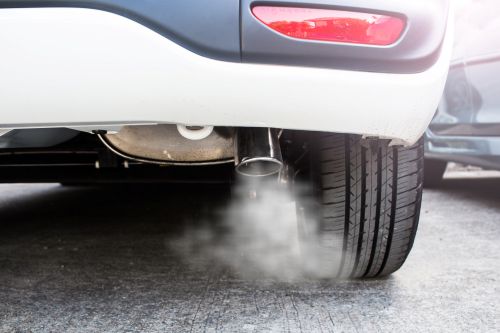 The Top 5 Causes of Black Exhaust Smoke
Now that we know black smoke is a dead giveaway for an engine running rich (too much fuel, not enough air), let’s get into the nitty-gritty. What parts actually fail to cause this problem?
Think of it like a team responsible for managing your engine’s diet. When one player drops the ball, the whole system gets thrown out of whack. We’ll walk through the five most common culprits to give you a better idea of what might be going on under your hood.
This infographic really nails the core issue behind black exhaust smoke. It’s all about an imbalanced recipe: too much fuel and too little air.
As you can see, a healthy engine is all about maintaining that precise ratio. The moment it gets disrupted, you end up with lousy combustion and that tell-tale sooty smoke.
1. Clogged Engine Air Filter
Your engine needs to breathe clean air to work properly, and the air filter is its first line of defense. Its job is simple but absolutely critical: trap all the dust, pollen, and other gunk before it gets sucked into the engine. Especially here in Arizona, those filters can get packed with dirt in a hurry.
When that filter gets clogged, it’s like trying to breathe through a stuffy nose. It physically blocks air from getting in. Your engine’s computer, however, might not get the memo and keeps sending the usual amount of fuel. The result is a fuel mixture that’s way too rich, and thankfully, this is often the easiest and cheapest fix.
2. Faulty Fuel Injectors
Fuel injectors are essentially high-tech spray nozzles. They deliver a super-fine, precisely measured mist of gasoline into each cylinder. For a clean burn, they have to open and close with perfect timing, every single time.
But when an injector goes bad, it can leak or get stuck open.
- Stuck Open: A malfunctioning injector might stay open too long, dumping a stream of raw fuel into the cylinder instead of a fine mist.
- Leaking Injector: Sometimes the seals wear out, causing fuel to constantly drip into the engine, even when it’s supposed to be off.
Either way, you’ve got way too much gas in the combustion chamber. It can’t all burn properly, so it comes out the tailpipe as thick, sooty smoke. Keeping these clean is key, and you can learn more about the benefits of a clean fuel system in our related article.
3. Malfunctioning Fuel Pressure Regulator
If the injectors are the nozzles, the fuel pressure regulator is the guy controlling the spigot. It’s responsible for making sure the fuel travels from the tank to the injectors at a steady, correct pressure.
A bad regulator can cause fuel pressure to spike, forcing the injectors to spray way more gasoline than the engine can handle. This sudden flood of fuel completely overwhelms the system, leaving no chance for enough air to mix in. You’ll see that classic black smoke from exhaust and probably feel a serious drop in power.
Expert Tip: A failing fuel pressure regulator can sometimes cause other alarming symptoms, like fuel dripping from your tailpipe or a powerful smell of raw gas around the car. These are serious signs that you need to see a professional right away.
4. Bad Mass Airflow (MAF) Sensor
The Mass Airflow (MAF) sensor is one of the brains of the operation. This little sensor sits near your air filter and measures the exact amount of air flowing into the engine. It sends this vital info to your car’s main computer (the ECU), which then calculates the perfect amount of fuel to inject.
But when a MAF sensor gets dirty or fails, it starts feeding the computer bad data. It might report that there’s only a trickle of air coming in when there’s actually a flood. The computer, trusting this faulty intel, injects way too much fuel, creating a rich mixture that billows out as black smoke.
5. Failing Oxygen (O2) Sensor
Last but not least, we have the Oxygen (O2) sensor. This sensor lives in your exhaust system and acts like a final quality inspector. It measures how much unburned oxygen is left in the exhaust after combustion and tells the computer if the mix was lean (too much air) or rich (too much fuel).
If an O2 sensor goes bad, it can get stuck on a “lean” reading. It essentially cries wolf, telling the computer the engine is starving for fuel when it’s not. The computer tries to “fix” the non-existent problem by adding more and more fuel, leading directly to the black smoke you’re seeing. It’s a textbook case of bad data causing a bad outcome for your engine.
Simple DIY Checks You Can Perform at Home
Before you pick up the phone to call a mechanic, there are a handful of simple and safe checks you can do right in your own driveway. These steps are all about tackling the low-hanging fruit—the easy and cheap fixes that might be causing that puff of black smoke.
While most engine issues need a professional touch, starting here gives you a better sense of what’s going on under the hood. Sometimes, the solution is surprisingly simple, and these checks could save you a trip to the shop.
Inspect the Engine Air Filter
One of the most common reasons for a fuel-rich engine is a dirty, clogged air filter. Just think of it as your car’s lungs; if it can’t get enough air, it can’t run properly. The good news is that checking it is usually a quick, tool-free job.
Your air filter lives inside a black plastic box in the engine bay, which is often held shut by a few simple clips. Just pop them open and pull the filter out for a look.
- A clean filter will be white or a light off-white color. If you hold it up to a light, you should be able to see the light shining through the paper pleats.
- A dirty filter will be dark gray or even black, caked with dirt, bugs, and other road grime. If it’s clogged and filthy, it’s definitely starving your engine of air and needs to be replaced.
Look for Obvious Sensor Issues
Next up, just do a quick visual scan of your engine bay. You don’t need to be a seasoned mechanic to spot something that looks wrong. Keep an eye out for any electrical wires or connectors that are loose, unplugged, or chewed up. Pay special attention to the area around the air intake system, which is where the MAF sensor is located.
Even a slightly loose connection can send bad data to your car’s computer, throwing off the whole air-to-fuel calculation. This check costs you nothing but a few minutes of your time and can sometimes point you straight to the problem. It’s also a good chance to look for other issues—a damaged wire could be a symptom of something bigger, like a leaking header gasket slowly cooking nearby components.
Safety First: Always make sure the engine is cool before you start poking around to avoid getting burned. And never, ever run the engine with the air filter box open. That’s a surefire way to let dirt get sucked right into the heart of your engine.
Try a Quality Fuel Injector Cleaner
If the air filter looks clean and you don’t spot any loose wires, your next easy step is to try a high-quality fuel injector cleaner. Over thousands of miles, tiny carbon deposits can build up on your fuel injectors, causing them to drip fuel instead of spraying a fine mist.
Just pour a bottle of a reputable cleaner into your gas tank right before you fill it up so it mixes in well. It’s not a guaranteed fix for a completely failed injector, but it’s an inexpensive way to troubleshoot. If the black smoke clears up after you’ve run through that tank of gas, you’ve likely found your culprit.
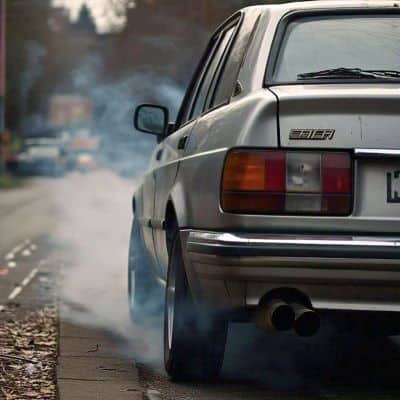 When to See a Professional for a Diagnosis
While checking the air filter or trying a fuel additive are great first steps, most causes of black smoke from exhaust need a professional touch. This is where guesswork can get expensive and frustrating fast, especially if you start replacing perfectly good parts.
When you’re dealing with critical components like the Mass Airflow (MAF) sensor, Oxygen (O2) sensors, fuel injectors, or the fuel pressure regulator, a simple visual inspection just won’t cut it. These parts need specialized tools to test their performance and confirm they’re actually the source of the problem.
Trying to diagnose these systems at home without the right gear is like trying to find a single faulty wire in a pitch-black room—you’re more likely to cause new problems than to solve the original one.
The Power of Professional Diagnostics
This is where the expertise of an ASE-certified technician really shines. At Pete Nelson Automotive, our team uses advanced diagnostic scanners that plug right into your vehicle’s onboard computer. This tech lets us see exactly what your car’s sensors are reporting in real-time.
Instead of just guessing, we can:
- Read Specific Fault Codes: The scanner tells us the exact error code your car’s computer has logged, pointing us directly to the system that’s acting up.
- Analyze Live Sensor Data: We monitor the performance of individual sensors to see if their readings are accurate or all over the place.
- Test Component Functionality: Our equipment allows us to test things like fuel pressure and injector spray patterns to make sure they’re within the manufacturer’s exact specifications.
This diagnostic-first approach is the most efficient and honest way to solve the problem. It guarantees we find the root cause correctly, saving you time and money by replacing only the parts that have truly failed.
Ultimately, bringing your vehicle to our auto repair Sun City AZ shop for a diagnosis is the smartest move when the DIY checks don’t fix the issue. We blend modern technology with decades of hands-on experience to get the job done right the first time.
You can learn more about how we tackle these issues by checking out our articles on professional engine diagnostics. Our goal is simple: get you back on the road safely and with total confidence in your car’s performance.
The Environmental and Performance Costs of Black Smoke
Seeing a puff of black smoke in your rearview mirror is more than just an ugly sight—it’s a clear warning sign from your engine. It’s a direct hit to your wallet and a problem for our beautiful Arizona environment.
Those sooty particles making up the smoke are what we call black carbon, and it’s essentially just wasted, unburned fuel. Every time you see that cloud, your vehicle is telling you its fuel efficiency has taken a serious nosedive.
This means you’re spending way more on gas than you should be. Your engine is literally throwing potential energy right out the tailpipe. A poorly performing engine doesn’t just burn through fuel faster; it also struggles to deliver the power and responsiveness you count on, hurting your car’s overall engine performance. Tackling the root cause isn’t just about a simple mechanical fix—it’s about getting your car’s efficiency back and saving real money at the pump.
More Than Just Wasted Fuel
Beyond the hit to your budget, these emissions have a real local impact. The black carbon particles contribute directly to poor air quality, which is a big concern for everyone here in the Sun City community. On a larger scale, these microscopic particles can have broader health implications and harm the environment.
Fixing the problem that causes black smoke from your exhaust is a responsible step toward better car ownership. A well-maintained vehicle is safer, more reliable, and kinder to the environment, ensuring it serves you well for years to come.
A clean-running engine is a true win-win. It operates at peak performance, makes the most of your fuel budget, and does its part to keep our air clean. It’s simply better for your car, your wallet, and our community.
Your Trusted Auto Repair Partner in Sun City
Seeing black smoke from your exhaust is definitely a cause for concern, but figuring out the solution shouldn’t be another source of stress. As we’ve covered, that dark plume is a dead giveaway that your engine is burning way too much fuel. This usually points back to just a handful of specific parts that might be failing.
The most important step you can take is getting an accurate diagnosis. Throwing parts at the problem is a great way to waste time and money, and we’d rather see you avoid that headache.
Here at Pete Nelson Automotive, we’re your local Sun City team dedicated to giving you straight answers and service you can count on. Our ASE-certified technicians have the know-how and the right diagnostic tools to find the real source of the trouble, whether it’s a quick fix or something more involved. We believe in showing you exactly what’s wrong and explaining how we’ll make it right, getting you back on the road safely. If your car is acting up, our crew has seen it all when it comes to exhaust repair in Sun City.
Don’t let a smoking exhaust mess up your day or, worse, your engine. Give us a call to set up a diagnostic appointment and feel the confidence that comes with having genuine experts on your side.
Frequently Asked Questions About Black Smoke
Can I still drive my car if it’s blowing black smoke?
While your car might still run, it’s strongly advised not to drive it for long. That black smoke is unburned fuel, which means you’re getting terrible gas mileage. More importantly, it can quickly damage expensive components like your oxygen sensors and catalytic converter, turning a small problem into a major repair bill.
How much does it cost to fix black smoke from an exhaust in Sun City, AZ?
The cost can vary widely depending on the cause. A simple fix, like replacing a clogged engine air filter, is very affordable. However, if the issue is a faulty MAF sensor, a bad fuel injector, or a failing fuel pressure regulator, the cost for parts and labor will be higher. An accurate diagnosis is the first step to getting a clear estimate.
Will my car fail an emissions test with black smoke?
Yes, almost certainly. Black exhaust smoke is a clear sign that your vehicle is emitting excessive hydrocarbons and pollutants. This is exactly what emissions tests are designed to detect, so it’s essential to get the underlying problem fixed before your test.
Does black smoke mean my engine is about to fail?
Not necessarily, but it’s a serious warning that shouldn’t be ignored. The “rich” fuel condition causing the smoke can lead to carbon buildup on internal parts, foul your spark plugs, and eventually cause more severe engine damage if left unaddressed for too long.
Call 623-974-4723 or visit petenelsonautorepair.com to schedule your appointment today.
Pete Nelson Automotive
This Offer Will Expire 12-31-2026
Pete Nelson Automotive is pleased to offer you
"Get Ready for the Holidays"
A $215.00 Value for Only $159.95 (+tax)
Lube, Oil, & Filter Change, Up to 5 quarts of Engine oil
Inspect and top off all fluid levels, Includes up to 5 Quarts of 5w30 synthetic blend oil, additional charge for synthetic oil.
Travel Evaluation
Set Air Pressures and Tire Rotation if needed.
Battery, Alternator and Starter Electrical Test
Load test battery, Alternator output and Starting amps.
Full Brake Evaluation
Includes check brake system on four wheels, checking and testing brake fluid condition.
So Call 623-974-4723 today and make an appointment for this exclusive Special!
*Most Cars, Vans, Motor homes, 4×4’s, Diesels, and some foreign cars may be higher. You must bring this letter at time of service and allow 2 hours to complete.



