
There’s nothing more frustrating than starting your day in sunny Sun City, AZ, only to be greeted by silence when you turn the key in your ignition. That dreaded click, click, click means your car battery is dead, turning your morning commute into a major headache. If your car battery keeps draining overnight, it’s not just bad luck—it’s a sign of a hidden problem that needs attention.
A car battery that can’t hold a charge is often the victim of what mechanics call a parasitic draw. This happens when an electrical component—like an interior light, a faulty computer module, or a glove box light that won’t turn off—continues to pull power long after you’ve parked the car. It could also be a simple sign that your battery is getting old and can no longer hold a full charge, a common issue we see thanks to Arizona’s intense heat.
The Frustrating Mystery of a Dead Battery
Waking up to a car that won’t start isn’t just an inconvenience; it’s a puzzle. While obvious mistakes like leaving headlights on happen, the real culprit is often something far more subtle, working behind the scenes to drain your battery’s power.

Why Your Battery Keeps Dying
The issue usually comes down to one of a few key areas. Once you know what to look for, you can start to understand what’s really happening under your hood.
- Parasitic Drains: This is the number one hidden cause we find. It’s when an electrical part doesn’t shut off completely. It could be anything from a faulty alarm system to a computer module that keeps “waking up” on its own.
- An Aging Battery: Batteries don’t last forever, and our Sun City climate is especially brutal on them. An older battery just can’t hold a charge the way it used to, and what might seem like a tiny power draw overnight is enough to completely drain it. You can learn more by reading about the common signs your battery is about to fail.
- Charging System Problems: Sometimes the problem isn’t the battery at all, but the system that’s supposed to be charging it. A bad alternator or a worn, slipping belt can keep the battery from getting the full recharge it needs while you’re driving.
At Pete Nelson Automotive, we see this all the time. A customer will come in totally frustrated with a battery that dies repeatedly. After a few quick diagnostic checks, we often find a small, overlooked component is the source of the whole headache.
Figuring out the ‘why’ behind your dead battery is the first step toward a real, lasting fix. It’s about getting you back in control and making sure you aren’t stranded again.
Finding the Hidden Culprits of Overnight Battery Drain
When your car won’t start after sitting overnight, it’s rarely something as obvious as leaving the headlights on. More often than not, the real problem is a sneaky electrical issue called a parasitic drain. This is what happens when some component in your vehicle keeps pulling power long after you’ve turned off the ignition.
Think of it like a slow, silent leak. Certain systems—like your car’s clock, alarm, and computer memory—are designed to sip a very small amount of power to stay active. But when a component malfunctions, that tiny sip can turn into a constant gulp, leaving you with a dead battery by morning.
The Usual Suspects Behind a Parasitic Drain
Figuring out what’s causing a parasitic drain can feel like a bit of a detective story, but most of the time, it boils down to just a handful of common culprits. These issues can pop up suddenly or develop over time, often without any other warning signs.
Here are some of the most frequent offenders we see at the shop:
- Faulty Relays or Modules: A relay that gets stuck in the “on” position can keep a fuel pump or cooling fan running all night. Likewise, a computer module that fails to go into its low-power “sleep mode” will continuously draw a surprising amount of current.
- Interior Lights: It’s easy to overlook, but a glove box light that stays on, a vanity mirror with a bad switch, or a trunk light that never shuts off will slowly but surely drain your battery.
- Aftermarket Accessories: We see this all the time. Badly installed stereos, alarms, or remote start systems are famous for causing parasitic drains. If the wiring wasn’t done right, these gadgets can pull power straight from the battery 24/7.
- Worn-Out Alternator: The alternator itself can be the problem. Bad diodes inside the alternator can create a circuit that lets current flow out of the battery when the engine is off, slowly killing it.
In a modern vehicle, a normal parasitic draw is between 50 and 85 milliamps (mA). This is just enough to power the essential systems when the car is off. But a faulty part can cause that draw to spike, sometimes draining the battery in just a few hours.
The Role of Battery Age and Arizona Heat
It’s also critical to think about the battery’s own health, especially here in Sun City, AZ. The brutal heat we get in the summer dramatically shortens a battery’s lifespan. An older battery just can’t hold a full charge like it used to, making it way more vulnerable to even a small parasitic drain.
A battery that might have shrugged off a minor electrical draw last year might not have the capacity to make it through the night now. The combination of an aging battery and a hidden electrical fault is the perfect storm for a car that won’t start.
Expert Tip from Pete Nelson: “We often find that a customer’s battery drain issue is a two-part problem. First, there’s a small, hidden electrical draw. Second, their battery is already weakened by a few years of Arizona summers. Fixing the draw and testing the battery’s health is the only way to ensure a reliable start every morning.”
Diagnosing these complex issues really needs a systematic approach. If you’ve ruled out the obvious stuff and are still dealing with a dead battery, it’s probably time for a professional to look at your vehicle’s electrical system. For a full breakdown of how we track down these frustrating problems, check out our guide on professional electrical system repair. Our team has the right tools to trace the drain and get you back on the road with confidence.
How to Troubleshoot a Parasitic Drain at Home
If you’re comfortable with a few basic tools and want to play detective, you can often find the source of a parasitic drain yourself. This process requires a bit of patience, but it’s a systematic way to narrow down the problem, much like our technicians do right here at Pete Nelson Automotive in Sun City.
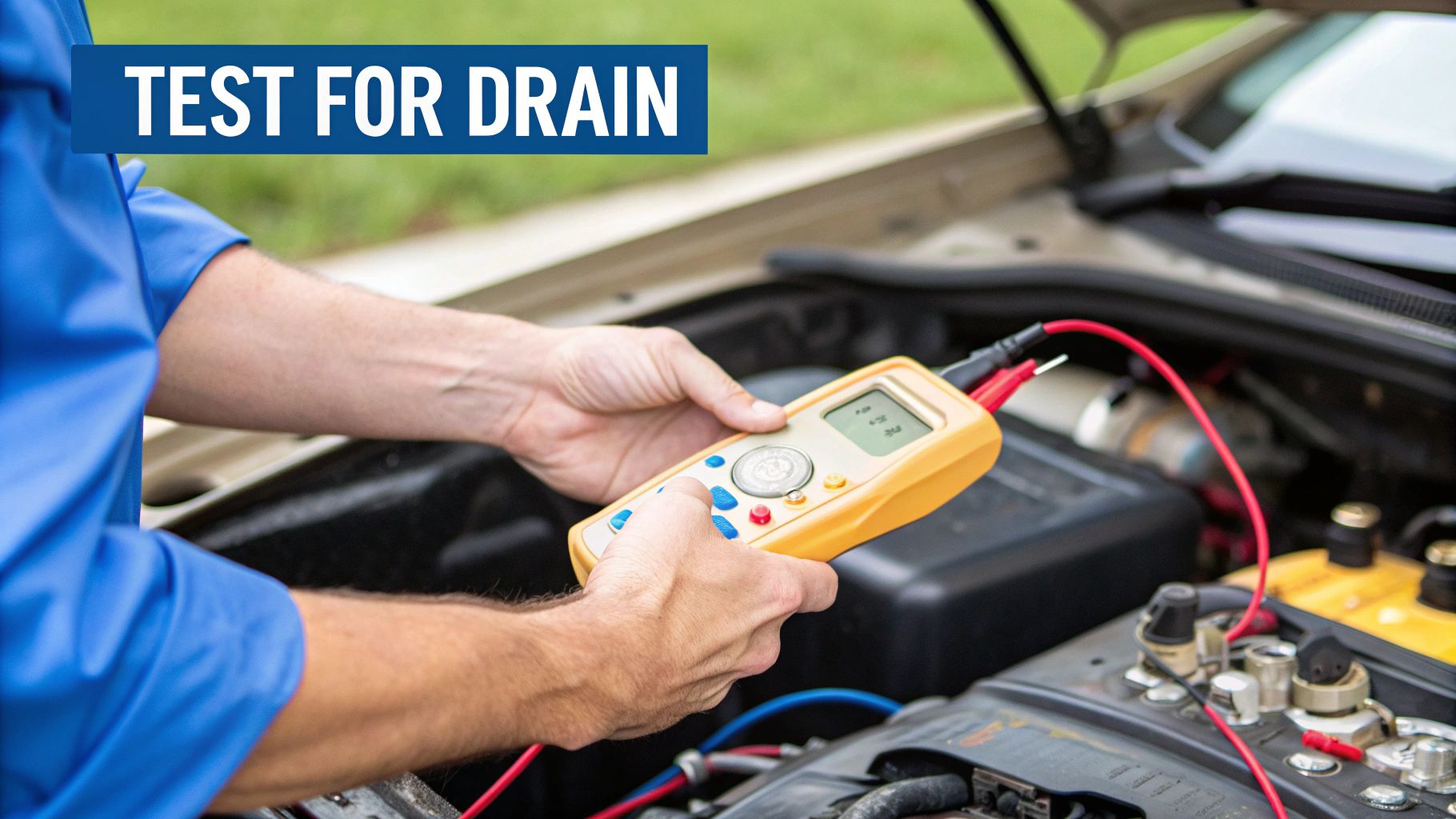
The main tool you’ll need is a digital multimeter. This handy device lets you measure the electrical current being drawn from your battery when the car is completely off.
Before you jump in, a little prep work is critical. The following infographic breaks down the simple but crucial first steps to get your vehicle ready for a parasitic draw test.
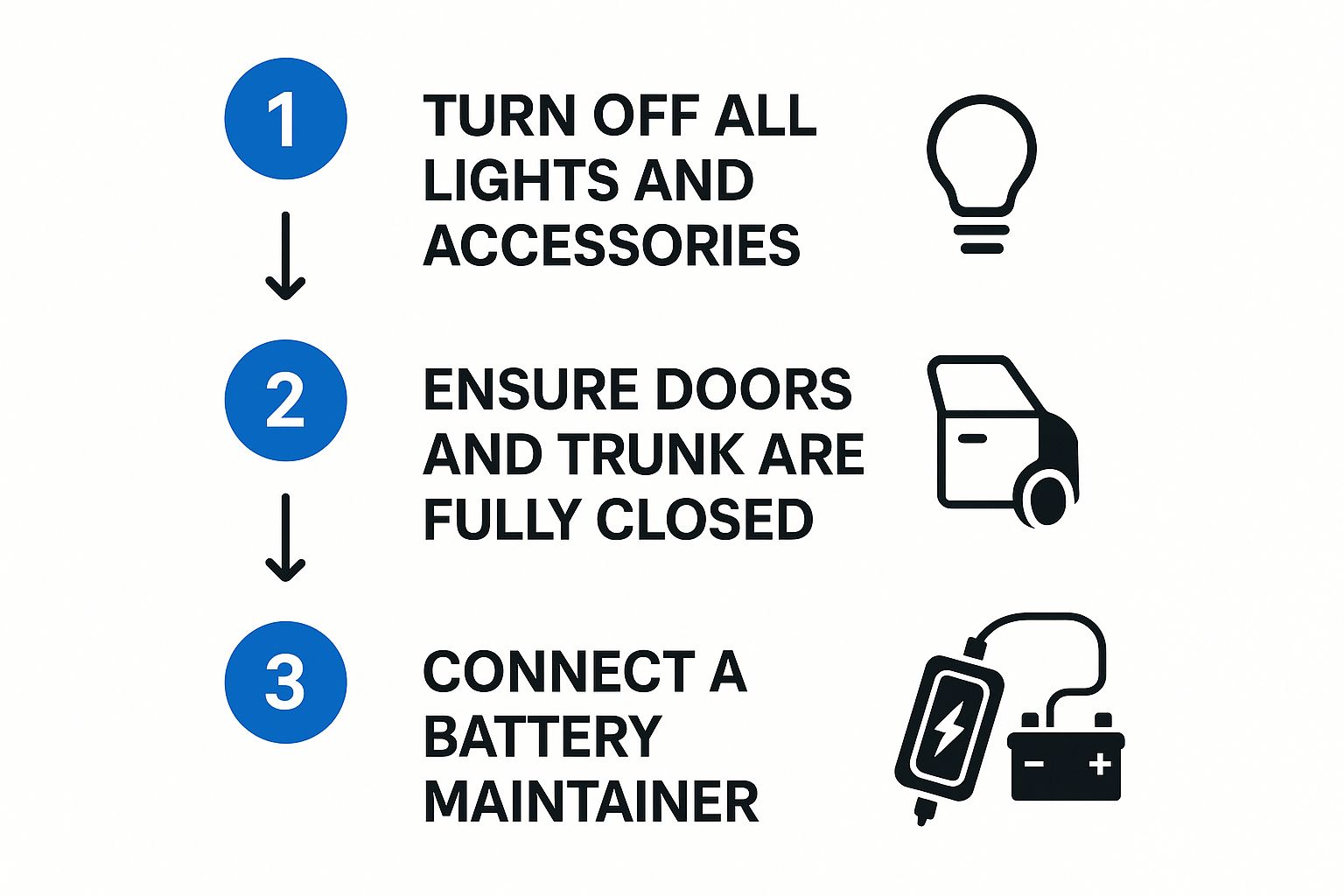
Following these initial steps is essential. It ensures all the car’s systems are in their normal “off” state, which is the only way to get an accurate baseline reading for your test.
Performing a Parasitic Draw Test
Once your car is prepped, it’s time to see exactly how much power is being pulled from the battery. Your goal is to get a precise reading, measured in milliamps (mA).
First, set your multimeter to measure DC amps. Then, you’ll need to disconnect the negative battery terminal. For this test, it’s crucial that you only disconnect the negative side.
Next, you’ll connect the multimeter “in series.” This means you’ll connect one probe to the disconnected negative cable and the other to the negative battery post. This setup forces all the electricity being drawn by the car to flow through the multimeter, giving you that precise reading you’re looking for. A word of caution: don’t start the car or even turn on the ignition while the meter is hooked up like this. Doing so can easily blow the fuse inside your multimeter.
When you first connect the meter, you’ll probably see a high reading for a minute or two. Don’t panic. This is just the car’s computer modules waking up before going back to sleep. After about 5–10 minutes, the reading should settle down to a normal parasitic draw, which is typically under 50-85 mA.
If your reading stays high—let’s say it’s hovering around 200 mA or more—you’ve officially confirmed a parasitic drain. Something is definitely staying on when it shouldn’t be.
The Fuse Pull Method: How to Isolate the Problem
With a parasitic drain confirmed, the next step is to find out which circuit is the culprit. This is where the classic “fuse pull” method comes in. It’s a simple but effective process of elimination that helps you isolate the faulty component.
Leaving the multimeter connected, head to your vehicle’s fuse box. You might have one under the hood and another inside the cabin—check your owner’s manual if you’re not sure. One by one, you’re going to pull a fuse and watch the multimeter.
- If the reading doesn’t change: The circuit tied to that fuse is fine. Put the fuse back in its slot and move on to the next one.
- If the reading drops significantly: Bingo! You’ve found the circuit causing the drain.
Let’s say your multimeter reading drops from 300 mA all the way down to 40 mA after you pull the fuse for the interior dome lights. You’ve just pinpointed the problem area. The issue could be a faulty light switch, a glove box light that’s stuck on, or a wiring problem within that specific circuit. The same logic applies to any other circuit, whether it’s the radio, power seats, or instrument cluster.
Below is a table outlining some common sources of parasitic drains and the symptoms you might notice. This can help you connect the dots between what you’re experiencing and where the problem might be lurking.
Common Parasitic Drain Sources and Their Symptoms
| Potential Faulty Circuit | Common Symptoms You Might Notice | Average Parasitic Draw (If Faulty) |
|---|---|---|
| Interior Lights | Dome/map/trunk lights staying on, glove box light won’t turn off. | 150 mA – 1.5 A |
| Aftermarket Radio/Amp | Radio display stays lit, amp feels warm, humming sound from speakers. | 100 mA – 1 A+ |
| Stuck Relay | Faint clicking sound from fuse box, a component (like a fuel pump) runs constantly. | 200 mA – 500 mA |
| Alternator | Whining noise from the engine bay, dimming headlights. | 250 mA – 2 A |
| Door Lock Actuators | Clicking or buzzing from doors long after locking/unlocking the car. | 100 mA – 400 mA |
| Power Seat Module | Seat adjustment motors run briefly on their own. | 80 mA – 300 mA |
This table isn’t exhaustive, but it covers many of the usual suspects we see in the shop. Once you’ve isolated the circuit, you’re one giant step closer to fixing the problem for good.
Keep in mind that even intermittent draws as low as 80 mA can be enough to drain a modern battery overnight. These sneaky, short-lived draws can be tricky to find but still add up. In fact, many of the most common vehicle issues we fix for Sun City drivers are tied to these hidden electrical faults. Knowing what to look for can save you a ton of time and frustration.
Knowing When to Call an Auto Repair Professional
While running a DIY parasitic draw test is a great way to find a simple problem, some electrical issues are masters of disguise. This is where a professional’s experience becomes not just helpful, but absolutely essential.
If you’ve pulled every fuse in the box and still can’t figure out why your car battery is draining overnight, that’s a strong sign the problem is more complex than a bad light bulb or a stuck relay.
Sometimes, the issue isn’t a constant drain but an intermittent one that pops up randomly. These are notoriously difficult to catch with a standard multimeter test because the problem might not even be happening while you’re looking for it. A computer module that only fails to “sleep” every few hours or a sensor that shorts out sporadically won’t give you a steady reading to trace.
When the Problem is Hidden in the Code
Modern cars are packed with sophisticated computer modules controlling everything from the engine to the power windows. When one of these modules starts acting up, it can create an elusive electrical drain that’s nearly impossible to find with basic tools.
The culprit could be a Body Control Module (BCM) that keeps waking up the car’s network or even a faulty door latch sensor that’s telling the system a door is open when it isn’t. These situations demand advanced diagnostic tools that can communicate directly with your car’s computers and monitor the electrical activity in real-time.
At Pete Nelson Automotive, our ASE-certified technicians in Sun City use specialized scanning equipment to track down these “electrical gremlins.” This technology lets us see exactly which module is misbehaving, saving you hours of frustrating guesswork.
Signs You Need a Professional Touch
In certain situations, calling a professional is the smartest, safest, and most efficient move. If you run into any of the following, it’s time to schedule a visit with an expert.
- The drain is intermittent. If your battery dies randomly—sometimes it’s fine for days, other times it’s dead overnight—it points to a tricky, inconsistent fault.
- Multiple circuits seem to be involved. You pull one fuse and it doesn’t solve the problem, or the issue seems to jump around. This often indicates a deeper issue with a control module.
- The drain is very small but persistent. A draw of just 80-100 mA is enough to kill a battery over a few days but can be tough to pinpoint without sensitive equipment.
- You’ve recently had aftermarket electronics installed. Incorrect wiring for stereos, alarms, or remote starters is a leading cause of complex parasitic drains.
These advanced issues go way beyond simple troubleshooting. Learning about how regular computer diagnostics can save you money helps explain why professional tools are so critical for these jobs.
Trying to fix complex computer-related problems without the right knowledge can easily lead to even more expensive repairs. Instead of spending a weekend chasing a phantom problem, let a professional auto repair Sun City AZ specialist handle it.
Proactive Tips to Extend Your Car Battery Life
It’s always better to prevent your car battery from draining overnight than to deal with a dead car in the morning, especially in the demanding Sun City climate. A little bit of proactive care goes a long way and helps make sure your vehicle starts reliably, every single time. Simple, consistent habits are really your best defense against an unexpected battery failure.
The good news is, taking control of your battery’s health doesn’t require complex tools or a huge time commitment. It all starts with some basic visual checks and being mindful of driving habits that support your vehicle’s entire electrical system.
Keep It Clean and Secure
One of the easiest yet most overlooked maintenance tasks is simply keeping your battery terminals clean. You know that fuzzy, crusty buildup you sometimes see? That’s corrosion, and it acts like an insulator, which weakens the electrical connection. This makes it much harder for your alternator to charge the battery and for the battery to deliver the power needed to start your engine.
A quick cleaning with a wire brush and a simple baking soda solution can make a huge difference. While you’re under the hood, give the battery cables a wiggle to ensure they’re tight and secure. A loose connection can trick you into thinking you have a dead battery, even if the battery itself is perfectly healthy.
Mind Your Driving Habits
Your daily driving routine has a direct impact on your battery’s health. Short, infrequent trips—like a quick run to the grocery store and back—are especially tough on a battery. The alternator just doesn’t get enough time to fully replenish the significant amount of power it took to start the engine in the first place.
If your daily commute is on the shorter side, try to take a longer drive of at least 20-30 minutes about once a week. This gives the charging system plenty of time to do its job and keep the battery topped off. Keeping it fully charged is crucial for extending its lifespan, particularly in our intense Arizona heat.
A Note on Modern Vehicles: It’s not just traditional cars facing this issue. Even electric vehicle owners report significant overnight battery drain, with some newer models losing up to 9% of their charge while parked. This highlights how crucial efficient battery management is for all vehicles today. Learn more about EV battery health trends on geotab.com.
Regular Professional Check-Ups
Honestly, the single best way to prevent surprises is to have your battery and charging system professionally tested. Next time you’re in for routine oil changes Sun City AZ, just ask our technicians at Pete Nelson Automotive to perform a quick battery load test. It’s a simple diagnostic check that measures your battery’s real-world ability to hold a charge under pressure.
This test can spot a weakening battery long before it leaves you stranded on the side of the road. Catching it early means you can replace it on your own terms, avoiding all the stress and hassle of an unexpected breakdown. Considering a battery’s lifespan is often just 2-3 years in our climate, an annual check is a smart, small investment. And for great value on bundled services, be sure to check out our latest specials.
Frequently Asked Questions (FAQ)
Here are answers to a few common questions we hear from drivers in Sun City about why their car battery is draining overnight.
Can the hot Arizona weather make my car battery drain overnight?
Absolutely. The extreme heat we experience in Sun City accelerates the chemical reactions inside a car battery, causing it to degrade much faster. An older battery that seems fine in cooler weather can easily fail to hold a charge overnight after baking in the Arizona sun all day. This makes proactive battery checks a local necessity. For more details, see our guide on prolonging car battery life in Sun City heat.
How long should a car battery last in Sun City?
In a hot climate like ours, a car battery’s lifespan is often much shorter than the national average. While some batteries might last 4-5 years in milder climates, you should realistically expect around 2-3 years here in Arizona. Once your battery passes the two-year mark, we strongly recommend having it professionally tested at least once a year.
Will driving my car more often fix the battery drain problem?
Not if there’s an underlying parasitic drain. While regular, longer drives (over 20 minutes) are great for helping the alternator fully recharge the battery, it won’t fix a faulty component that’s secretly drawing power when the car is off. The battery will just die again the next time it sits for a while, so you have to find and repair the source of the drain first.
Is it expensive to fix a parasitic battery drain?
The cost really depends on what’s causing it. The first and most important step is the diagnostic process to pinpoint the exact source of the drain. Sometimes it’s a simple and affordable fix, like a stuck relay. Other times, a major computer module might need to be replaced. At Pete Nelson Automotive, we always provide a clear diagnosis and a detailed estimate before starting any work, so you’ll never face any surprises.
Don’t let a dead battery disrupt your day. For expert diagnostics and reliable auto repair Sun City AZ, trust the team at Pete Nelson Automotive to get to the bottom of the problem and provide a lasting solution. Summarizing the key takeaways: a parasitic draw, an old battery, or a faulty charging system are the usual suspects, and professional diagnostics are key for complex issues.
Call 623-974-4723 or visit petenelsonautorepair.com to schedule your appointment today.
Pete Nelson Automotive
This Offer Will Expire 12-31-2026
Pete Nelson Automotive is pleased to offer you

"Get Ready for the Holidays"
A $215.00 Value for Only $159.95 (+tax)
Lube, Oil, & Filter Change, Up to 5 quarts of Engine oil
Inspect and top off all fluid levels, Includes up to 5 Quarts of 5w30 synthetic blend oil, additional charge for synthetic oil.
Travel Evaluation
Set Air Pressures and Tire Rotation if needed.
Battery, Alternator and Starter Electrical Test
Load test battery, Alternator output and Starting amps.
Full Brake Evaluation
Includes check brake system on four wheels, checking and testing brake fluid condition.
So Call 623-974-4723 today and make an appointment for this exclusive Special!
*Most Cars, Vans, Motor homes, 4×4’s, Diesels, and some foreign cars may be higher. You must bring this letter at time of service and allow 2 hours to complete.



