Have you ever been cruising down Grand Avenue and felt your car hesitate for a split second when you press the gas? Or maybe you’ve noticed you’re visiting the pump more often than usual, especially during our intense Arizona summers. These common frustrations often point to one critical, and often overlooked, part of your vehicle: the car fuel system.
Think of it as your car’s circulatory system. It’s the intricate network that stores fuel and delivers a precise, uninterrupted flow of energy to your engine. Without it working flawlessly, your car simply won’t perform its best. At Pete Nelson Automotive, your trusted auto repair shop in Sun City, AZ, we want to empower you with the knowledge to keep this vital system in top shape.
Why a Healthy Fuel System Matters for Sun City Drivers
Your car’s fuel system is much more than just a gas tank. It’s a finely tuned symphony of pumps, filters, lines, and injectors all working in perfect harmony. When every part does its job, your vehicle runs smoothly, powerfully, and efficiently. But when one component starts to struggle, the effects can be felt throughout your entire driving experience.
The Impact of Our Arizona Climate
Living here in the Valley of the Sun presents a unique set of challenges for our vehicles. The intense heat can cause fuel to evaporate more quickly and puts a serious strain on the fuel pump, forcing it to work harder. On top of that, the fine desert dust we live with can easily clog fuel filters, restricting flow and leading to sluggish performance. Understanding how the Arizona heat affects your vehicle is the first step toward preventing a breakdown when you least expect it.
Expert Tip: A healthy fuel system not only improves performance but also plays a critical role in controlling vehicle emissions. A malfunctioning component can lead to increased pollution and a failed emissions test, which is why routine checks are so important for Sun City drivers.
By learning the basics, you can spot the warning signs early and take action before a small issue turns into a major repair bill. This guide will walk you through everything a local driver should know, from how the system works to the signs that it’s time for a professional check-up at our shop.
The Journey: From Gas Pump to Engine Power
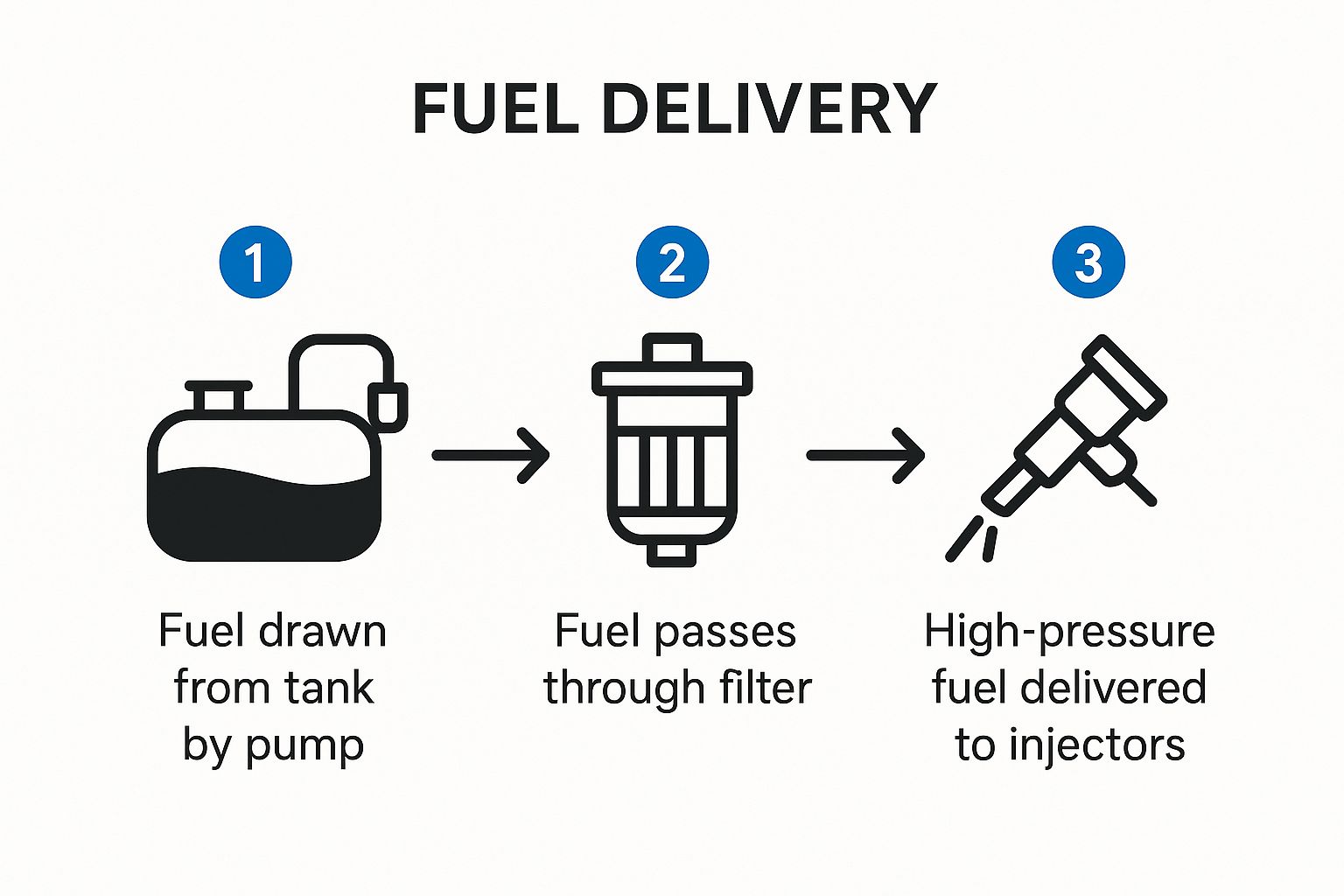
Ever wonder what happens after you fill up your tank? That fuel is about to go on a rapid, high-stakes journey to your engine in a matter of seconds. Let’s follow its path, step by step, to understand why each component of your car fuel system is so critical.
Stop 1: The Fuel Tank
The journey starts in the fuel tank. It’s engineered to hold fuel safely, prevent leaks, and allow for expansion as temperatures change—a must-have feature here in the Sun City heat. Inside the tank is the first critical player: the fuel pump.
Stop 2: The Fuel Pump
The fuel pump is the heart of the system. The moment you turn the key, this electric pump pressurizes the system and pushes gasoline out of the tank. A weak or failing pump is like having low blood pressure; the engine just won’t get the energy it needs to perform.
Stop 3: The Fuel Lines and Filter
From the pump, fuel travels through a network of fuel lines toward the engine. Along the way, it makes a crucial stop at the fuel filter. This component is your engine’s bodyguard, trapping dirt, rust particles, and any other gunk that might have found its way into your tank. A clogged filter can starve the engine of fuel, leading to hesitation and poor acceleration.
Final Stop: The Fuel Injectors
After being filtered, the clean, pressurized fuel arrives at the fuel rail, which distributes it to each fuel injector. This is where the magic happens. The injectors are electronically controlled nozzles that spray a fine, cone-shaped mist of fuel directly into the engine’s cylinders at precisely the right moment. The precision of modern fuel injectors has a direct impact on your car’s fuel efficiency, power, and emissions. When injectors get dirty, they can’t spray that perfect mist, leading to rough idling and a drop in gas mileage.
This entire process is a testament to modern engineering. You can learn more about how we keep this system in top shape by reading our guide to optimizing your vehicle’s performance with professional fuel system service. Regular maintenance ensures this journey stays smooth, keeping your vehicle reliable on the roads of Sun City.
From Carburetors to Modern Fuel Injection
If you’ve ever looked under the hood of a classic car, you’ve likely seen a carburetor. For decades, this mechanical device was responsible for mixing air and fuel. But as cars evolved, so did their fuel systems. Today, carburetors have been replaced by a far more intelligent technology: electronic fuel injection (EFI). Understanding this leap helps explain why your modern car fuel system requires specialized expertise, like what we provide right here at Pete Nelson Automotive.
What Was a Carburetor?
A carburetor worked on a simple suction principle. As air rushed into the engine, it would pull fuel from a small reservoir to create a combustible mix. While clever for its time, it wasn’t very precise and struggled to adapt to changing conditions like temperature or altitude. This often led to poor gas mileage, higher emissions, and inconsistent performance.
The Rise of Electronic Fuel Injection (EFI)
EFI completely changed the game. Instead of a simple mechanical process, EFI uses a network of sensors to monitor everything from engine speed to air temperature in real-time. This data is sent to the vehicle’s computer, the Engine Control Unit (ECU), which calculates the exact amount of fuel needed. It then tells the fuel injectors to spray a perfectly timed mist of gasoline for optimal combustion.
Why This Matters for You: The magic of EFI is its adaptability. It delivers the perfect air-fuel mixture whether you’re idling at a stoplight on Bell Road or dealing with a scorching summer day. That means you get peak performance, better fuel economy, and lower emissions, no matter the conditions.
The automotive industry continues to innovate in this area, with the growth of fuel injection systems driven by the demand for greater efficiency.
Carburetor vs. EFI at a Glance
| Feature | Carburetor (Older Technology) | Electronic Fuel Injection (Modern Technology) |
|---|---|---|
| Fuel Delivery | Mechanical suction, less precise | Electronic spray, highly precise |
| Adaptability | Struggles with temperature changes | Constantly adjusts to real-time conditions |
| Fuel Economy | Lower, often wastes fuel | Higher, optimizes every drop |
| Emissions | Higher pollutants | Lower, cleaner burn |
| Performance | Inconsistent, prone to rough idling | Smooth, reliable, and responsive |
| Maintenance | Requires frequent manual adjustments | Low maintenance, self-adjusting |
The precision and reliability of modern fuel injection systems are in another league. At Pete Nelson Automotive, we have the state-of-the-art diagnostic tools required to accurately service your vehicle’s sophisticated fuel system and keep it running at its best.
Signs Your Fuel System Needs Attention
Your car has a way of telling you when something’s wrong. When it comes to the car fuel system, the signs of trouble often start small but can quickly escalate if ignored. Knowing what to look and listen for is your best defense against a sudden breakdown, especially here in Sun City where heat and dust accelerate wear and tear.
Common Warning Signs to Watch For
Think of these symptoms as your car’s way of asking for help. Catching them early can save you from more costly repairs down the road.
- Difficulty Starting: Does your engine take a few extra cranks to turn over? This is a classic sign of a weak fuel pump or a clogged fuel filter that’s restricting fuel flow.
- Rough Idling: If your car shudders or vibrates at a stoplight, it’s often due to dirty or clogged fuel injectors that aren’t delivering a consistent spray of fuel.
- Poor Acceleration: Does your car feel sluggish or hesitate when you step on the gas? The engine is likely being starved of fuel, pointing to a clogged filter or a failing pump.
- Sudden Drop in Gas Mileage: Making more trips to the pump than usual? A noticeable dip in your miles per gallon (MPG) often points to a fuel system issue, like a leaky injector or a faulty sensor.
When the Check Engine Light Comes On
Of course, the most direct signal is your check engine light. Many issues, from a loose gas cap to a failing oxygen sensor, are tied to the fuel system. Don’t ignore it! That light is your car’s plea for a professional diagnostic check to pinpoint the exact problem. You can learn more about these and other issues in our guide to common car problems every vehicle owner should know.
Essential Maintenance for a Healthy Fuel System
Proactive care is always smarter—and cheaper—than reactive repairs. A little bit of routine maintenance for your car fuel system goes a long way in preventing breakdowns, improving performance, and boosting your fuel economy.
Here are a few actionable tips to keep your fuel system in prime condition, especially for drivers in Sun City, AZ.
Your Fuel System Maintenance Checklist
- Use High-Quality Fuel: Top-tier gasolines contain detergents that help keep your fuel injectors and intake valves clean, preventing harmful carbon buildup. It’s a simple habit that protects your entire system.
- Replace the Fuel Filter Regularly: Your fuel filter is on the front lines, blocking desert dust and debris. We recommend replacing it according to your vehicle manufacturer’s schedule (typically every 20,000 to 40,000 miles) to prevent strain on your fuel pump.
- Schedule Professional Fuel System Cleaning: Over time, deposits can still form on your fuel injectors. A professional cleaning service every 60,000 to 90,000 miles can restore lost performance, smooth out a rough idle, and improve your gas mileage.
- Get Regular Inspections: During routine services like an oil change, our technicians can perform a visual inspection of fuel lines and listen for any signs of a struggling fuel pump. This is a great way to catch potential issues early.
For more practical advice tailored to our local climate, be sure to check out our guide on 5 car maintenance tips every Arizona driver should know. At Pete Nelson Automotive, we believe in arming our customers with the knowledge to make smart choices for their cars.
Frequently Asked Questions (FAQ)
Here are answers to some of the most common questions we hear from drivers in Sun City about their car fuel systems.
How often should I have my car’s fuel system checked?
We recommend a visual inspection during every oil change to check for leaks or damage. For a more thorough service, like a fuel filter replacement or injector cleaning, it’s best to follow the schedule in your vehicle’s owner’s manual, typically every 20,000 to 40,000 miles for the filter.
Can a dirty fuel filter really hurt my car?
Yes, absolutely. A clogged fuel filter forces the fuel pump to work much harder to push fuel through, which can cause the pump to overheat and fail prematurely. It also restricts fuel flow to the engine, leading to poor acceleration, hesitation, and reduced fuel economy.
Is it bad to drive with the gas tank almost empty?
It’s a habit you should try to avoid. The gasoline in your tank helps cool and lubricate the electric fuel pump. When the tank is nearly empty, the pump can overheat and suck up sediment from the bottom of the tank, which can cause damage and lead to costly repairs.
What is fuel system cleaning and do I need it?
Fuel system cleaning is a professional service that uses specialized solvents to remove carbon deposits and gunk from your fuel injectors, intake valves, and combustion chambers. If you’re experiencing rough idling, poor acceleration, or decreased MPG, it can restore performance and efficiency, especially for vehicles with higher mileage. You can learn more in our guide about what maintenance a high-mileage car needs in Arizona.
If you’re experiencing any of the issues we’ve discussed or just want to keep your vehicle in peak condition, the expert team at Pete Nelson Automotive is here to help. We are committed to providing honest, high-quality auto repair services for the Sun City, AZ community.
Call 623-974-4723 or visit petenelsonautorepair.com to schedule your appointment today.
Pete Nelson Automotive
This Offer Will Expire 12-31-2026
Pete Nelson Automotive is pleased to offer you
"Get Ready for the Holidays"
A $215.00 Value for Only $159.95 (+tax)
Lube, Oil, & Filter Change, Up to 5 quarts of Engine oil
Inspect and top off all fluid levels, Includes up to 5 Quarts of 5w30 synthetic blend oil, additional charge for synthetic oil.
Travel Evaluation
Set Air Pressures and Tire Rotation if needed.
Battery, Alternator and Starter Electrical Test
Load test battery, Alternator output and Starting amps.
Full Brake Evaluation
Includes check brake system on four wheels, checking and testing brake fluid condition.
So Call 623-974-4723 today and make an appointment for this exclusive Special!
*Most Cars, Vans, Motor homes, 4×4’s, Diesels, and some foreign cars may be higher. You must bring this letter at time of service and allow 2 hours to complete.



