
There’s nothing quite like that feeling of turning the key on a hot Arizona morning, expecting your engine to roar to life, and getting nothing but a frustrating click-click-click in return. It’s a sound that can sink your heart, especially when you have places to be. If your car won’t start and you hear that clicking sound, you’re not alone. This is one of the most common issues we see here at our Sun City auto repair shop, and that click is actually your car’s way of telling you exactly where to start looking.
Why That Click is Your First Big Clue
While it’s easy to jump to the worst-case scenario, that specific clicking noise is actually a huge diagnostic clue. It tells us that your car is trying to do what you asked, but something is falling short right at the finish line.
So, what’s actually happening under the hood? That clicking you hear is the starter solenoid. Think of it as a powerful switch. When you turn the key, the solenoid gets the signal to start the engine, but the battery just doesn’t have the high amperage—that massive jolt of electricity—needed to turn the heavy crankshaft. It’s like trying to power a massive floodlight with a tiny watch battery. There’s some power, but not nearly enough to get the main event started.
Your Battery is the Prime Suspect
The number one reason for that clicking noise is a weak or dying battery. On average, a car battery lasts anywhere from 2 to 8 years, but most see a lifespan of about 4 to 6 years. Here in the US, roughly 25% of all roadside assistance calls are for battery failures, and you can bet a lot of those started with that familiar clicking.
You can actually see how this works by checking out some great videos from automotive experts that break it down visually.
This is easily one of the most common issues we see at our Sun City auto repair shop. Understanding that the battery is the likely culprit is the first step toward a quick fix. It’s just one of many issues you might run into, which is why we put together a guide on common car problems every vehicle owner should know.
Is It a Rapid Tick or a Single Loud Click?
When your car won’t start, that clicking sound is more than just an annoyance—it’s a critical clue. Paying close attention to the kind of click you’re hearing can tell you a lot about what’s going on under the hood. Not all clicks are created equal, and figuring out which one you have is the first real step in diagnosing the problem.
So, is the sound a fast, almost frantic series of ticks? Or is it more of a single, heavy “thud” or “clunk” when you turn the key? The difference is huge.
The Fast-Paced Ticking Sound
A rapid, machine-gun-style ticking almost always points back to one thing: a weak or dying battery. What you’re hearing is the starter solenoid trying its best to engage, but it just doesn’t have enough juice to finish the job. It has enough power to try, but not enough amperage to crank the engine.
This rapid-fire clicking happens because the solenoid engages, fails, resets, and immediately tries again in a split second. It’s your car’s way of screaming that it’s starved for power. While a failing battery is the prime suspect, this sound can also be caused by corroded or loose battery connections that stop the power from getting where it needs to go. Before you jump to conclusions, it’s worth learning the other signs your battery is about to fail to see if the symptoms line up.
The Single, Loud Click
On the other hand, if you turn the key and hear one solid, decisive click followed by silence, you’re dealing with a different problem entirely. A single click usually means the battery has plenty of power and successfully sent the signal to the starter motor. The message was sent and received.
Expert Insight: A single click tells us the electrical system delivered its message, but the starter motor itself didn’t—or couldn’t—act on it. This shifts the diagnosis away from the battery and points directly toward a problem with the starter motor or solenoid.
The starter motor is the powerhouse component that does the heavy lifting of cranking your engine. If its internal parts are worn out, damaged, or completely seized up, it simply won’t be able to turn the engine over, resulting in that one loud click. Think of it like a doorbell: the button works fine, but the chime inside is broken.
By knowing which sound your car is making, you can give an auto repair expert in Sun City AZ the exact information they need to diagnose the issue faster and more accurately.
How to Inspect Your Battery and Connections
So, your car won’t start and you’re hearing that dreaded clicking sound. Before you jump to a big repair bill, let’s pop the hood. More often than not, the problem is something you can spot—and maybe even fix—yourself with a quick visual check. A few minutes spent safely looking at your battery and its connections could save you time and the cost of a tow.
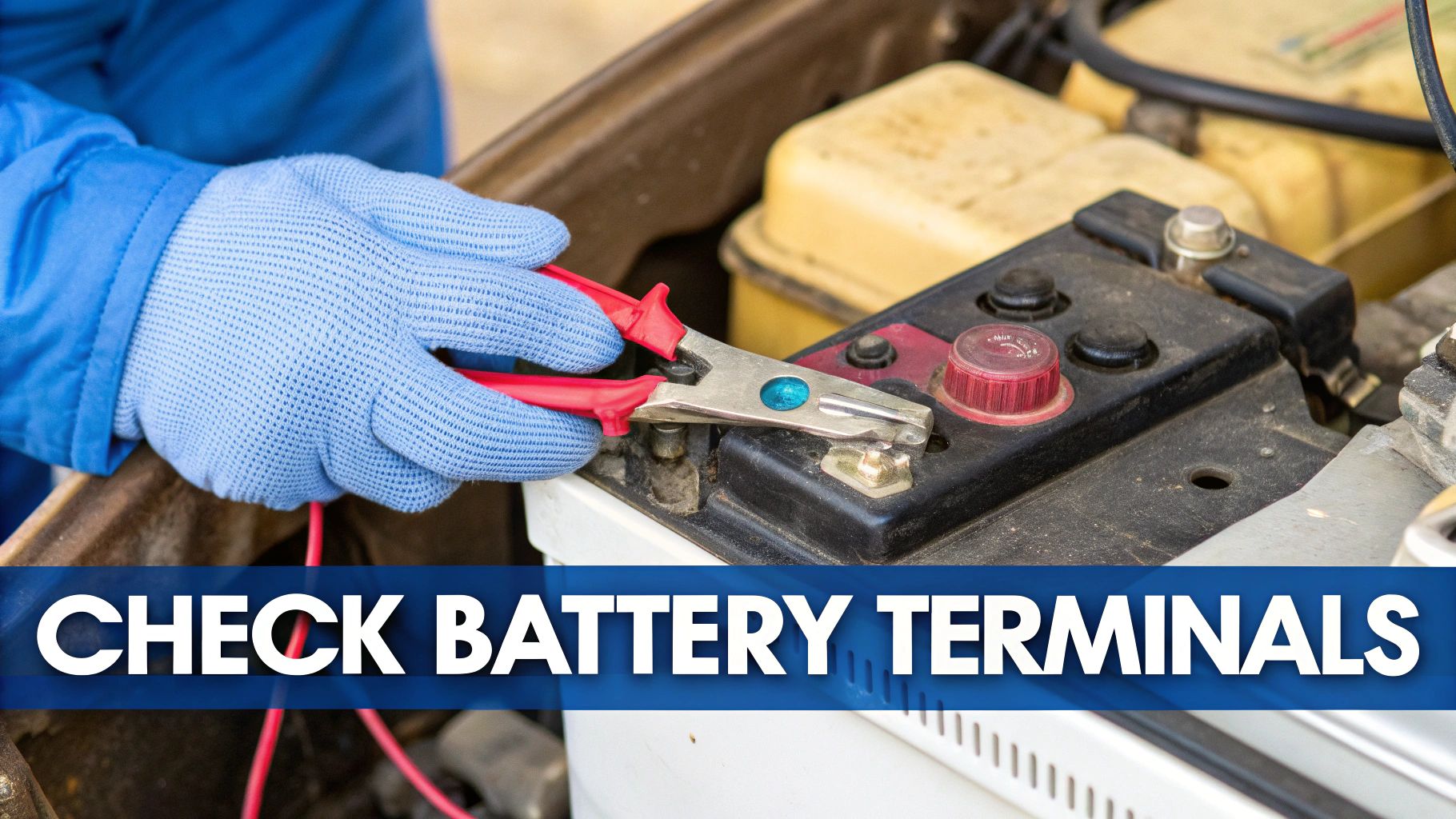
First things first: safety. Car batteries pack a serious punch and contain corrosive acid, so you need to be smart about it. Always put on a pair of protective gloves and safety glasses before you start poking around. Once the hood is up, find the battery. It’s usually a black rectangular box with two posts, called terminals, on top.
Identifying Corrosion and Loose Cables
Now, get a good look at those battery terminals. See any chalky, white, or greenish-blue gunk building up around the metal posts? That’s corrosion, and it’s a massive roadblock for electricity. It essentially chokes off the power flow from your battery to the rest of the car, including the starter motor.
Even a small amount of that stuff can be enough to cause that clicking noise. It’s an incredibly common problem, especially with the temperature swings we get here in Sun City. In fact, industry diagnostics show that somewhere around 18-20% of cars with that “no-start click” have a simple issue with corroded terminals or loose cables.
Next, give the connections themselves a once-over.
- The Wiggle Test: Carefully grab the cables connected to the positive (+) and negative (-) terminals and give them a gentle wiggle. They should feel rock solid, with absolutely no movement.
- The Visual Check: Follow the thick red (positive) and black (negative) cables as far as you can see. You’re looking for any obvious signs of damage, like fraying, cracks, or breaks in the insulation.
Pro Tip: A connection that feels even a little bit loose can stop the massive jolt of power your starter needs to crank the engine. It’s such a simple thing to check, but it’s the root of the problem more often than you’d think.
Steps for a Safe Inspection
If you’ve spotted an issue, you might be in luck. Loose terminals can often just be tightened with the right size wrench. If you’ve got a corrosion problem, cleaning it up is a great next step, but you have to do it safely.
- Always Disconnect the Negative First: This is non-negotiable. Always start with the black, negative (-) terminal. Removing it first breaks the circuit and drastically reduces the risk of creating a spark.
- Then Disconnect the Positive: With the negative cable safely tucked out of the way, you can now remove the red, positive (+) one.
- Scrub Away the Gunk: Use a wire brush or one of those special battery terminal cleaning tools to scrub all the corrosion off the posts and the inside of the cable clamps. You want them to be shiny metal again.
- Reconnect Securely: Now, do everything in reverse. Reconnect the positive (+) cable first, then the negative (-) cable last. Make sure both are tightened down firmly so they don’t wiggle.
Running through these steps can often solve that “car not starting clicking sound” right in your own driveway. For more great advice on battery maintenance, check out our guide on the top 10 tips for keeping your car battery in prime condition.
Diagnosing a Failing Starter Motor
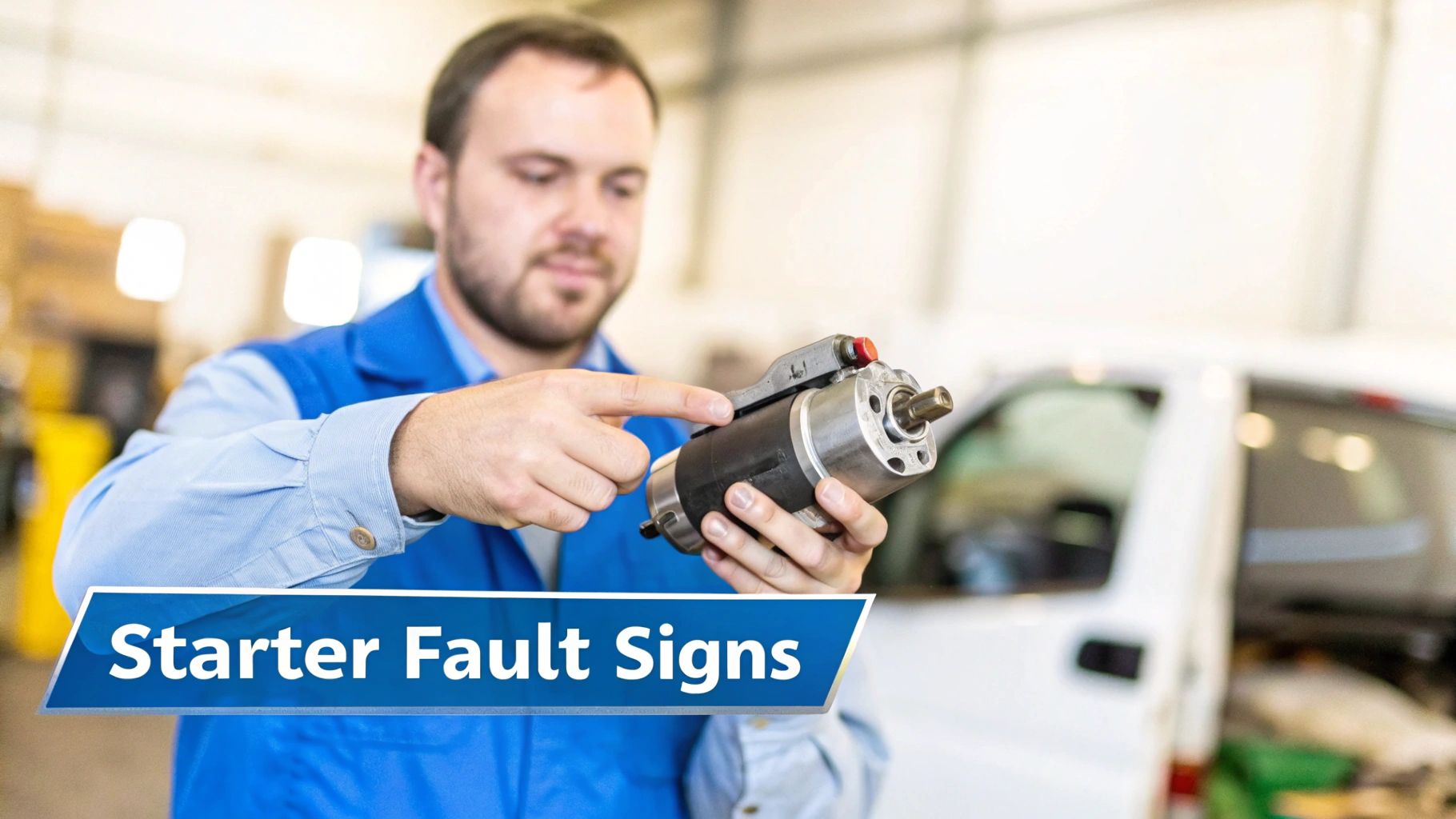
So, you’ve confirmed the battery has juice and all the connections are clean and snug, but you’re still just getting that infuriating click. It’s time to turn our attention to the next likely culprit: the starter motor. This is the tough little component that does the heavy lifting, physically cranking your engine to get it going. When it starts to give up the ghost, it can leave you high and dry.
The starting system really has two main players: the starter motor and the starter solenoid. The solenoid acts as the gatekeeper. When you turn the key, it gets a small electrical signal. That’s its cue to open the floodgates and let the massive electrical current from the battery pour into the starter motor, which then roars the engine to life.
Symptoms Beyond a Single Click
A single, loud click is the classic calling card of a bad starter, but it’s definitely not the only symptom. A failing starter can be maddeningly inconsistent. It might work perfectly fine for a week and then suddenly leave you stranded.
Keep your ears open for these other tell-tale signs:
- Grinding Noises: If you hear a horrible, metallic grinding sound when you turn the key, that’s a bad sign. It often means the starter gear is struggling to mesh properly with the engine’s flywheel.
- Engine Won’t Crank With a Jump: You’ve got the jumper cables hooked up, the dashboard lights are bright, but the engine still refuses to turn over. This is a huge clue that the battery isn’t the issue and points the finger directly at the starter.
- Intermittent Starting: The most frustrating one of all. Sometimes it starts, sometimes it doesn’t. This usually happens as the starter’s internal parts wear out, making its performance a total gamble.
Industry data shows that starter motor problems are responsible for about 10-15% of no-start incidents where a click is the primary symptom. A starter usually lasts somewhere between 100,000 to 150,000 miles, and that single click is often the first sign that its time is up.
Why Do Starters Fail?
Like any hard-working mechanical part, it takes a beating. The internal brushes, bearings, and electrical windings simply wear out over thousands of starts. Another common killer is an engine oil leak that drips down onto the starter, causing it to short out or seize up.
A Real-World Scenario: We had a customer in Sun City recently whose car would start perfectly every morning but would refuse to start after a short drive. The engine’s heat was causing a worn-out electrical winding inside the starter to expand just enough to break the connection. Once the engine cooled down, it would start right up again. That kind of intermittent failure is a classic starter problem.
Figuring out these complex electrical issues is where having a professional in your corner really matters. Our technicians have the specialized tools to test the entire starting and charging system to pinpoint the true cause. If you think you’re dealing with a starter issue, our team is ready to perform a full electrical system repair and get you back on the road with confidence.
When to Call for Professional Auto Repair in Sun City
While it’s great to tackle a few DIY checks, there’s a point where you need the right tools and deep expertise. You’ve cleaned the terminals and even had the battery tested, but you’re still stuck with that maddening click-click-click. Now what?
This is usually the moment when it’s time to call in the professionals. Just throwing new parts at the problem—a new battery here, a new starter there—can get expensive, fast. An expert diagnosis is all about precision, saving you the headache and cost of replacing components that aren’t actually broken.
At Pete Nelson Automotive, our ASE-certified technicians don’t guess; we test. We use specialized diagnostic equipment that tells us the whole story, going far beyond a simple voltage check.
Going Beyond the Basic Battery Test
A professional diagnosis looks at the entire electrical ecosystem of your car. A handheld tester might say your battery is “good,” but it can’t tell you if something is slowly draining it overnight. This is called a parasitic drain, and it’s a notoriously tricky issue to hunt down without the right gear.
Our diagnostic process is thorough. We dig deeper to find the root cause:
- Charging System Analysis: We test the alternator to make absolutely sure it’s recharging your battery properly while you drive. A weak or failing alternator can make a brand-new battery die in no time.
- Starter Draw Test: This is a crucial one. We measure the exact amount of amperage the starter motor is pulling from the battery. If that number is abnormally high, it’s a dead giveaway the starter itself is failing.
- Voltage Drop Testing: This is where we find the hidden culprits. We can pinpoint resistance in cables or connections that might be choking the flow of electricity, even if everything looks perfectly clean on the outside.
By running these comprehensive tests, we can definitively tell you if the problem is a faulty starter, a weak alternator, or a more complex wiring issue. That accuracy is what prevents unnecessary repairs. There are many signs that your vehicle needs immediate attention from an auto repair shop, and a car that won’t start is right at the top of the list. Don’t let a small electrical gremlin leave you stranded in the Sun City heat.
Frequently Asked Questions
Can a bad alternator cause a clicking sound when I try to start my car?
Yes, indirectly. A failing alternator can’t recharge your battery properly as you drive. Over time, the battery will lose its charge, becoming too weak to turn the engine over. This results in the rapid clicking sound that signals a dead or weak battery.
How does the Arizona heat affect my car battery?
The extreme heat we experience in Sun City, AZ, is incredibly hard on car batteries. High temperatures accelerate the chemical reactions inside, causing the battery’s fluid to evaporate and internal components to degrade much faster. This can significantly shorten its lifespan, making regular battery checks a crucial part of local vehicle maintenance.
Is it safe to jump-start a car that is making a clicking noise?
For a rapid, machine-gun-like clicking, a jump-start is generally safe and often effective, as this indicates a weak battery. However, if you hear only a single, loud click, a jump-start probably won’t work because the issue is likely a faulty starter motor, not a lack of power. Always check your owner’s manual for the correct jump-starting procedure to avoid damaging your vehicle’s electrical system.
How much does it cost to replace a starter in Sun City, AZ?
The cost to replace a starter motor varies widely depending on your vehicle’s make and model. The part itself can range from under a hundred dollars to several hundred, and labor costs depend on how difficult it is to access. For an accurate quote, it’s best to bring your car to a trusted auto repair shop in Sun City, AZ for a professional diagnosis.
If you’re tired of guessing what that clicking sound means and just want your car to start reliably, let the experts at Pete Nelson Automotive take a look. We’ll find the real issue and get you back on the road with total peace of mind. Call 623-974-4723 or visit petenelsonautorepair.com to schedule your appointment today.
Pete Nelson Automotive
This Offer Will Expire 12-31-2026
Pete Nelson Automotive is pleased to offer you

"Get Ready for the Holidays"
A $215.00 Value for Only $159.95 (+tax)
Lube, Oil, & Filter Change, Up to 5 quarts of Engine oil
Inspect and top off all fluid levels, Includes up to 5 Quarts of 5w30 synthetic blend oil, additional charge for synthetic oil.
Travel Evaluation
Set Air Pressures and Tire Rotation if needed.
Battery, Alternator and Starter Electrical Test
Load test battery, Alternator output and Starting amps.
Full Brake Evaluation
Includes check brake system on four wheels, checking and testing brake fluid condition.
So Call 623-974-4723 today and make an appointment for this exclusive Special!
*Most Cars, Vans, Motor homes, 4×4’s, Diesels, and some foreign cars may be higher. You must bring this letter at time of service and allow 2 hours to complete.



