
You’re cruising down Bell Road, maybe heading to the grocery store or a tee time, and suddenly it happens—complete silence. The engine cuts out, the power steering gets heavy, and a string of warning lights flashes across your dashboard. If your car shuts off while driving, it’s more than just an inconvenience; it’s a genuinely alarming experience that can leave any driver feeling helpless.
Here at Pete Nelson Automotive, we understand that sinking feeling. As Sun City’s trusted auto repair experts, we’ve helped countless drivers get to the bottom of this exact problem. The good news is that it’s almost always a solvable issue, usually pointing to a problem with the fuel system, electrical components, or ignition. Let’s walk through what could be happening and what you should do next.
Navigating the Shock of a Sudden Engine Shutdown

Few experiences are more stressful than your engine suddenly going silent while you’re on the road. One moment you’re cruising along, and the next, you’re left coasting. It’s a jarring moment that can leave any driver feeling worried.
When a car just dies like that, it’s a clear signal that a critical system has failed. Your engine needs a precise, constant mix of fuel, air, and spark to run. Interrupt any one of those, and everything comes to a halt.
Why Your Car Might Stall Unexpectedly
The reasons for a sudden stall can range from something simple to a more complex issue. It isn’t always a catastrophic failure; sometimes, a single faulty sensor is all it takes to bring your drive to a standstill. Knowing the possibilities can help you explain the situation clearly to your mechanic.
When a vehicle comes into our Sun City shop with this exact problem, these are the primary areas we start investigating:
- Fuel System Failures: The engine might be starved of gasoline. This could be anything from a clogged fuel filter or a sputtering fuel pump that can’t maintain pressure to an issue with the fuel injectors.
- Electrical Glitches: Modern cars are packed with electronics. A bad alternator can’t keep the battery charged or power the vehicle’s systems, eventually causing it to die. A faulty crankshaft position sensor is another common cause, as it tells the car’s computer when to fire the spark plugs. If it fails, the engine stops cold.
- Ignition System Problems: Things like worn-out spark plugs, bad ignition coils, or faulty wiring can prevent the fuel from igniting properly, which leads directly to a stall.
A sudden engine shutdown is definitely one of the key signs that your vehicle needs immediate attention from an auto repair shop. Ignoring it isn’t an option, as it poses a major safety risk to you and everyone else on the road. The goal of this guide is to arm you with the knowledge to handle the situation calmly and make an informed decision about getting professional help.
Your First Moves When the Engine Cuts Out
The moment your engine goes silent on a busy road is terrifying. One second you’re cruising along, the next you’re coasting with a dead car. Your first instinct might be to panic, but staying calm and acting deliberately is your most powerful tool right now.
With the engine off, your car is going to feel very different. The steering wheel will suddenly get much harder to turn because the power steering pump isn’t running. Your power brakes will also lose their assist, meaning you’ll have to press the pedal much harder to slow down. Be ready for that change.
Stay Calm and Signal Immediately
First thing’s first: hit your hazard lights. This is the universal signal for “I’m in trouble” and immediately lets other drivers know something is wrong. It gives them a chance to slow down and give you some space.
Now, take a deep breath and keep a firm grip on the steering wheel. Your car is coasting, and your main goal is to guide it somewhere safe. Focus on maintaining control as you scan for a place to pull over.
Expert Tip: Whatever you do, don’t turn the ignition key all the way off while you’re still moving. This can lock the steering wheel, and you’ll completely lose the ability to steer. Keep the key in the “on” position until you are completely stopped.
Navigate to a Safe Location
Your priority is getting out of the flow of traffic. Look for the nearest shoulder, breakdown lane, or even an empty parking lot if one is close enough. Use the momentum you have left to carefully maneuver your vehicle to the side of the road. On Arizona highways, that means getting as far onto the right-hand shoulder as you possibly can.
Once you’re safely off the road and have come to a complete stop, shift the car into park and set the emergency brake. Now you can safely turn the ignition completely off.
Gather Clues for Your Mechanic
Before you even pick up the phone to call for a tow, take a moment to play detective. The little details you notice right now can make a huge difference for a mechanic trying to figure out what went wrong. Ask yourself these questions and jot down the answers if you can:
- What did you see? Did any warning lights pop up on the dashboard right before or after it stalled? The check engine light, battery light, or oil pressure light are common culprits.
- What did you hear? Was there a loud bang, a sputtering sound, or did the engine just go completely silent?
- What did you feel? Did the car jerk or hesitate at all, or did it just smoothly lose all power?
This information gives our technicians a valuable head start. Knowing these details helps us narrow down the possibilities and streamlines the process of running car computer diagnostics. If you’re curious, you can learn more about this by checking out our guide on how car computer diagnostics work and why they are important.
How Fuel System Problems Cause Engine Stalls
Your car’s engine needs a constant, precise flow of fuel to run. Think of it like a marathon runner needing a steady supply of water to keep going. Any hiccup in that fuel delivery, even for a split second, can cause the engine to sputter and die, leaving you stranded on the side of the road.
When a car shuts off while driving, the fuel system is one of the first places we look. Globally, fuel system failures are a major headache for drivers, accounting for roughly 10-15% of all roadside assistance calls. A failing fuel pump or a clogged filter can starve your engine of the gas it needs until it just gives up. You can read more about why car engines cut out on Bumper.co for additional insights.
The Role of the Fuel Pump
The fuel pump is the heart of the whole operation. It’s a small electric motor, usually located inside your gas tank, that pushes fuel from the tank all the way up to the engine. When it starts to go bad, it can’t maintain the right amount of pressure, especially when the engine needs more gas, like when you’re accelerating to merge onto the highway.
Before it fails completely, a weak fuel pump usually gives off a few warning signs:
- Engine Sputtering: The car might feel like it’s jerking or hesitating, particularly when you’re pushing it at higher speeds.
- A Whining Noise: You might hear an unusual humming or whining sound coming from the rear of the car, right around the fuel tank area.
- Difficulty Starting: A pump that’s on its last legs will struggle to send enough fuel to get the engine running in the first place.
Our Expert Insight: Here in Arizona, that intense summer heat is brutal on fuel pumps. High temperatures can cause the pump to overheat and fail much faster. A good tip is to always keep your gas tank at least a quarter full. This helps keep the pump submerged in gasoline, which actually cools it and can help it last longer.
Clogged Fuel Filters
Another frequent offender is a clogged fuel filter. Its job is pretty straightforward: catch any gunk, rust, or dirt floating around in your gasoline before it can get to your sensitive fuel injectors. But over thousands of miles, that filter can get so packed with debris that it restricts the flow of fuel, basically choking the engine.
A clogged filter typically causes problems that get worse under pressure. Your car might idle just fine, but the moment you try to accelerate or climb a hill, it will struggle or even shut down completely. That’s because the engine is asking for more fuel than the clogged filter can possibly deliver.
Regular maintenance is the only way to prevent this headache. For a deeper look at keeping this system healthy, check out our guide on optimizing your vehicle’s performance with professional fuel system service.
To help you connect the dots between what your car is doing and what might be wrong, here’s a quick look at common fuel system issues and their tell-tale signs.
Common Fuel System Problems and Their Symptoms
| Component | Common Symptoms | Recommended Action |
|---|---|---|
| Fuel Pump | Whining noise from the tank, engine sputtering at high speeds, trouble starting | Test fuel pressure; replace the pump if it’s weak or failing. |
| Fuel Filter | Loss of power under acceleration or on hills, engine stalling | Replace the fuel filter as part of routine maintenance. |
| Fuel Injectors | Rough idling, poor fuel economy, engine misfires | Professional cleaning or replacement of clogged injectors. |
This table should give you a starting point, but keep in mind that a professional diagnosis is the only way to be certain.
The chart below shows how much time our technicians usually block out for initial diagnostic steps. As you can see, testing the fuel system is often the most involved part of the process.
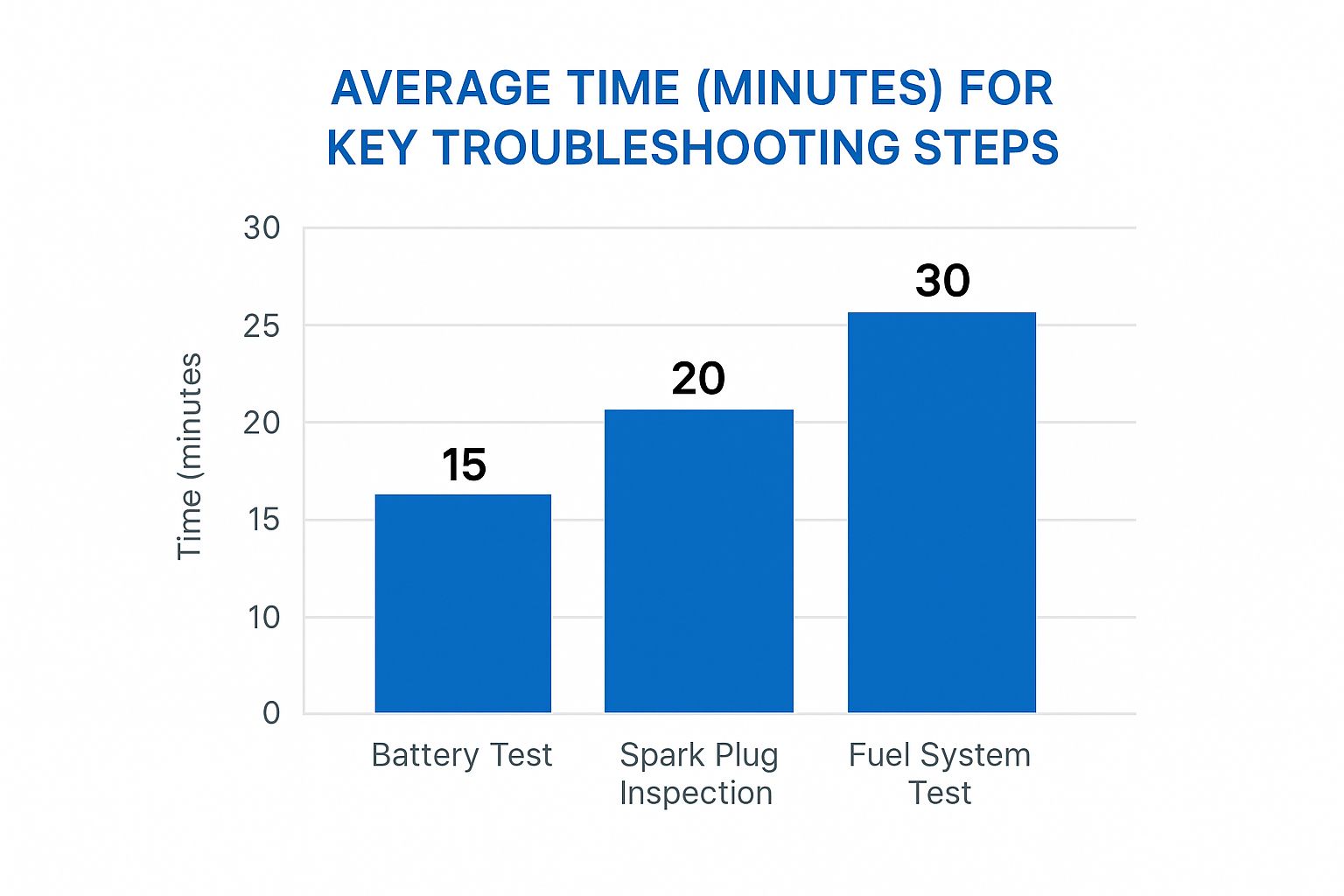
This just goes to show why a proper diagnosis is so important. Pinpointing a fuel-related problem takes more time and specialized tools than a simple battery check, but it’s the only way to get the fix right the first time.
When Electrical Glitches Shut Your Car Down
While a fuel issue might cause your engine to sputter and die slowly, electrical problems are usually more abrupt. Think of it like a light switch—one moment everything is running perfectly, the next, it’s all off. Your car is basically a rolling computer, and a fault in its complex electrical network can shut the engine down instantly and without warning.
Electrical failures are a surprisingly common reason a car shuts off while driving. In fact, industry data suggests that up to 20% of all engine stalls are tied directly to an electrical system malfunction, from a failing alternator to a bad sensor. This is only becoming more frequent as vehicles get packed with more technology.
The Role of the Alternator and Battery
Think of your alternator as the small but mighty power plant under the hood. Its main job is to generate electricity to run everything—from headlights to the ignition—while simultaneously keeping the battery charged. If that alternator fails, your car starts running solely off the battery’s stored power.
This kicks off a countdown. The battery can only last for so long on its own. You might notice the classic signs of an alternator failure right before the stall: your dashboard lights flicker, the headlights dim, or the radio cuts out. Eventually, the battery just doesn’t have enough juice left to power the fuel pump and ignition system, and the engine cuts off completely.
Expert Tip: The battery and alternator are a team. A weak battery forces the alternator to work overtime, and a dying alternator can’t properly charge the battery. If you suspect a problem with one, it’s always best to have both tested.
Knowing the early warning signs can save you from getting stranded. For more on this, check out our guide on the signs your battery is about to fail, which can help you spot trouble before it’s too late.
Faulty Sensors Can Cause Sudden Shutdowns
Modern engines are managed by an army of sensors feeding constant data to the main computer, or ECU. The ECU uses this information to make instant adjustments to keep everything running smoothly. If a critical sensor goes dark, the computer loses essential data and might just shut the engine down as a safety measure.
Two of the most common culprits are:
- Crankshaft Position Sensor: This sensor is the MVP. It tells the ECU the precise rotational speed and position of the crankshaft, which is vital for timing the spark plugs and fuel injectors. If it fails, the computer has no idea when to fire the plugs, and the engine stops dead in its tracks. A bad crankshaft sensor is notorious for causing stalls with zero sputtering or warning.
- Camshaft Position Sensor: This sensor works in tandem with the crankshaft sensor, tracking the camshaft’s position to control the engine’s valves. A failure here can also lead to an immediate stall or a car that cranks but refuses to start.
Finding these electrical gremlins isn’t a job for guesswork. Here at Pete Nelson Automotive, our technicians use advanced diagnostic tools to plug directly into your car’s computer and read the stored error codes. This lets us pinpoint the exact failed sensor or component and get you back on the road safely. For those curious about the fundamentals, a basic understanding battery technology can really put into perspective just how critical a stable power source is for every single part of your car.
Distinguishing a Stall from Start-Stop Technology
If you drive a newer car, you’ve probably felt it happen. You pull up to a stoplight, and the engine goes completely silent. It can feel just like a stall, but it’s almost certainly a feature, not a fault.
This is start-stop technology, and it’s pretty standard in many modern vehicles. The system is designed to improve your fuel economy and cut down on emissions by automatically shutting the engine off when the car isn’t moving. Instead of burning gas while you’re idling, your car saves fuel, then instantly restarts the moment you’re ready to go.
Why It Feels Different
The first few times it happens, that sudden silence can be a little unnerving. We’re all used to the familiar low rumble of an idling engine, so the quiet can feel wrong.
Don’t worry, though. Automakers have engineered these vehicles with heavy-duty components, like more robust starters and batteries, specifically to handle the thousands of extra start cycles over the car’s lifetime.
Modern start-stop systems are pretty smart, too. They’re calibrated to avoid shutting down when the engine’s power is needed, like when you’re coasting or in the middle of shifting gears. While it feels like a sudden shutdown, this technology is designed to reduce fuel use by up to 10-12% in city driving. You can discover more insights about start-stop systems on Wikipedia, including how they’ve become so common.
How to Tell the Difference
So, how do you know if your car is actually stalling or if the start-stop system is just doing its job? It’s usually pretty easy to tell them apart.
Here’s a simple checklist to help you differentiate:
- Look for an indicator light. Most cars have a dashboard symbol that lights up when the start-stop system is active. It’s often an “A” with a circle around it.
- Does it restart on its own? This is the key difference. A start-stop system will restart the engine automatically as soon as you lift your foot from the brake or press the clutch. A real stall almost always requires you to manually turn the key or push the start button again.
- Did any warning lights pop up? A genuine stall is often accompanied by a warning light you wouldn’t normally see, like the check engine light or the battery light. If you see one of those, it’s a good sign something else is going on. For a deeper dive, check out our guide on 8 reasons your check engine light may be on.
Answering Your Engine Stalling Questions
We get it—having your car shut off while you’re driving is unsettling and leaves you with a ton of questions. Here in Sun City, AZ, our team at Pete Nelson Automotive hears these concerns every single day.
To give you a little more peace of mind, we’ve pulled together answers to the most common questions we get from drivers just like you.
Frequently Asked Questions about Engine Stalling
Why did my car shut off while driving but start back up?
This often points to an intermittent problem, like a failing crankshaft position sensor that acts up when hot, a weak fuel pump struggling under load, or a loose electrical connection. Even though it restarted, the underlying issue is still there and needs a professional diagnosis to prevent it from happening again, potentially in a more dangerous situation.
Can low oil cause a car to shut off while driving?
Absolutely. Modern engines have safety sensors that will shut the engine down if oil pressure drops to a critically low level. This is a self-preservation measure to prevent catastrophic engine damage. Regular oil changes in Sun City AZ are the best way to ensure your oil level and quality are always protecting your engine.
Is it safe to drive my car if it stalled once?
We strongly advise against it. A stall is a serious symptom of a problem that will not fix itself. Continuing to drive a car that has stalled is a safety risk, as you can’t predict when or where it will happen again. It’s best to have your vehicle inspected by a trusted auto repair Sun City AZ shop as soon as possible.
Why does my car only shut off when I stop or slow down?
This symptom typically points to an issue with the systems that control your engine’s idle. Common culprits include a dirty idle air control valve, a vacuum leak, or a clogged fuel filter that can’t supply enough fuel at low RPMs. These parts are responsible for keeping your engine running smoothly when your foot isn’t on the gas.
Can a bad gas cap cause my car to stall?
While less common, it’s possible. A faulty or loose gas cap can disrupt the pressure in the fuel tank, which is part of the vehicle’s EVAP (Evaporative Emission) system. While this usually just triggers a check engine light, in some cases it can interfere with fuel delivery and contribute to stalling.
Your Trusted Auto Repair Partner in Sun City, AZ
If your car has stalled or you’re just worried about its reliability, don’t wait for the problem to leave you stranded on the side of Grand Avenue. The ASE-certified technicians at Pete Nelson Automotive have the know-how and diagnostic tools to pinpoint the issue and fix it right the first time. We are the trusted choice for auto repair in Sun City, AZ, because we treat your car like it’s our own.
Call 623-974-4723 or visit petenelsonautorepair.com to schedule your appointment today.
Pete Nelson Automotive
This Offer Will Expire 12-31-2026
Pete Nelson Automotive is pleased to offer you

"Get Ready for the Holidays"
A $215.00 Value for Only $159.95 (+tax)
Lube, Oil, & Filter Change, Up to 5 quarts of Engine oil
Inspect and top off all fluid levels, Includes up to 5 Quarts of 5w30 synthetic blend oil, additional charge for synthetic oil.
Travel Evaluation
Set Air Pressures and Tire Rotation if needed.
Battery, Alternator and Starter Electrical Test
Load test battery, Alternator output and Starting amps.
Full Brake Evaluation
Includes check brake system on four wheels, checking and testing brake fluid condition.
So Call 623-974-4723 today and make an appointment for this exclusive Special!
*Most Cars, Vans, Motor homes, 4×4’s, Diesels, and some foreign cars may be higher. You must bring this letter at time of service and allow 2 hours to complete.



