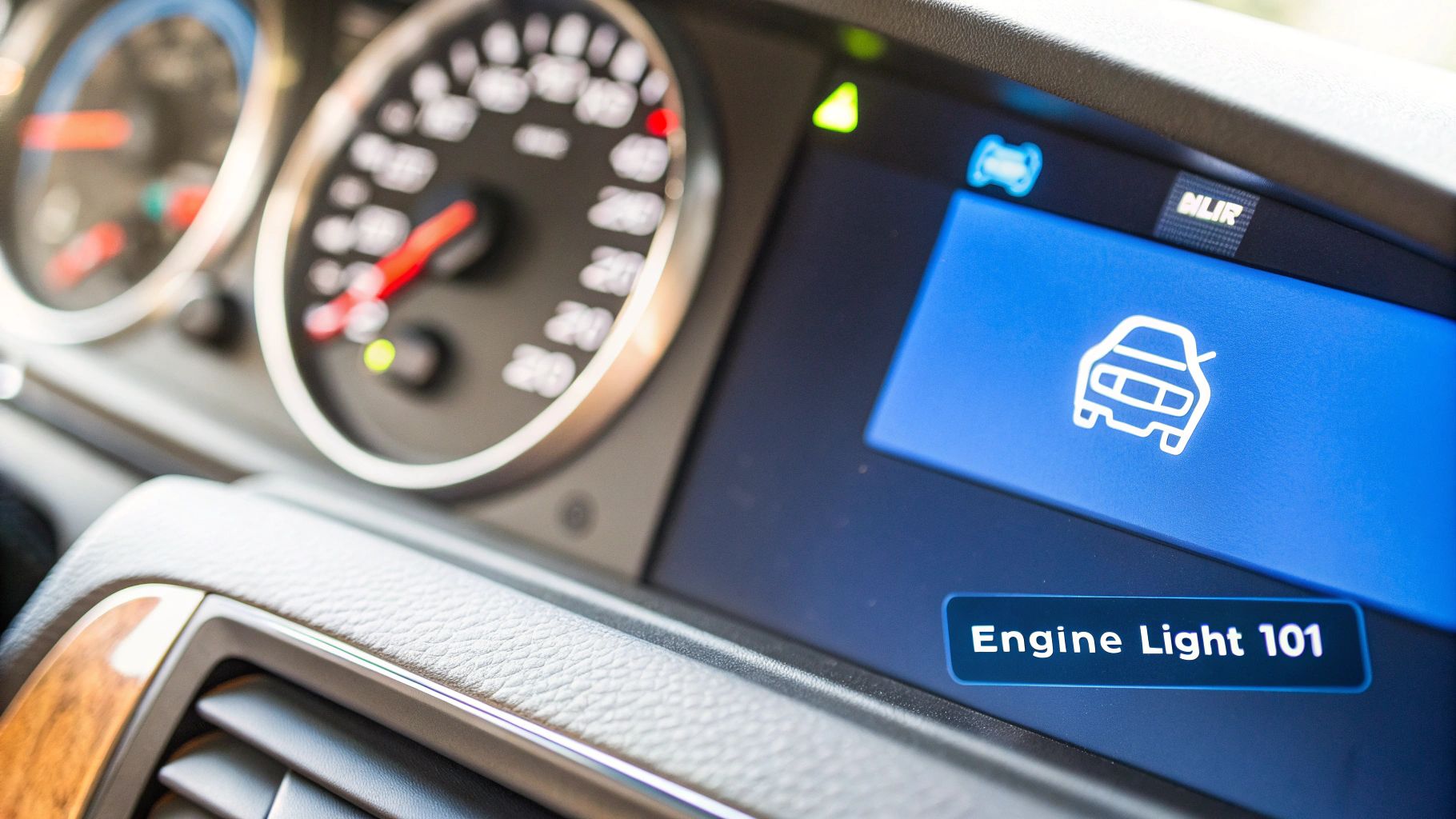
You’re driving through Sun City, enjoying the beautiful Arizona weather, when a small, amber light shaped like an engine suddenly illuminates your dashboard. Your mind starts racing: Is this serious? Is my car about to break down? How much is this going to cost? It’s a moment every driver dreads, but understanding what that light means is the first step toward a simple solution.
A check engine light diagnostic is the professional process we use to determine exactly why that warning light is on. Using advanced scanning tools, our technicians read the error codes stored in your vehicle’s computer. These codes act as a road map, guiding us to the source of the problem—whether it’s a simple loose gas cap or a more complex engine issue.
What That Glowing Dashboard Light Really Means
That little engine light is your car’s primary communication tool. It’s a direct message from the onboard diagnostics (OBD-II) system, alerting you that a sensor has detected something operating outside its normal parameters. The cause can range from something incredibly minor, like failing to tighten your gas cap after fueling up, to a more significant problem that needs professional attention.
Why You Should Never Ignore It
As your local auto care experts in Sun City, our advice is always the same: don’t ignore that light. A seemingly small issue can escalate into a major, costly repair if left unchecked. For example, a faulty sensor might not seem like an emergency, but it could cause your engine to run inefficiently, burning excess fuel and putting extra strain on critical components like the catalytic converter.
So, what is that light trying to tell you? Here are a few common reasons:
- Emissions System Fault: The majority of check engine light triggers are related to the emissions system. This could be anything from a failing oxygen sensor to a problem with the catalytic converter or that loose gas cap we mentioned.
- Engine Performance Problem: Issues like worn-out spark plugs or a bad mass airflow sensor can cause your engine to misfire or run poorly, which will definitely trigger the light.
- Transmission Issues: In some vehicles, the check engine light can also serve as an early warning for developing transmission problems.
The check engine light is your vehicle’s way of asking for help. Responding promptly with a professional diagnostic check is the best way to protect your investment and ensure your safety on the road.
Getting a professional check engine light diagnostic at an auto repair shop here in Sun City, AZ, is the smartest and most efficient way to resolve the issue. We use advanced diagnostic tools that provide far more data than the basic code readers available at auto parts stores. This allows us to see the full picture, diagnose the root cause, and fix the problem right the first time. You can learn more about the common culprits in our guide covering 8 reasons your check engine light may be on and what to do next.
Decoding Your Car’s Secret Language: The Diagnostic Process
Many drivers think a check engine light diagnostic is just guesswork, but it’s a highly precise, data-driven process. Every vehicle manufactured since 1996 is equipped with an On-Board Diagnostics port (OBD-II port). Think of it as a direct data line to your car’s central computer.
When one of our certified technicians plugs a professional-grade scanner into this port, we retrieve specific Diagnostic Trouble Codes (DTCs). These codes are part of a standardized language that tells us exactly which system and circuit is experiencing a fault.
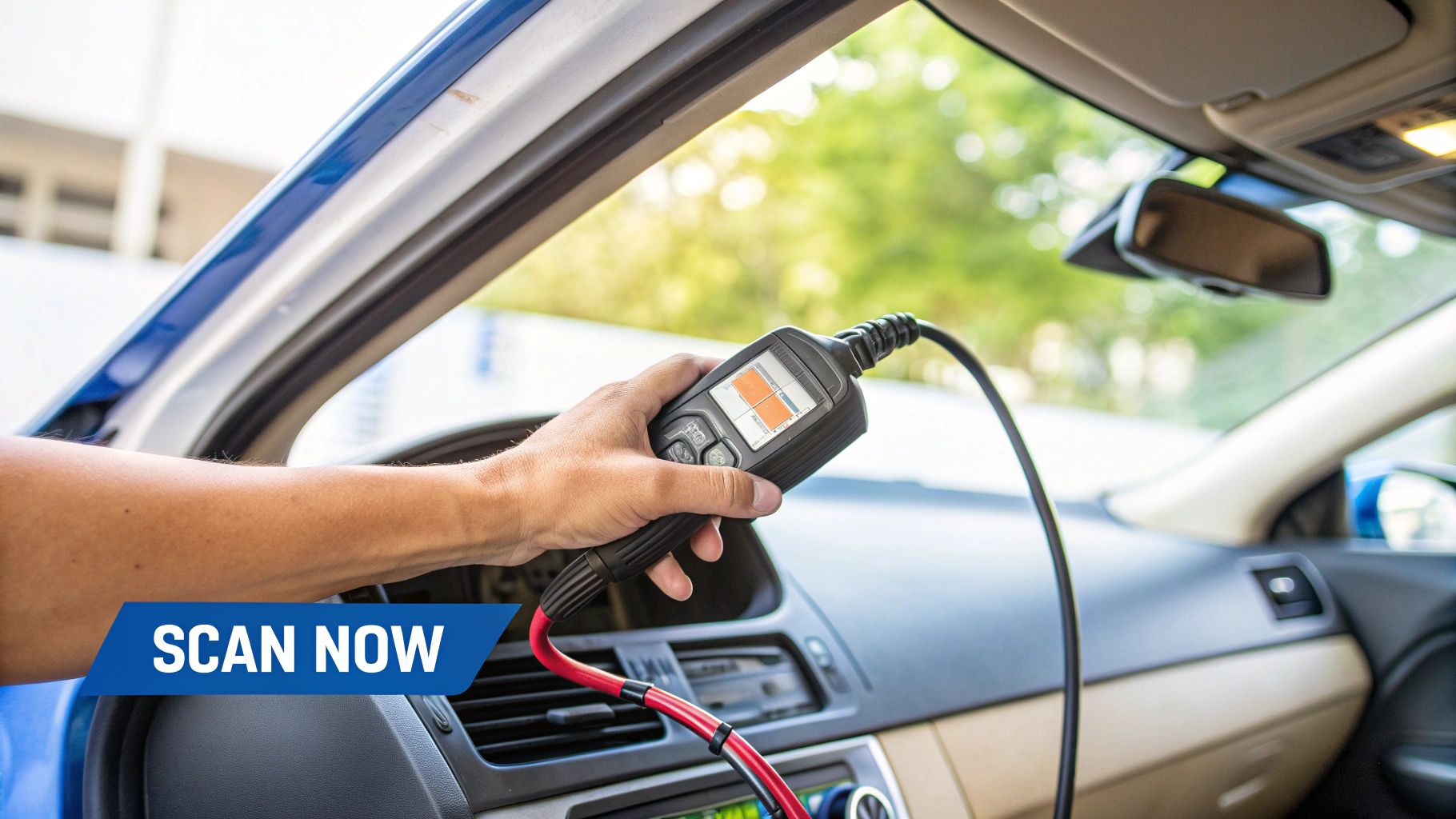
This image shows a technician using an OBD-II code reader to communicate directly with the vehicle’s computer.
Pulling these codes is the first, most critical step. It allows us to bypass the guesswork and focus our investigation on the correct area, saving you time and money on unnecessary repairs.
Understanding the Diagnostic Codes
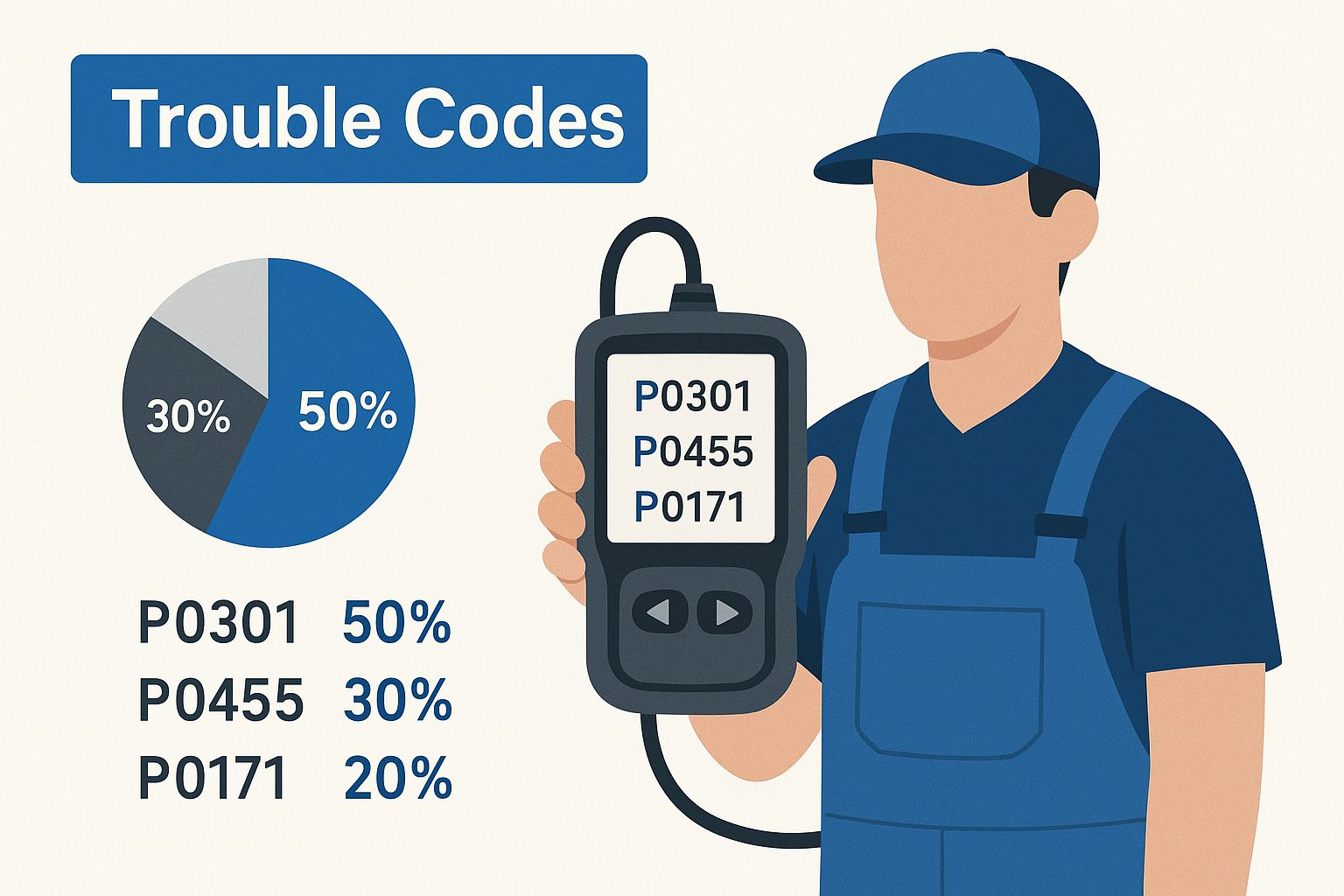
These codes are incredibly specific. For instance, a code like P0301 doesn’t just say “engine problem”; it tells us there’s a misfire detected in cylinder number one. This immediately allows our team to focus on the spark plug, ignition coil, or fuel injector for that specific cylinder.
The first letter of the code itself is a major clue, indicating which system is reporting the fault:
- P for Powertrain (engine, transmission, fuel system)
- B for Body (airbags, power seats, interior electronics)
- C for Chassis (anti-lock brakes, steering, suspension)
- U for Network (communication errors between vehicle computers)
This level of detail is why a professional diagnosis is so valuable. We can move straight from the warning light to the root of the problem.
Common OBD-II Codes and Their Meanings
Here’s a quick-reference table of common trouble codes we see from drivers around Sun City, illustrating what they mean and their potential severity.
| DTC Code Example | Related System | Common Cause | Severity Level |
|---|---|---|---|
| P0420 | Powertrain (Exhaust) | Failing catalytic converter or O2 sensor | Moderate to High |
| P0300 | Powertrain (Engine) | Random/multiple cylinder misfire | High |
| P0171 | Powertrain (Fuel System) | System too lean (vacuum leak, bad O2 sensor) | Moderate |
| C0035 | Chassis (ABS) | Wheel speed sensor fault | Moderate |
| B0081 | Body (SRS/Airbag) | Passenger seat occupant sensor fault | High (Safety System) |
These are just a few examples, but they show how a simple code points our diagnostic process in a very specific direction.
The Growing Importance of Vehicle Diagnostics
Vehicle technology is constantly evolving. The global vehicle diagnostics market was valued at around USD 48 billion in 2024 and is projected to reach USD 164 billion by 2032. This growth is driven by the increasing complexity of modern cars and the sophisticated tools needed to service them. You can read the full research on the vehicle diagnostics market to learn more about this trend.
An OBD-II code isn’t the final answer; it’s the clue that points an experienced technician toward the real problem. The code tells us where to look, but our expertise tells us what’s actually broken.
For example, a code for an oxygen sensor doesn’t always mean the sensor has failed. It could be a wiring issue, an exhaust leak, or another problem causing a bad reading. Similarly, a battery-related code requires further testing to determine if the issue is the battery itself or a failing alternator. Our guide on the signs your battery is about to fail provides more detail on this common issue. A proper check engine light diagnostic always combines the code with hands-on testing to confirm the failure, ensuring we fix the right part the first time.
Common Causes of a Check Engine Light in Arizona
While hundreds of issues can trigger a check engine light, we see a few common culprits time and again, especially given the intense heat and driving conditions here in Sun City, AZ. Understanding these can help you know what might be happening with your vehicle.
Of course, only a professional check engine light diagnostic can provide a definitive answer, but here are the issues we see most frequently.
The Surprisingly Simple Loose Gas Cap
It sounds too simple to be true, but a loose or faulty gas cap is one of the most common reasons a check engine light appears. Your car’s fuel system is pressurized to prevent harmful gasoline vapors from escaping. If the cap isn’t tightened until it clicks, or if its rubber seal is cracked from the Arizona sun, this pressure is lost. The vehicle’s computer detects this vapor leak as an emissions fault and turns on the light.
Failing Oxygen Sensors
Oxygen (O2) sensors in your exhaust system measure the amount of unburned oxygen. This data is critical for your engine’s computer to maintain the correct air-fuel ratio for optimal performance and fuel economy. Over time, these sensors can become fouled with exhaust byproducts and fail. Signs of a failing O2 sensor include:
- A noticeable drop in gas mileage
- Rough idling or poor engine performance
- Failing an emissions test
Worn Spark Plugs and Ignition Coils
Spark plugs ignite the air-fuel mixture in the engine’s cylinders, while ignition coils provide the high-voltage electricity needed for that spark. When these parts wear out, they can cause an incomplete fuel burn, known as an engine misfire. Your car’s computer will detect this immediately and trigger the check engine light. Driving with a misfire can cause severe damage to other components, particularly the catalytic converter.
Mass Airflow Sensor Malfunction
The mass airflow (MAF) sensor measures the amount of air entering the engine, another key piece of data for calculating the proper air-fuel mixture. In our dusty Arizona environment, the MAF sensor can become contaminated with dirt and debris, causing it to send inaccurate readings. This can lead to poor fuel economy, rough idling, and even difficulty starting the engine.
Think of your engine’s computer as a chef following a recipe. If the MAF sensor gives it the wrong amount for a key ingredient (air), the entire dish (combustion) will be ruined.
Catalytic Converter Failure
This is one of the more serious—and expensive—problems a check engine light can signal. The catalytic converter is an essential part of your exhaust system that converts harmful pollutants into less harmful gases. A converter usually fails as a result of another unresolved issue, like driving too long with a misfiring spark plug, which dumps raw fuel into the exhaust and overheats the converter. Regular maintenance and addressing smaller issues promptly is the best way to prevent this costly repair. To learn about other potential issues, visit our page on common vehicle issues.
A Solid vs. A Flashing Check Engine Light
When the check engine light appears, its behavior—solid or flashing—tells you a lot about the urgency of the situation.
Think of a solid light as a yellow traffic light: a caution sign that you need to get the issue checked soon. A flashing light, however, is a red light: a sign of a severe problem that requires immediate attention.
The Message Behind a Solid Check Engine Light
A solid, steady check engine light is the most common scenario. It means the car’s computer has detected a fault, often related to the emissions system or a sensor. While it’s not typically an emergency, you shouldn’t ignore it. Putting off a diagnosis can allow a small problem to worsen.
Common causes for a solid light include:
- A loose gas cap
- A failing oxygen sensor
- A malfunctioning mass airflow sensor
In this case, the vehicle is usually safe to drive to a trusted shop for a check engine light diagnostic. Getting it checked promptly can save you from poor performance, bad gas mileage, and more expensive repairs down the road. You can learn more about how we pinpoint these issues in our guide to the power of automotive computer diagnostics.
Why a Flashing Light Is a True Emergency
A flashing check engine light is your car’s version of a siren. It almost always indicates a severe engine misfire, where fuel is not burning correctly in one or more cylinders. This allows raw, unburned gasoline to be dumped into the hot exhaust system, which can be catastrophic.
A flashing check engine light means one thing: pull over safely as soon as possible and turn off the engine. Continuing to drive can destroy your catalytic converter in just a matter of minutes.
The catalytic converter operates at extremely high temperatures. When raw fuel hits it, those temperatures can spike, melting the internal components and rendering it useless. Replacing a catalytic converter is a very expensive repair, often costing over $1,000.
Industry Growth and Vehicle Complexity
The technology behind these warning systems is becoming more advanced every year. The global market for these systems was valued at USD 8.5 billion in 2023 and is expected to nearly double by 2033, driven by complex vehicle engineering and strict emissions standards. You can discover more insights about the check engine light market to learn more. Knowing the difference between a solid and flashing light helps you make the right call for your car and your budget.
Why Professional Diagnostics Beat DIY Scanners
With inexpensive OBD-II code readers readily available, it’s tempting to diagnose a check engine light diagnostic yourself. However, this DIY approach often leads to more confusion and wasted money. A basic scanner only gives you one piece of the puzzle: the Diagnostic Trouble Code (DTC). While that code is a starting point, it’s rarely the complete story.
Beyond the Basic Code
The professional diagnostic equipment we use at our Sun City auto repair shop goes much deeper. It doesn’t just pull a single code; it allows us to see your car’s systems in real-time.
Here’s what a professional scan provides that a basic reader can’t:
- Live Data Streams: We can monitor data from dozens of sensors while the engine is running, helping us spot erratic performance that a static code would miss.
- Freeze-Frame Data: This is a snapshot of your car’s sensor readings at the exact moment the fault occurred, providing critical context for the diagnosis.
- Manufacturer-Specific Codes: Our advanced tools can access detailed manufacturer codes related to the body, chassis, and network systems that generic readers can’t see.
The Real Cost of Guesswork
The most important thing to remember is that a code does not condemn a part. A code pointing to an oxygen sensor, for instance, doesn’t automatically mean the sensor is bad. The problem could be a wiring short, a vacuum leak, or an exhaust issue causing a faulty reading.
An experienced, ASE-certified technician uses that code as the beginning of an investigation, not the end. We use it to know where to start testing—checking wiring, looking for vacuum leaks, or analyzing fuel trim data to find the true root cause.
This expertise saves you from the cycle of “parts-swapping,” where you replace part after part based on a code, only for the light to return because the underlying issue was never fixed. As vehicles become more complex, accurate diagnostics are more critical than ever. The North American check engine light market is projected to hit nearly USD 976 million by 2033, highlighting the industry’s focus on precision. You can learn more about these automotive market findings and industry trends.
An Investment in Accuracy
Paying for a professional check engine light diagnostic is an investment in getting the repair done right the first time. It prevents you from spending money on parts you don’t need and ensures your vehicle is safe and reliable. Our article on how regular computer diagnostics can save you money further explains the long-term benefits. When you bring your vehicle to a professional auto repair shop in Sun City, AZ, you’re paying for experience, advanced equipment, and a diagnostic strategy that provides a definitive solution.
Frequently Asked Questions About the Check Engine Light
Can I drive my car if the check engine light is on?
If the light is solid and the car is driving normally, it’s usually safe to drive to a repair shop for a diagnosis. However, if the light is flashing, you should pull over as soon as it’s safe, turn off the engine, and call for a tow. A flashing light indicates a severe misfire that can quickly cause expensive damage to your catalytic converter.
How much does a check engine light diagnostic cost in Sun City, AZ?
The cost for a diagnostic service covers a technician’s time and the use of advanced equipment to accurately find the problem’s source. At Pete Nelson Automotive, we provide transparent pricing for our diagnostic services. Investing in a proper diagnosis from a professional auto repair shop in Sun City, AZ saves you money by avoiding incorrect repairs and replacing unnecessary parts. Check our current specials for any available offers.
Will my check engine light turn off by itself?
Sometimes it might, for example, if the cause was a loose gas cap that you’ve since tightened. For most other issues, the light will remain on until the underlying problem is repaired and the code is cleared from the vehicle’s computer. Ignoring it and hoping it goes away can lead to worse fuel economy and more significant engine problems over time.
Is it a good idea to reset the check engine light myself?
We strongly advise against this. Resetting the light by disconnecting the battery or using a basic code reader erases important diagnostic data, including “freeze-frame” information that helps us identify the root cause. The light will almost certainly reappear if the actual problem hasn’t been fixed, leaving you back at square one.
What is the difference between a check engine light and a maintenance light?
The check engine light (an engine-shaped icon) signals an actual problem detected by your car’s diagnostic system. In contrast, a maintenance or service light (often a wrench icon or text like “MAINT REQD”) is simply a pre-set reminder for routine services like oil changes in Sun City. One indicates a problem, while the other is just a helpful reminder. You can view all our maintenance options on our Services page.
At Pete Nelson Automotive, we’re here to take the mystery out of your check engine light. We are dedicated to providing our Sun City community with honest, expert service to keep your vehicle running safely and efficiently.
Call 623-974-4723 or visit petenelsonautorepair.com to schedule your appointment today.
Pete Nelson Automotive
This Offer Will Expire 12-31-2026
Pete Nelson Automotive is pleased to offer you
"Get Ready for the Holidays"
A $215.00 Value for Only $159.95 (+tax)
Lube, Oil, & Filter Change, Up to 5 quarts of Engine oil
Inspect and top off all fluid levels, Includes up to 5 Quarts of 5w30 synthetic blend oil, additional charge for synthetic oil.
Travel Evaluation
Set Air Pressures and Tire Rotation if needed.
Battery, Alternator and Starter Electrical Test
Load test battery, Alternator output and Starting amps.
Full Brake Evaluation
Includes check brake system on four wheels, checking and testing brake fluid condition.
So Call 623-974-4723 today and make an appointment for this exclusive Special!
*Most Cars, Vans, Motor homes, 4×4’s, Diesels, and some foreign cars may be higher. You must bring this letter at time of service and allow 2 hours to complete.



