
You’re driving through Sun City on a beautiful Arizona day when an unfamiliar, amber-colored light suddenly pops up on your dashboard. It looks like a squashed horseshoe with an exclamation mark in the middle. That’s your vehicle’s Tire Pressure Monitoring System (TPMS) warning light, and it’s not just a minor annoyance—it’s an important safety feature designed to keep you safe on the road.
At Pete Nelson Automotive, we want to help our neighbors in Sun City, AZ, understand what this light means and what to do when it appears.
What That Light on Your Dashboard Really Means
Seeing that light can be a bit startling, but think of it as your car trying to tell you something important about its health and your safety. Ignoring it is never a good idea. A tire with low pressure can lead to poor handling, worse gas mileage, and in the worst-case scenario, a dangerous blowout on the road.
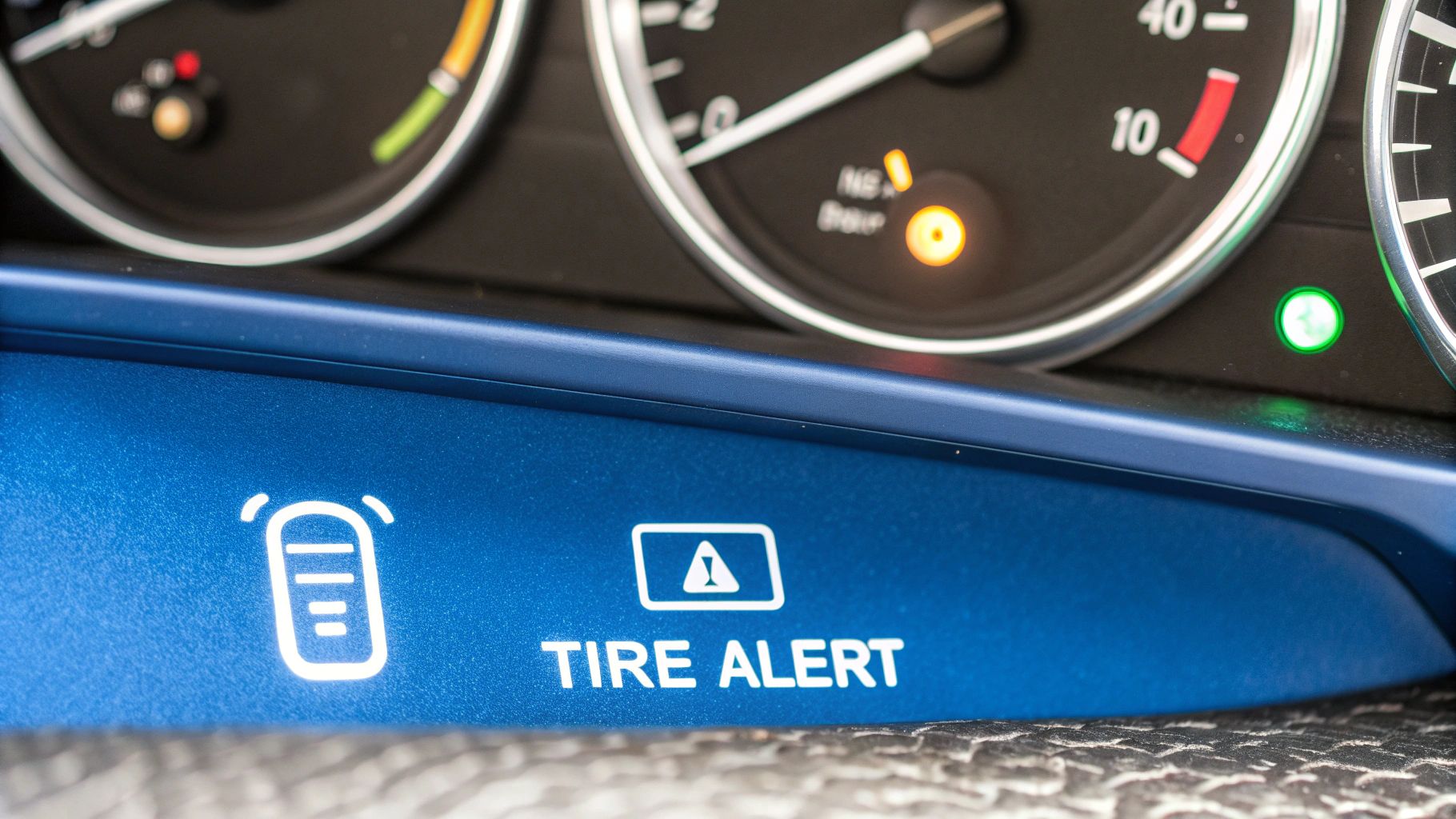
The TPMS has become a standard safety feature for good reason. The market for this technology was valued at over $5.8 billion in 2023 and is expected to keep growing, largely because of safety regulations around the world. It’s a testament to how crucial these systems are for modern driving.
Your Immediate First Steps
So, what do you do when that light comes on? Don’t panic. The first thing is to find a safe spot to pull over and get off the road.
Once you’re stopped, follow these simple steps:
- Visually Inspect Your Tires: Take a quick walk around your car and look at all four tires. Is one obviously flat or lower than the others?
- Check with a Gauge: Even if everything looks fine to the naked eye, it’s still critical to check the pressure with a reliable tire gauge as soon as you can.
Sometimes, a warning light that just won’t go away points to a deeper problem, like a faulty sensor or an issue with the car’s computer. To understand how these systems work together, see our guide on how regular computer diagnostics can save you money on auto repairs. Here at Pete Nelson Automotive, our Sun City, AZ team has the right tools to quickly figure out exactly what’s going on.
Getting to Know Your Vehicle’s TPMS
Let’s pull back the curtain on the technology behind that little dashboard light. Think of your Tire Pressure Monitoring System (TPMS) as a silent guardian, constantly keeping an eye on your tires to make sure they’re properly inflated for those demanding Arizona roads. It’s a quiet hero, working behind the scenes to keep you safe.
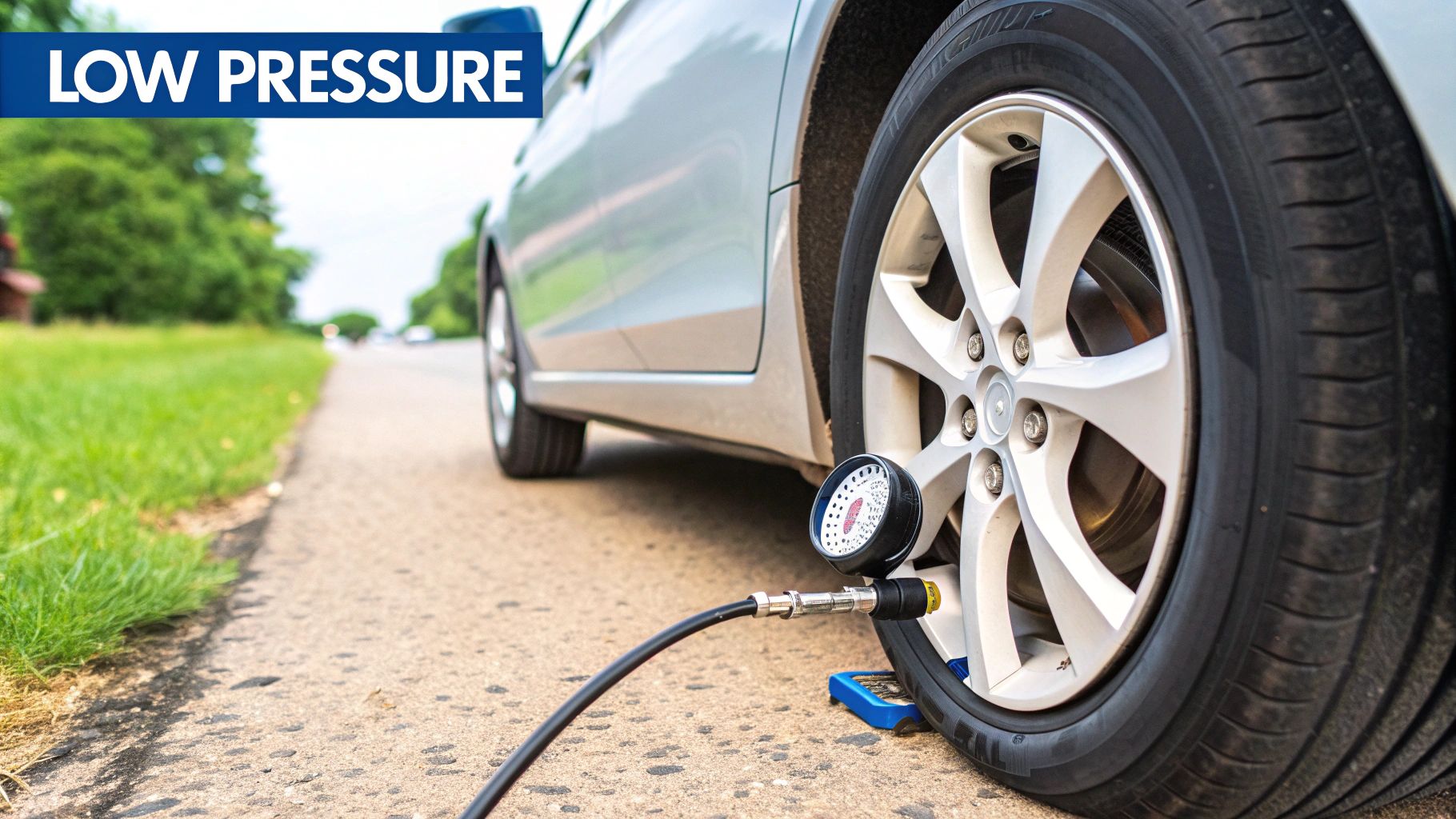
This system is a sophisticated piece of tech that comes in two main types. Knowing the difference helps you understand what’s really happening when that tire pressure warning light decides to pop up.
Direct vs. Indirect TPMS
Both types of TPMS have the same mission, but they go about it in completely different ways.
- Direct TPMS: This is the most common—and most precise—system. A tiny, battery-powered sensor sits inside each of your tires (and sometimes the spare). These gadgets read the exact pressure inside each tire and beam that data wirelessly to your car’s computer. If the pressure dips below a safe level, the computer flicks on that warning light.
- Indirect TPMS: This system is a bit more clever, as it doesn’t need dedicated sensors inside the tires. Instead, it piggybacks on your car’s Anti-lock Braking System (ABS) wheel speed sensors. Here’s the trick: an underinflated tire spins at a slightly different speed than a properly inflated one. The ABS sensors pick up on this difference in rotation, and if it’s significant enough, the system figures a tire is low and lights up the warning.
Expert Tip: While indirect systems get the job done, they’re generally not as pinpoint accurate as direct TPMS. Direct systems give you real-time, specific data for each individual tire.
No matter which system your car has, its main job is to give you a heads-up about a potentially dangerous situation. For a deeper dive into overall tire health, check out our comprehensive tire maintenance checklist for rotation, alignment, and replacement.
Common Reasons Your Tire Pressure Light Is On
Seeing that little horseshoe-shaped warning light pop up on your dash can be a bit jarring, but don’t panic. It’s usually your car’s way of telling you something simple needs attention. While the number one reason is low tire pressure, it’s not the only thing that can trigger your TPMS. Let’s walk through the likely culprits.
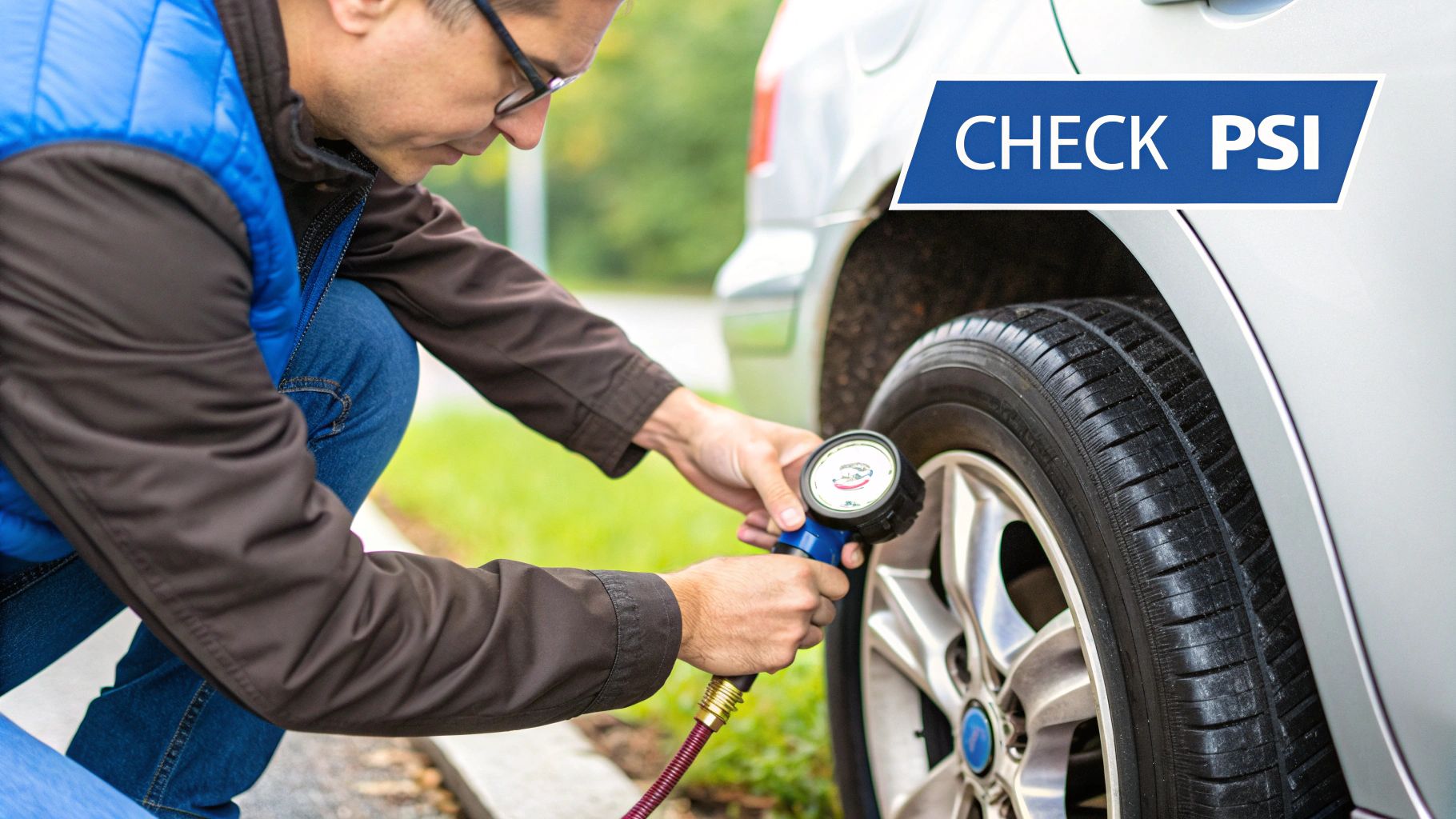
Most of the time, the simplest explanation is the right one. A slow leak from a nail or screw you picked up on the road is a classic. It’s also completely normal for tires to lose about 1 PSI (pound per square inch) of air per month.
The Impact of Arizona Temperatures
Living here in Sun City, AZ, we know all about temperature swings, and your tires feel it, too. You might notice the light flicks on during a surprisingly cool morning. That’s because for every 10-degree drop in the outside temperature, your tires can lose around 1 PSI.
As the air inside the tire gets colder overnight, it contracts, causing the pressure to dip. Often, the light will turn off by itself after a few minutes of driving as the tires heat up. But think of this as a heads-up: your pressure is borderline and needs to be topped off. Our intense summer heat poses its own set of challenges, which is why it’s so important for local drivers to understand how Arizona heat affects your vehicle.
Beyond Simple Air Loss: Signs of a Bigger Problem
What if you’ve checked all four tires and the pressure is perfect, but the light is still on? This usually points to an issue with the TPMS itself.
Here are a few other common causes to look for:
- Failing TPMS Sensor: The sensors inside your tires don’t last forever. They can fail due to corrosion, damage from hitting a pothole, or just old age.
- Dead Sensor Battery: Every direct TPMS sensor has a small battery that lasts about 5 to 10 years. Once it dies, the sensor goes dark, and your car’s computer will trigger the warning light.
- A Flashing Light: If the TPMS light flashes for 60-90 seconds when you start the car and then stays solid, this is a clear sign of a system malfunction.
Properly inflated tires are a cornerstone of your vehicle’s safety, performance, and fuel economy. Under-inflated tires wear out faster, hurt your gas mileage, and make your car handle poorly. For other helpful pointers, check out our guide on essential tire maintenance tips.
How To Check and Inflate Your Tires Correctly
So, that little tire pressure light flicked on. Taking a few minutes to check and inflate your tires yourself is one of the most useful skills a driver can have. It’s simple, quick, and keeps you safer on the road.
First, let’s clear up a common mistake. The number printed on the side of your tire is the tire’s maximum pressure, not the recommended pressure for your car.
Finding Your Vehicle’s Correct PSI
The right number is easy to find. Just open your driver-side door and look for a sticker on the door jamb. This placard has the manufacturer’s recommended pounds per square inch (PSI) for your front and rear tires. That’s your magic number.
For the most accurate reading, always check the pressure when your tires are “cold”—meaning the car has been parked for at least three hours or driven less than a mile.
A Step-By-Step Guide to Checking and Inflating
Once you know your target PSI, the rest is a breeze.
- Get Your Tools Ready: You’ll need a reliable tire pressure gauge and an air compressor, which you can find at most gas stations.
- Check Each Tire: Remove the valve stem cap and press the gauge firmly onto the stem. Note the reading.
- Add Air Slowly: If the pressure is low, use the air compressor to add air in short bursts, checking the pressure again after each one.
- Repeat for All Tires: Do this for all four tires. Don’t forget to check the spare if your car has a TPMS sensor on it. Screw the valve caps back on tightly.
After topping off the air, you may need to reset the light. Many cars do this automatically after a short drive.
DIY Tire Check vs. Professional Service
Knowing how to check your tire pressure is a great skill, but sometimes the warning light points to a bigger issue. This table can help you decide whether a quick DIY fix is enough or if it’s time to let the pros at Pete Nelson Automotive take a look.
| Task | DIY Solution | When to Call a Pro |
|---|---|---|
| Routine Pressure Check | Use a gauge to check PSI monthly. | If you’re unsure or don’t have the tools. |
| Low Pressure Light | Inflate tires to the recommended PSI. | If the light comes back on soon after inflating. |
| Visible Tire Damage | Look for nails, cuts, or bulges. | If you find any damage, even if it’s not leaking air yet. |
| Persistent/Flashing Light | Light stays on or flashes after inflating. | This indicates a faulty TPMS sensor or a slow leak. |
| Uneven Tire Wear | Visually inspect tread for uneven patterns. | Uneven wear points to alignment or suspension problems. |
In short, a simple air top-off is something every driver can handle. But if that light just won’t stay off or you spot signs of damage, don’t ignore it. For more details on our approach, see our guide on the best tire repair and maintenance services to keep your vehicle running smoothly.
Frequently Asked Questions (FAQ)
At Pete Nelson Automotive, we get a lot of questions from drivers here in Sun City, AZ. Here are answers to a few of the most common ones about the tire pressure warning light.
Why did my tire pressure light come on when it got cold?
This is very common, especially during our cooler Arizona mornings! For every 10-degree drop in ambient temperature, your tire pressure can decrease by about 1 PSI. If your tires were already a little low, a cool night is often enough to trigger the warning light.
How do I reset the tire pressure warning light?
For most vehicles, the light will reset itself automatically after you’ve inflated the tires to the correct pressure and driven for a few miles. Some cars have a manual reset button, usually found under the steering wheel or in the glove box. If the light remains on or flashes, it’s a sign that there’s a deeper issue that needs professional diagnosis.
Can I drive with the tire pressure light on?
It’s not recommended to drive for an extended period with the light on. A significantly underinflated tire affects your car’s handling, braking, and fuel efficiency. It also increases the risk of a dangerous blowout. It’s best to find a safe place to pull over and check your tires as soon as possible.
What does it mean if my tire pressure light is flashing?
A flashing TPMS light (usually for 60-90 seconds upon startup) signals a malfunction within the system itself, not necessarily low tire pressure. This could mean a dead sensor battery, a damaged sensor, or a communication failure. When the light is flashing, your TPMS cannot warn you of low pressure, so it’s important to have an expert at a local auto repair shop in Sun City, AZ check it out.
Your TPMS is a critical safety feature, not just a dashboard annoyance. Don’t let a stubborn tire pressure warning light put your safety at risk. If you have questions or need an expert to figure out what’s going on, trust the ASE-certified team at Pete Nelson Automotive. We’re here to provide the expert auto repair Sun City, AZ drivers count on.
Call 623-974-4723 or visit petenelsonautorepair.com to schedule your appointment today.
Pete Nelson Automotive
This Offer Will Expire 12-31-2026
Pete Nelson Automotive is pleased to offer you
"Get Ready for the Holidays"
A $215.00 Value for Only $159.95 (+tax)
Lube, Oil, & Filter Change, Up to 5 quarts of Engine oil
Inspect and top off all fluid levels, Includes up to 5 Quarts of 5w30 synthetic blend oil, additional charge for synthetic oil.
Travel Evaluation
Set Air Pressures and Tire Rotation if needed.
Battery, Alternator and Starter Electrical Test
Load test battery, Alternator output and Starting amps.
Full Brake Evaluation
Includes check brake system on four wheels, checking and testing brake fluid condition.
So Call 623-974-4723 today and make an appointment for this exclusive Special!
*Most Cars, Vans, Motor homes, 4×4’s, Diesels, and some foreign cars may be higher. You must bring this letter at time of service and allow 2 hours to complete.



