Why Wheel Alignment Is Important for Sun City Drivers
You leave Bell Recreation Center after pickleball, turn onto 99th Avenue, and notice the steering wheel tugging slightly toward the curb. The road looks level, so you blame pavement slope or the wind. A few days later, you see feathered wear along one front tire, and the fuel gauge seems to be dropping faster than usual.
That combination deserves attention. Wheel alignment isn’t just about keeping the steering wheel straight. It controls how the tires meet the pavement, how confidently the vehicle tracks, how efficiently it rolls, and how predictably steering and safety systems respond. For Sun City and West Valley drivers, monsoon potholes, curb strikes in crowded parking lots, and rough road transitions can move those settings outside the manufacturer’s target range without leaving obvious damage.
A Common Drive Home That Tells You Something
A slight pull can be easy to ignore, especially on familiar roads. You may correct the steering without thinking, accept a crooked wheel as normal, or assume the car follows the crown of the road. But if the vehicle pulls consistently on a flat stretch, the steering wheel sits off-center, or one tire develops unusual wear, the car is giving you useful information.
The driver leaving Bell Recreation Center might not notice the alignment problem during a short neighborhood trip. On a longer drive along Grand Avenue, however, the constant correction becomes tiring. The front tires aren’t tracking evenly, and the vehicle may feel less settled through curves or during a sudden lane change. A useful starting point is Pete Nelson Automotive’s guide to why a car pulls to one side, especially when the symptom appears after a curb or pothole impact.
Alignment sets the relationship between the wheels and the suspension. When those relationships change, the effects spread across several systems:
- Tires: Incorrect angles can create shoulder wear, feathering, and scrub.
- Fuel use: Tires that slide slightly instead of rolling freely create extra resistance.
- Steering: The vehicle may wander, pull, or fail to return smoothly after a turn.
- Safety: Less predictable tracking makes emergency steering and braking more difficult.
- Driver assistance: Cameras and other sensors work from the vehicle’s intended direction of travel, so geometry matters on vehicles equipped with ADAS.
The important point is timing. Alignment problems often begin as a small steering sensation, then become a tire, fuel, and handling expense if the driver waits.
What Wheel Alignment Actually Adjusts
Think about an office chair with casters. If one caster points slightly inward, the chair won’t roll cleanly forward. It may drag, twist, or steer away from the direction you push. A vehicle wheel works in a similar way, although its suspension and steering system must manage much greater forces.
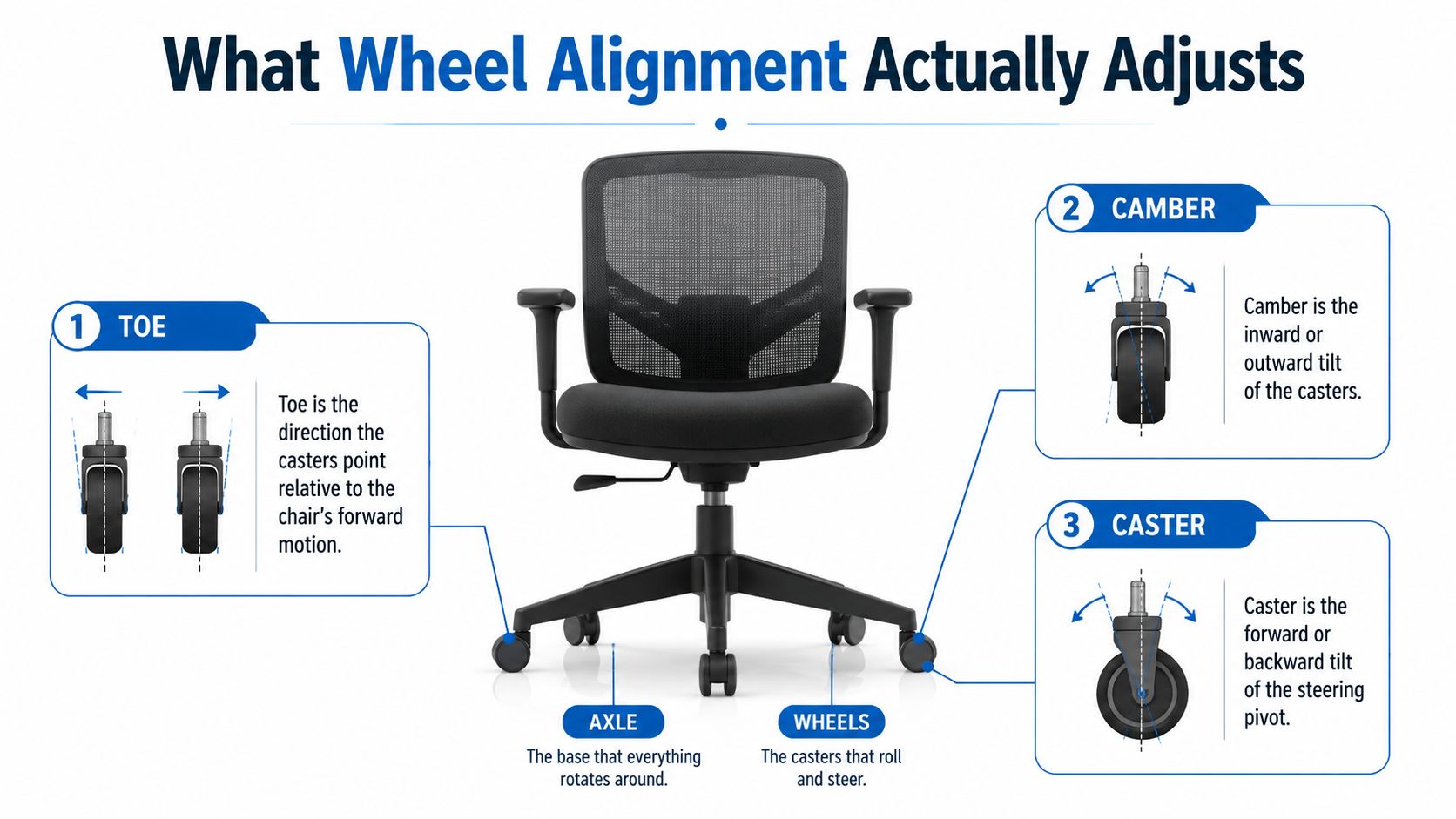
Toe changes the direction of travel
Stand in front of the chair and look at the casters. If their leading edges point toward each other, they resemble toe-in. If they point away from each other, they resemble toe-out. On a vehicle, toe describes the direction the wheels point when viewed from above or the front.
Toe is especially sensitive because modern vehicles generally use very small toe settings, often around 0 to 0.10 degrees per wheel, according to technical alignment specifications. Typical tolerances are also tight, approximately ±0.25 to 0.5 degrees for camber and caster, and ±0.05 to 0.15 degrees for toe. Those measurements are small enough to be invisible from the driver’s seat, yet they can change tire contact and steering behavior.
Camber controls the wheel’s lean
Now tilt the top of the caster toward or away from the chair. That represents camber, the inward or outward lean of the wheel. Too much tilt loads one part of the tire’s contact patch, which can wear an inner or outer shoulder instead of using the tread evenly.
Caster helps the vehicle track and return
Caster is like the rake of a bicycle fork. The steering pivot tilts forward or backward, influencing straight-line stability, steering effort, and how the wheel returns after a turn. ASE training materials identify toe as the most important alignment angle, while alignment training guidance also explains how camber, caster, and toe work together.
Most modern vehicles include rear alignment specifications, too. That matters because the rear axle’s position influences how the front of the vehicle tracks. A four-wheel alignment checks the vehicle as a complete system instead of assuming the front wheels are the only concern. You can read a plain-language explanation of the process in this guide to what a wheel alignment is.
How Misalignment Affects Tires, Fuel, and Safety
A drive home on Grand Avenue can reveal more than a crooked steering wheel. If the vehicle drifts, the tires scrub across the pavement instead of rolling straight. That small sideways movement links alignment to tire life, fuel use, steering, and safety systems.
When toe, camber, or another setting moves outside specification, part of the tread carries more load while the tire fights the vehicle’s direction. The result can be feathering, shoulder wear, or an uneven contact patch. A tire may need replacement while usable tread remains elsewhere, turning a correctable alignment problem into an avoidable tire expense.
The EPA study on vehicle alignment and fuel economy estimated that the average misaligned vehicle experiences about a 3% to 6% decrease in fuel economy. The same study estimated that roughly 10% of vehicles in use operate with about a 4% fuel-efficiency loss from improper front-end alignment.
The dollar effect depends on miles driven, fuel prices, and how far the geometry has shifted. A postponed alignment can cost more through early tire replacement and fuel wasted overcoming rolling resistance. The vehicle also demands more steering correction, which adds work during ordinary Sun City driving.
| Effect area | What the driver notices | Typical impact |
|---|---|---|
| Tires | Feathering, shoulder wear, or an uneven tread pattern | Replacement may come before the tread is fully used |
| Fuel economy | The fuel gauge falls faster during regular driving | Rolling resistance raises operating costs |
| Steering | Pulling, wandering, or a crooked steering wheel | The driver makes frequent corrections |
| Cornering | Vague response through turns | The vehicle feels less settled on roads such as Grand Avenue |
| Safety systems | The vehicle does not point as expected | ADAS functions may need inspection or calibration after related repairs |
Safety deserves more attention than ride comfort. A vehicle pulling on Bell Road can require constant input, and a sudden maneuver may feel less predictable. Alignment also interacts with tire pressure, suspension condition, braking, and wheel balance, so every shake or stopping concern does not come from alignment alone. Still, a vehicle that pulls or scrubs its tires should be checked before a monsoon pothole or parking-lot curb strike makes the problem more expensive.
Causes and Warning Signs Arizona Drivers Should Not Ignore
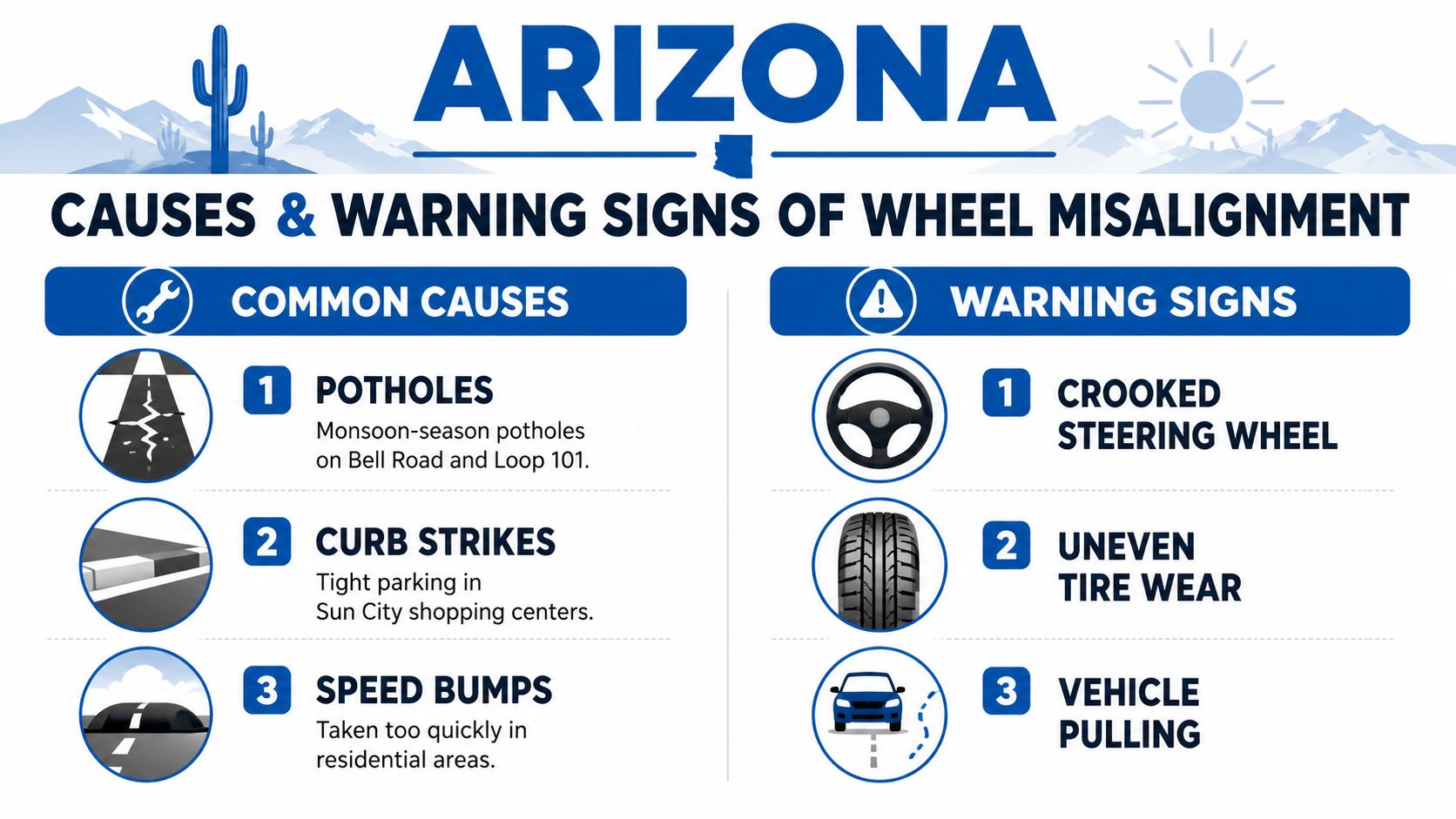
Arizona roads give suspension components plenty of opportunities to take a hard hit. A deep monsoon-season pothole on Bell Road or the Loop 101 can compress one side of the suspension sharply. A curb strike in a Sun City shopping center can bend or shift a steering component, while a rough railroad crossing near downtown Phoenix or a speed bump taken too quickly in a newer West Valley subdivision can add another impact.
Common local triggers
- Pothole impacts: A sudden hit can alter toe or camber and may damage a wheel, tire, control arm, or other suspension part.
- Curb strikes: Parking lots near grocery stores and recreation centers create tight turns where the inside front wheel can contact a curb.
- Repeated rough travel: Railroad crossings, broken pavement, and speed bumps transmit force through bushings, struts, and steering links.
- Suspension repairs: Replacing a tie rod, control arm, strut, or related part can change geometry even when the repair itself is correct.
- Road trips: A small existing pull becomes more obvious after hours of highway driving.
Symptoms you can notice without equipment
- Pulling: The vehicle drifts left or right on a level stretch of Bell Road.
- Crooked steering wheel: The car travels straight while the wheel sits noticeably off-center.
- Uneven tire wear: Look for inner-edge feathering, an outer shoulder worn more than the rest, or tread that feels rough in one direction.
- Squealing during turns: Scrubbing tires may complain during low-speed corners.
- Loose steering: The vehicle feels vague or requires more correction at highway speed.
These signs don’t prove alignment is the only fault. Worn ball joints, struts, tie rods, and bushings can create similar symptoms, and a technician needs to inspect those parts before adjusting angles. A practical checklist is available in this guide to signs your car needs an alignment.
When to Schedule an Alignment Check
A calendar reminder helps because alignment problems don’t always announce themselves immediately. For a practical maintenance baseline, schedule a check every 12 months or 12,000 miles, whichever comes first. That interval gives a technician an opportunity to identify gradual changes before they turn into a tire replacement problem.
Schedule sooner after any of these events:
- A deep pothole hit, particularly if the steering wheel suddenly changes position.
- A curb strike, even if the tire appears undamaged.
- New pulling or wandering, especially after a road trip.
- A front-end suspension repair, including work involving steering or control components.
- New tires or shocks and struts, so the replacement parts start with correct geometry.
A new tire can’t correct a vehicle that points incorrectly. If the wheel continues to scrub, fresh tread can develop an uneven pattern and lose value much sooner than expected. The same logic applies to new shocks or struts. Those parts restore suspension performance, but the completed repair still deserves a geometry check.
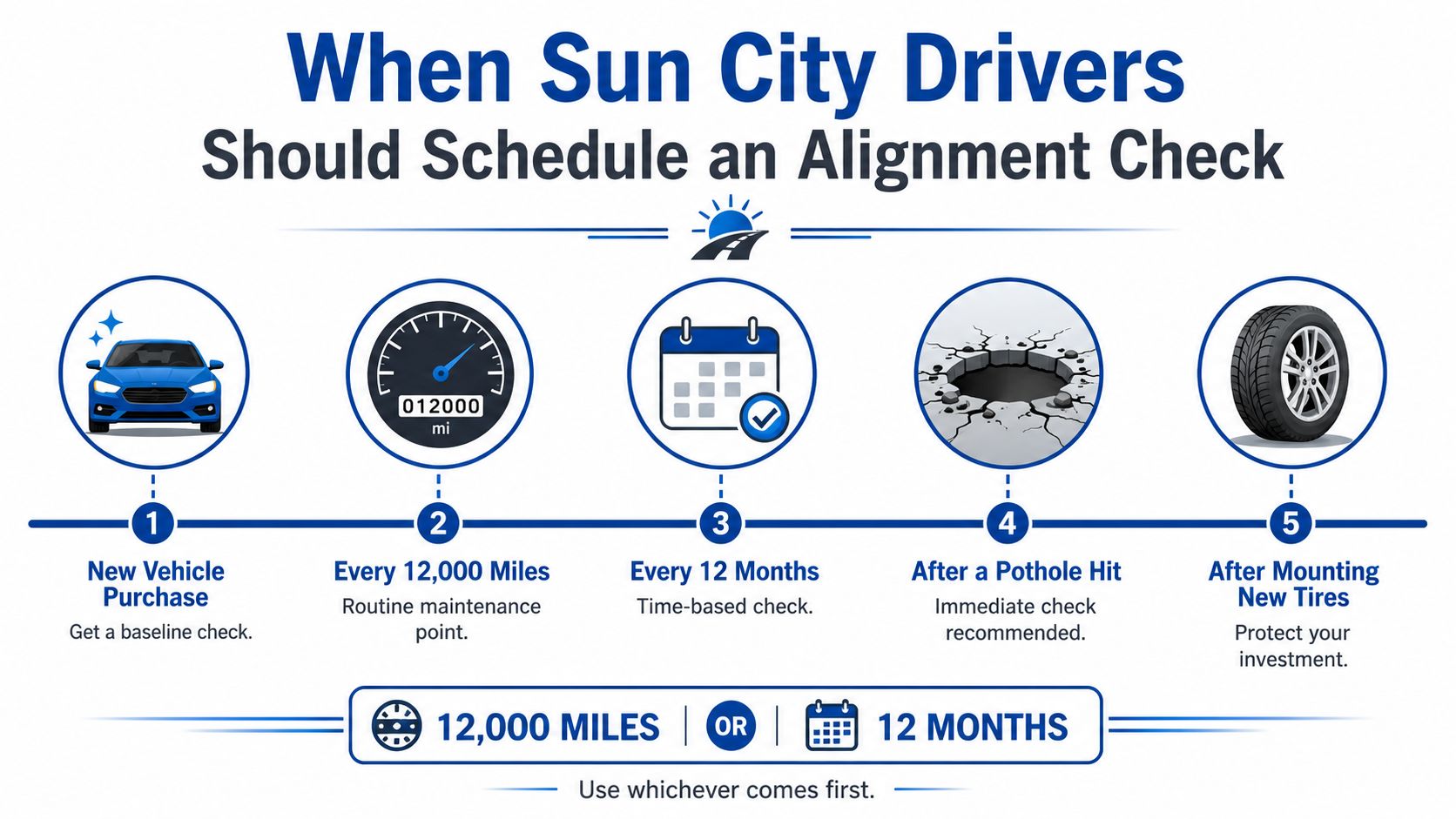
Use a simple decision rule: put the annual or mileage check on your calendar, then add an immediate check after a pothole, curb strike, new symptom, suspension repair, or tire installation. The practical scheduling guidance in this wheel alignment frequency guide can help you match the inspection to your driving habits.
Why Professional Alignment at Pete Nelson Automotive Matters
Alignment isn’t a driveway adjustment based on whether the steering wheel looks straight. A professional service measures each wheel’s position, compares the readings with vehicle-specific specifications, and checks whether the suspension can hold the adjustment.
Pete Nelson Automotive uses computer-aligned, laser-measured Hunter equipment for vehicle-specific measurements. That approach applies to common Sun City vehicles, including Toyota, Honda, Ford, and Chevrolet models, as well as other domestic and import vehicles. The shop’s ASE-certified technicians inspect suspension components before making adjustments, because a worn bushing, ball joint, or tie rod can make an alignment reading misleading or prevent the vehicle from staying aligned.
Practical rule: Don’t adjust alignment around a worn part. Find the loose or damaged component first, repair it, then set the geometry.
A quick chain-store visit may address a visible angle without explaining why it changed. A complete inspection connects the alignment reading to tire condition, steering feel, and suspension health. Drivers who want one preventive visit can ask about the Smooth Ride Special, which combines a lube, oil, and filter change with fluid top-off, a bumper-to-bumper trip safety inspection, and four-tire balance and rotation. Alignment verification can be discussed alongside those services when the vehicle’s symptoms or maintenance needs justify it.
Clear communication matters as much as equipment. A women-friendly service experience should include understandable explanations, photo-based inspection reports, and no-pressure recommendations. Drivers can review the findings and decide what needs attention without having to translate unexplained technical language. Details about local auto repair in Sun City, AZ are available before scheduling.
Key Takeaways for Safer Sun City Driving
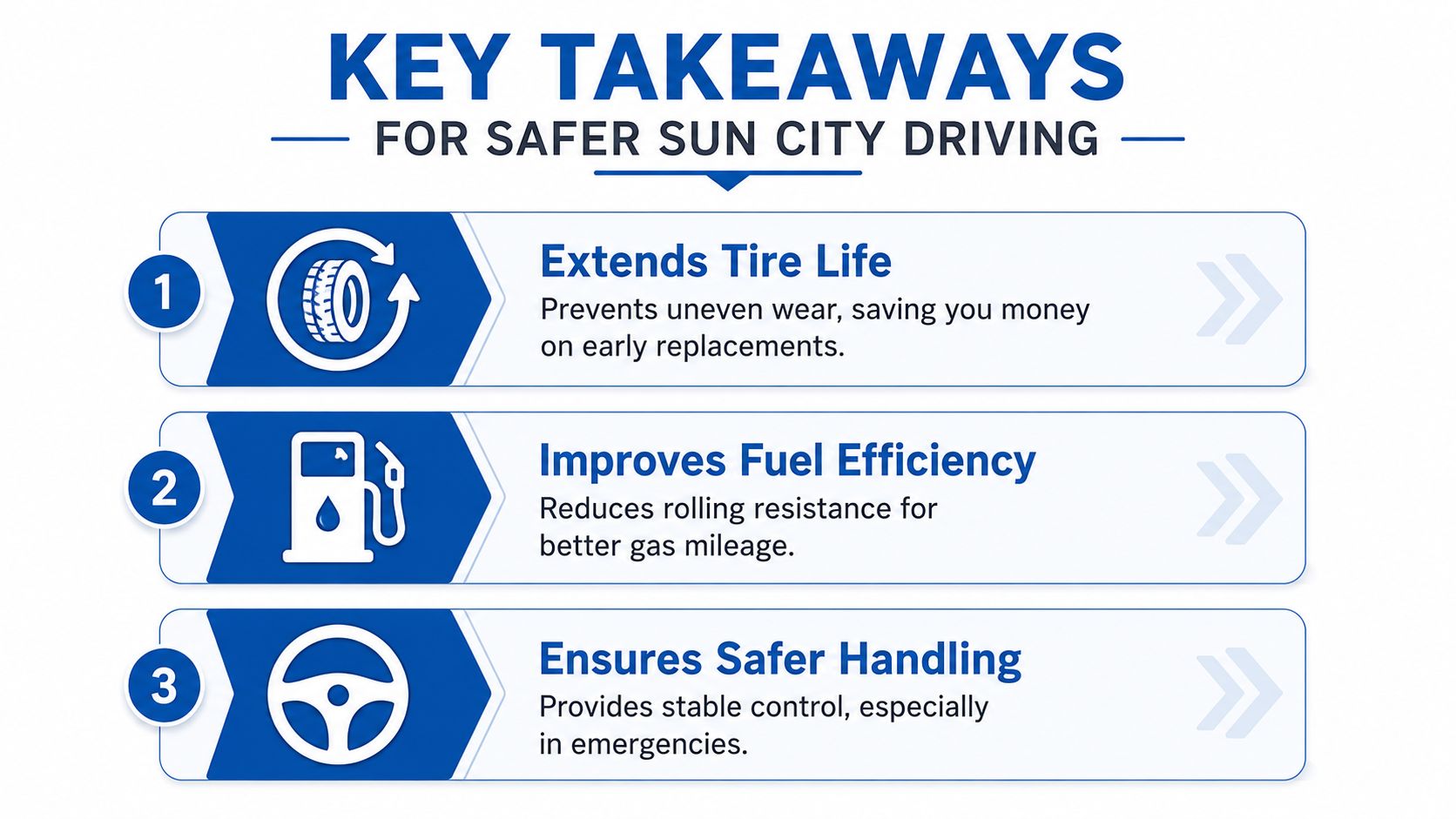
A vehicle that pulls after a curb strike or feels unsettled over a monsoon-damaged road may be signaling more than tire wear. Wheel alignment connects tire contact, rolling resistance, steering control, and the mechanical foundation used by driver-assistance systems.
Correct geometry helps the tires meet the pavement evenly, so the tread you already paid for wears more consistently. It also reduces sideways scrubbing. That can lower unnecessary resistance and help control fuel costs, making alignment part of operating-cost planning rather than a tire-only repair.
Handling is the safety concern. A properly aligned vehicle tracks more predictably, responds more consistently, and gives ADAS features a sound mechanical starting point. Alignment cannot replace calibration or repair, but incorrect wheel angles can complicate how the vehicle drives and how those systems support the driver. EPA alignment findings
Monsoon potholes, faded lane markings on Bell Road, and curb strikes in shopping-center parking lots are practical reasons to check alignment before uneven wear becomes a larger bill. The Smooth Ride Special combines tire rotation and pressure checks with broader vehicle maintenance, giving Sun City drivers a practical starting point for several routine needs.
Frequently Asked Questions About Wheel Alignment
How much does a wheel alignment cost?
Pricing varies by vehicle, the type of alignment required, and whether the inspection identifies worn suspension parts. A four-wheel alignment may differ from a front-only service, and ADAS recalibration can add another consideration on vehicles that require it. Ask for a written explanation of the recommended service before authorizing repairs.
What are the most common signs of bad alignment?
Watch for uneven tire wear, a steering wheel that sits off-center, pulling to one side, or vague wandering at highway speeds. Squealing during turns and frequent steering corrections also deserve an inspection, although worn suspension components can produce similar symptoms.
How often should I get a wheel alignment?
Use 12 months or 12,000 miles, whichever comes first, as a practical baseline, then schedule an earlier check after a pothole, curb strike, new pulling, suspension repair, or tire installation. Drivers who regularly travel rough roads may need to respond to symptoms rather than wait for the calendar.
Do new tires need an alignment check?
Yes. New tires should be installed on a vehicle whose geometry has been checked, because misalignment can make the fresh tread wear unevenly from the beginning. Tire balancing is a separate service that addresses shake and vibration, while alignment addresses wheel angles and tracking.
Pete Nelson Automotive can inspect your tires, suspension, steering geometry, and alignment needs for Sun City and West Valley driving. Visit Pete Nelson Automotive to schedule service, or call 623-974-4723 and ask about an alignment check or the Smooth Ride Special. Call 623-974-4723 or visit petenelsonautorepair.com to schedule your appointment today.
Pete Nelson Automotive
This Offer Will Expire 12-31-2026
Pete Nelson Automotive is pleased to offer you
"Get Ready for the Holidays"
A $215.00 Value for Only $159.95 (+tax)
Lube, Oil, & Filter Change, Up to 5 quarts of Engine oil
Inspect and top off all fluid levels, Includes up to 5 Quarts of 5w30 synthetic blend oil, additional charge for synthetic oil.
Travel Evaluation
Set Air Pressures and Tire Rotation if needed.
Battery, Alternator and Starter Electrical Test
Load test battery, Alternator output and Starting amps.
Full Brake Evaluation
Includes check brake system on four wheels, checking and testing brake fluid condition.
So Call 623-974-4723 today and make an appointment for this exclusive Special!
*Most Cars, Vans, Motor homes, 4×4’s, Diesels, and some foreign cars may be higher. You must bring this letter at time of service and allow 2 hours to complete.



