
You’re trying to merge onto Grand Avenue, but when you press the gas pedal, your car hesitates. Instead of a smooth, confident burst of speed, you get a frustrating sputter or a sluggish pull that feels like you’re driving through mud. These car acceleration problems are more than just an annoyance; they’re a clear signal from your vehicle that something isn’t right under the hood, and a major safety concern in Sun City traffic.
When your car won’t accelerate properly, it’s usually telling you there’s an issue with one of three critical systems: how it gets fuel, how it breathes air, or how it creates a spark. Let’s break down what could be happening and why it’s so important to get it checked out.
Why Your Car Struggles to Accelerate
You expect your car to go when you hit the gas, but a lack of power can be unsettling and dangerous. When your vehicle hesitates or struggles to get up to speed, it’s telling you that a critical system needs help. The problem almost always boils down to an imbalance in the engine’s fundamental recipe for creating power.
Think of your engine like a high-performance athlete. To perform at its peak, it needs the right amount of fuel and air, ignited at the perfect moment by a spark. If any part of that combination is off, the whole system falters.
The most common reasons for poor acceleration fall into a few key categories:
- Restricted Fuel Supply: A clogged fuel filter or a dying fuel pump can literally starve your engine of the gasoline it needs to run properly.
- Insufficient Airflow: A dirty engine air filter or a bad sensor can choke the engine, preventing it from getting the oxygen required for combustion.
- Weak Ignition Spark: Old, worn-out spark plugs or failing ignition coils can’t deliver a strong enough spark to ignite the fuel-air mix, leading to misfires and a noticeable loss of power.
It’s also worth noting the difference between a true mechanical failure and driver error. While vehicle malfunctions are a real concern, extensive research shows that over 99% of unintended acceleration incidents are caused by “pedal misapplication”—in other words, accidentally hitting the gas instead of the brake. You can get more details on the findings from studies on pedal error versus mechanical failure. Here at Pete Nelson Automotive, we can run diagnostics to determine if the problem is with your vehicle, giving you the clarity and peace of mind you need.
Quick Guide to Acceleration Symptoms and Causes
To help you get a better handle on what your car might be trying to tell you, we’ve put together this quick-reference table. It connects the specific symptoms you’re feeling behind the wheel to the most likely culprits and gives you an idea of how urgently you should get it checked out.
| Symptom You Notice | Potential Cause | Urgency Level |
|---|---|---|
| Sluggishness, car feels weak when you press the gas | Clogged fuel filter or failing fuel pump | Medium |
| Sputtering or jerking during acceleration | Dirty fuel injectors or worn-out spark plugs | High |
| Car hesitates for a moment before accelerating | Faulty mass airflow (MAF) or throttle position sensor | Medium |
| Engine misfires (feels like a shudder or shake) | Bad spark plugs, ignition coils, or clogged EGR valve | High |
| Loud roaring noise, but slow acceleration | Clogged catalytic converter or exhaust system restriction | High |
This table is a great starting point, but remember that many of these symptoms can overlap. The best way to know for sure is to have a professional technician at an auto repair shop in Sun City, AZ take a look.
How Fuel System Clogs Starve Your Engine
Ever tried running a marathon while breathing through a coffee stirrer? No matter how much you want to go faster, you just can’t get enough air. That’s a pretty good picture of what happens to your engine when its fuel system is clogged, and it’s a major cause of car acceleration problems.
For your car to accelerate with the punch you expect, it needs a steady, clean flow of fuel. If there’s a restriction anywhere along that line—from the gas tank all the way to the engine—it’s going to starve your engine of the power it needs to get moving. This is an issue we see all the time with vehicles here in the Sun City area.
Clogged Fuel Filter: The Silent Performance Thief
Think of your fuel filter as the engine’s bodyguard. It’s on the front line, trapping all the gunk—dirt, rust, and other contaminants—before they can do any real damage. But over time, typically every 20,000 to 40,000 miles, that filter gets saturated and starts to plug up.
Once that happens, your fuel pump has to work overtime just to force gasoline through the blockage. That extra effort translates directly into that sluggish, unresponsive feeling when you step on the gas. Your engine is calling for fuel, but it’s just not getting enough to answer the call. Often, a simple filter replacement is all it takes to bring that lost power right back.
A Failing Fuel Pump: The Heart of the Problem
If the filter is the bodyguard, the fuel pump is the heart of the whole operation. Its job is to pull fuel from the tank and send it to the engine under consistent pressure. When a fuel pump starts to wear out, it can’t keep that pressure steady, especially when you floor it and demand a sudden burst of power.
A weak fuel pump often gives itself away with a few key symptoms:
- Sputtering at high speeds: Your car might feel like it’s gasping for air or “choking” when you’re cruising on the highway.
- Engine surges: You might feel the vehicle lurch forward unexpectedly as the pump manages to deliver a quick burst of fuel.
- Difficulty starting: A weak pump just doesn’t have the oomph to prime the engine with enough fuel to start reliably.
Here at Pete Nelson Automotive, we frequently trace unpredictable acceleration issues back to a failing fuel pump. A professional pressure test is a quick and definitive way to see if the pump is delivering the rock-solid fuel flow your engine depends on.
Dirty Fuel Injectors: An Unbalanced Spray
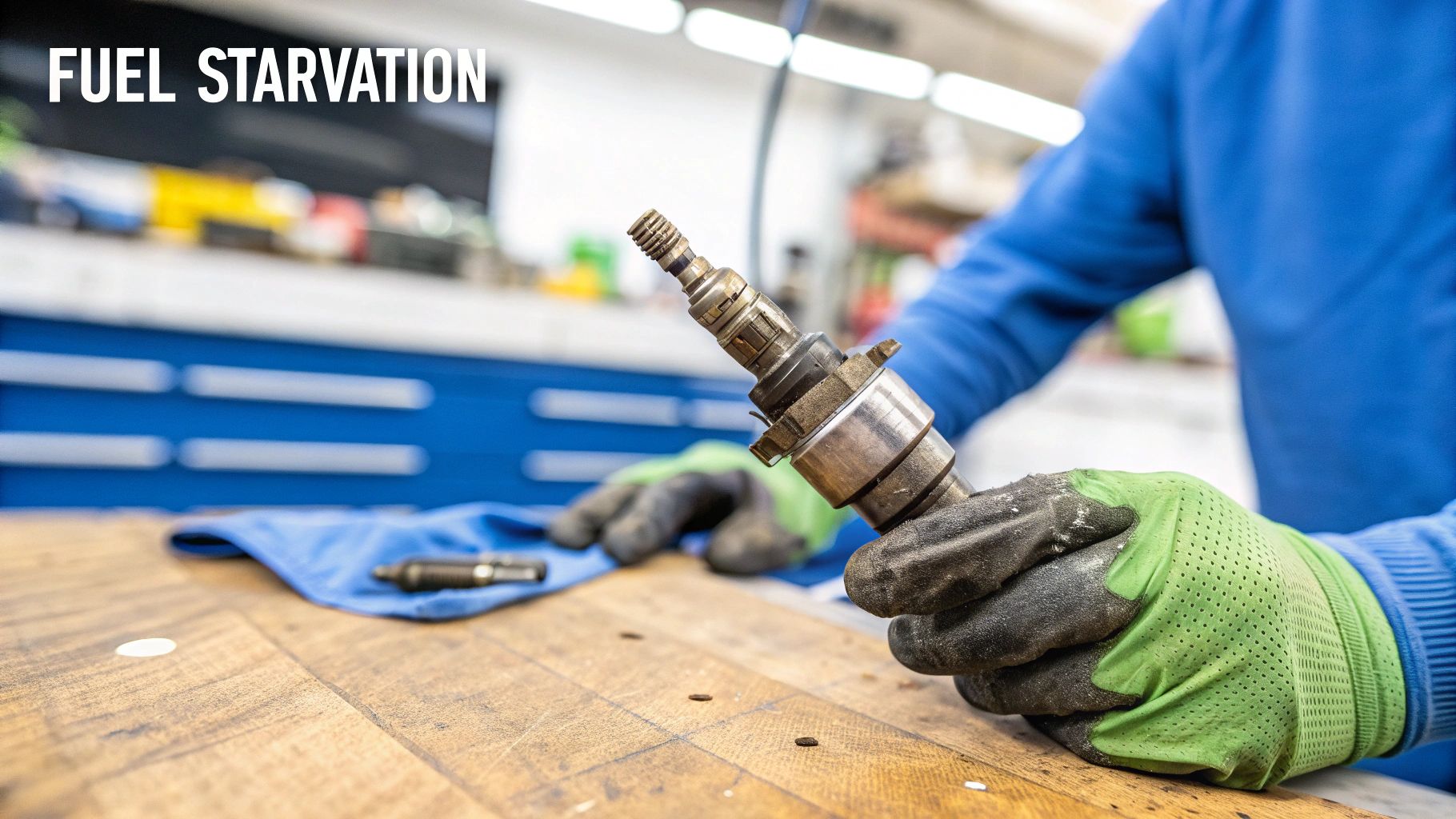
The fuel injectors are the last stop on the fuel’s journey. These are tiny, high-tech nozzles that spray a perfectly fine, cone-shaped mist of fuel into each cylinder for combustion. But after thousands of miles, nasty carbon deposits can build up on the injector tips, messing up that perfect spray pattern.
Instead of a fine mist, you might get a weak dribble or an uneven stream. This “poor atomization” leads to an inefficient burn in the cylinder, which you’ll feel as engine hesitation, misfires, and a general lack of get-up-and-go when you accelerate. Keeping these little guys clean is crucial for performance. You can learn more about how a professional fuel system cleaning can get your engine breathing easy again.
The Importance of Airflow and Ignition Spark
While getting clean fuel to the engine is a big deal, it’s only one piece of the puzzle. To get that powerful, smooth acceleration you expect, your engine needs two other things just as badly: a huge gulp of clean air and a perfectly timed, high-energy spark. If either one is off, your engine can’t create the controlled explosions that get you moving, leaving you with frustrating car acceleration problems.
Think of it like an athlete trying to sprint. It doesn’t matter how much energy they have if they can’t breathe properly. Your engine is the same way. This is exactly what happens when the airflow or ignition systems aren’t working right—a common problem we see with cars coming into our shop here in Sun City, AZ.
When Your Engine Can’t Breathe
Just like us, your engine needs to inhale clean air to function. The engine air filter is its first line of defense, catching all the dust, pollen, and road grime that’s constantly kicked up on Arizona roads. Over time, that filter gets clogged, and it literally starts to suffocate your engine.
When the airflow is choked off, the engine’s computer tries its best to adjust, but it can’t fix a physical blockage. This imbalance causes the engine to run “rich,” which is just a mechanic’s way of saying it has too much fuel and not enough air. The result is sluggish performance, worse gas mileage, and that weak, hesitant feeling when you step on the gas.
The Role of the Mass Airflow Sensor
Working hand-in-hand with the air filter is the mass airflow (MAF) sensor. This is a sensitive little device that acts like the engine’s lungs, measuring the exact volume of air coming in. It relays that info to the car’s computer, which then decides precisely how much fuel to inject for the perfect burn.
But if the MAF sensor gets dirty—usually from tiny particles that sneak past an old air filter—it starts sending bad data. Now your car’s computer is making decisions based on wrong information, injecting the wrong amount of fuel. That confusion is a direct cause of hesitation, stalling, and jerky acceleration.
A Weak Spark Leads to Misfires
Once you have that perfect mix of air and fuel ready in the cylinder, you need a powerful spark to set it off. That’s the spark plug’s job. But after tens of thousands of miles, the electrodes on the spark plugs wear down, creating a wider gap for the spark to jump across.
A worn-out plug delivers a weak, inconsistent spark that can’t fully ignite the mixture. We call this a misfire, and you’ll feel it as a noticeable shudder, jerk, or stumble when you’re trying to accelerate. Making sure your ignition system is in top shape is a huge part of our routine maintenance. You can learn more about why that matters in our guide on the importance of regular engine tune-ups.
A single worn-out spark plug can reduce your vehicle’s fuel efficiency by up to 30%. Replacing them on schedule not only restores power but also saves you money at the pump.
Silent Performance Killers in Your Exhaust System
An engine is a lot like a person—it needs to breathe in and out to do its job. We talk a lot about the importance of clean air and fuel getting in, but your engine’s ability to “exhale” is just as critical for strong, smooth acceleration. When the exhaust system gets blocked, your engine can’t push out spent gases efficiently. This creates a backup that literally chokes performance and leads to some serious car acceleration problems.
This “exhaust backpressure” is like trying to run a marathon while only being able to breathe out through a tiny straw. It forces the engine to work much, much harder just to clear the exhaust, quietly robbing your car of its power over time.
The Clogged Catalytic Converter
One of the most common culprits behind a blocked exhaust is the catalytic converter. Its entire job is to take harmful pollutants from your engine and convert them into less dangerous gases. But after thousands of miles, its internal honeycomb structure can break down or get completely clogged with carbon buildup, especially if other problems like engine misfires have been ignored.
When the catalytic converter is plugged up, you’ll start to notice a few classic symptoms:
- A major loss of power that seems to get worse the longer you drive.
- The engine feels incredibly sluggish, especially when you’re trying to climb a hill or merge onto the freeway.
- A distinct “rotten egg” smell wafting from the exhaust pipe.
Faulty Oxygen Sensors
Another key player in this system is the oxygen (O2) sensor. Think of it as your engine’s nose, constantly sniffing the exhaust fumes to check how much unburned oxygen is left over. It reports this information back to the car’s computer, which then fine-tunes the air-fuel mixture for the best possible performance and efficiency.
But when an O2 sensor goes bad, it starts sending faulty reports. The computer might think the engine is running too lean (not enough fuel) or too rich (too much fuel) and will overcorrect based on this bad intel. This mix-up often leads directly to:
- Lousy fuel economy.
- Spark plugs getting fouled up.
- The same hesitation and sluggish acceleration you’re trying to fix.
An exhaust system problem can feel a lot like other engine issues, which is why a professional diagnosis is so important. For example, a leaky header gasket can throw off sensor readings and hurt performance, too. Check out our guide on what to look for with a header gasket leak to learn more.
It’s also worth noting that other, non-exhaust factors can sometimes lead to acceleration issues. The famous Toyota crisis is a prime example, where a tragic 2009 accident ultimately led to recalls for nearly 10 million vehicles worldwide, mostly due to issues like pedals getting trapped by floor mats. You can read more about the history of these sudden unintended acceleration incidents.
When Transmission Problems Affect Acceleration
Sometimes, the issue isn’t that your engine is failing to make power—it’s that it’s failing to deliver that power to the wheels. Your transmission is the critical link between the engine and the road, and when it starts to go, it can feel exactly like an engine problem. It’s a different side of the same frustrating coin.
The transmission’s job is to manage the engine’s power and get you up to speed. When it’s struggling, you’ll feel it immediately.
What Slipping Gears Feel Like
One of the most common and unnerving transmission symptoms is a “slipping” gear. You’ll step on the gas, the engine will roar and the RPMs will shoot up, but your car barely gains any speed. It feels like a total disconnect, as if the engine is just spinning its wheels in neutral for a second before the gear finally catches.
This is a classic sign of internal wear and tear. It’s not just an annoyance; it’s a major safety hazard when you need to merge into traffic or pull out from a stop.
Arizona Heat and Transmission Fluid
Living here in Sun City, AZ, the intense heat puts a ton of stress on every part of your car, especially the fluids. Transmission fluid is no exception. Its job is to cool, lubricate, and create the hydraulic pressure needed to shift gears smoothly.
Under the strain of our constant high temperatures, transmission fluid breaks down way faster. Old, degraded, or low fluid just can’t do its job, leading to hard shifts, hesitation, and that dreaded slipping feeling when you try to accelerate.
Because of this, regular fluid checks aren’t just recommended—they’re a critical part of preventive maintenance for any Arizona driver. Catching low or dirty fluid early can stop catastrophic damage in its tracks and keep your transmission shifting the way it should.
Modern Electronic Glitches
Today’s vehicles rely on a sophisticated computer called the Transmission Control Module (TCM) to manage everything. This electronic brain uses data from sensors all over the car to make split-second shifting decisions for the best performance. But just like any computer, it can glitch out.
A faulty sensor or a failing TCM can send the wrong signals, causing your transmission to act erratically. This might show up as:
- Unpredictable, delayed shifts.
- Getting stuck in one gear.
- Sluggish, totally unresponsive acceleration.
These electronic gremlins can be a real headache to diagnose without the right tools. If you’re dealing with symptoms like these, you can learn more about the signs that your transmission is failing in our detailed guide.
Get Expert Diagnostics at Pete Nelson Automotive

While it’s great to understand what could be causing your car’s poor acceleration, pinpointing the exact problem requires specialized tools and years of hands-on experience. A simple hesitation could point to a dozen different parts, and throwing new parts at the problem hoping one will stick gets expensive fast.
That’s where professional diagnostics make all the difference. We bridge the gap between knowing something is wrong and getting it fixed correctly the first time. If you’re dealing with car acceleration problems, some warning signs are too serious to ignore.
When to See a Professional Immediately
Don’t wait to schedule a service if you notice any of these symptoms. They often signal a serious safety or performance issue that needs immediate attention from a professional auto repair shop in Sun City, AZ.
- Flashing Check Engine Light: This isn’t just a friendly suggestion; it’s a critical warning. A flashing light means your engine has a severe misfire that could quickly destroy expensive parts, like your catalytic converter.
- Grinding or Clunking Noises: Any strange, harsh sounds you hear when you accelerate often point to major mechanical trouble, like internal problems with the transmission or differential.
- A Smell of Rotten Eggs: That distinct, sulfur-like smell is the classic sign of a failing catalytic converter that’s dangerously overheating.
At Pete Nelson Automotive, our ASE-certified technicians don’t guess. We take a systematic approach, using advanced equipment to get clear, accurate answers. Getting to the root of your acceleration issue is an in-depth investigation, not just a quick look under the hood.
Our team uses sophisticated scan tools to perform advanced computer diagnostics, reading the specific fault codes stored in your vehicle’s onboard computer. These codes act like a roadmap, pointing us directly to the affected system. From there, we perform hands-on tests—like checking fuel pressure, inspecting ignition components, or testing sensors—to confirm the exact cause.
This detailed process ensures we can give you a clear, honest repair plan that restores your car’s performance and your peace of mind.
Frequently Asked Questions About Car Acceleration Problems
Can a simple oil change fix acceleration problems?
While regular maintenance is key, a standard oil change in Sun City, AZ alone won’t usually fix a sluggish car. Poor acceleration is almost always caused by a problem in the fuel, air, or ignition systems. However, an engine that is critically low on oil will perform poorly and can lead to severe damage, so keeping up with oil changes is your best defense against bigger problems.
Why does my car hesitate when accelerating from a stop?
That frustrating delay often points to a problem with fuel delivery or sensor readings. Common culprits include a clogged fuel filter, a dirty mass airflow (MAF) sensor, or old spark plugs that aren’t creating a strong enough spark. Since these issues have similar symptoms, a professional diagnosis is the best way to avoid replacing parts you don’t need.
Is it safe to drive with slow acceleration?
Frankly, it can be dangerous. A car that can’t get up to speed reliably is a serious safety risk, especially when you need to merge onto a busy road like Grand Avenue or pull into fast-moving traffic. We always recommend getting the issue checked by a professional as soon as you notice a problem to ensure your safety and the safety of others.
How much does it cost to fix acceleration problems?
The cost depends entirely on the root cause. A simple fix, like replacing a clogged engine air filter, is very inexpensive. On the other hand, a failing catalytic converter or a major transmission issue can be a significant repair. That’s why we always start with an accurate diagnosis at Pete Nelson Automotive, so we can give you a clear, transparent estimate before any work begins.
Beyond the immediate fix for acceleration issues, you might also be wondering about the long-term impact on your vehicle, including factors like how much your car is worth. Persistent mechanical problems can certainly affect a vehicle’s value over time.
Don’t let a sluggish car compromise your safety or your peace of mind. The expert team at Pete Nelson Automotive is here to deliver the accurate diagnostics and honest repairs you deserve.
Call 623-974-4723 or visit petenelsonautorepair.com to schedule your appointment today.
Pete Nelson Automotive
This Offer Will Expire 12-31-2026
Pete Nelson Automotive is pleased to offer you
"Get Ready for the Holidays"
A $215.00 Value for Only $159.95 (+tax)
Lube, Oil, & Filter Change, Up to 5 quarts of Engine oil
Inspect and top off all fluid levels, Includes up to 5 Quarts of 5w30 synthetic blend oil, additional charge for synthetic oil.
Travel Evaluation
Set Air Pressures and Tire Rotation if needed.
Battery, Alternator and Starter Electrical Test
Load test battery, Alternator output and Starting amps.
Full Brake Evaluation
Includes check brake system on four wheels, checking and testing brake fluid condition.
So Call 623-974-4723 today and make an appointment for this exclusive Special!
*Most Cars, Vans, Motor homes, 4×4’s, Diesels, and some foreign cars may be higher. You must bring this letter at time of service and allow 2 hours to complete.



