Driving through Sun City should be a relaxing experience, but what do you do when you press the brake pedal and hear a horrible, scraping grind? That sound isn’t just annoying—it’s your car’s most urgent warning signal, a clear sign that a critical safety system is failing. It’s more than a simple noise; it’s a problem that demands immediate attention to keep you and others safe on Arizona roads.
Ignoring this metal-on-metal sound is not an option. It means your brake pads are likely worn down to nothing, and with every stop, you’re causing more damage and seriously compromising your ability to brake safely.
Your Guide to That Unmistakable Grinding Sound
Picture this: you’re cruising down Bell Road and approach a red light. You press the brake pedal, but instead of a smooth, quiet stop, your car lets out a gut-wrenching metallic grinding noise. It’s a sound that makes your heart sink because you know something is very, very wrong.
That grinding is a direct cry for help from your braking system. In nearly every case, it means key components have worn down to a dangerous level. Let’s break down what that noise really means and what you need to do about it.
What That Grinding Noise Really Means
Your brake system is designed with built-in warnings. The first is a high-pitched squeal, which comes from a small metal tab called a wear indicator. That squeal is the early alert, letting you know your brake pads are getting low. The grinding noise you’re hearing now? That means you’ve completely ignored or missed the initial warning and have worn through all the protective friction material.
What’s happening now is that the brake pad’s metal backing plate is grinding directly against the metal brake rotor. This is just as bad as it sounds, and it’s incredibly unsafe.
This metal-on-metal contact seriously cripples your car’s ability to stop. Your stopping distance gets much longer, putting you, your passengers, and everyone else on the road in danger.
Before we dive deeper, here’s a quick cheat sheet to help you make sense of what your brakes might be telling you.
Quick Guide: What Your Brake Noises Mean
Use this list to quickly identify the potential issue based on the sound your brakes are making. As you’ll see, a grinding noise requires immediate, professional attention.
- High-Pitched Squeal: Your brake pads are getting low (this is the wear indicator doing its job).
- Action: Schedule a brake inspection soon.
- Loud Squeaking: This could be due to low-quality pads, glazing from heat, or moisture.
- Action: Have your pads checked, but it’s less urgent than a squeal.
- Clicking or Clunking: You may have a loose caliper or worn-out hardware.
- Action: Get it inspected right away to prevent further damage.
- Grinding or Scraping: CRITICAL! Your brake pads are completely gone, causing metal-on-metal contact.
- Action: Stop driving and call for professional help immediately.
As you can see, a grinding sound is in a category of its own. It’s an emergency alert from your car that you simply can’t afford to ignore.
Common Culprits Behind the Noise
While completely worn-out brake pads are the number one offender, a few other issues can cause a similar grinding or scraping sound. Knowing the possibilities helps you have a more informed conversation with your mechanic.
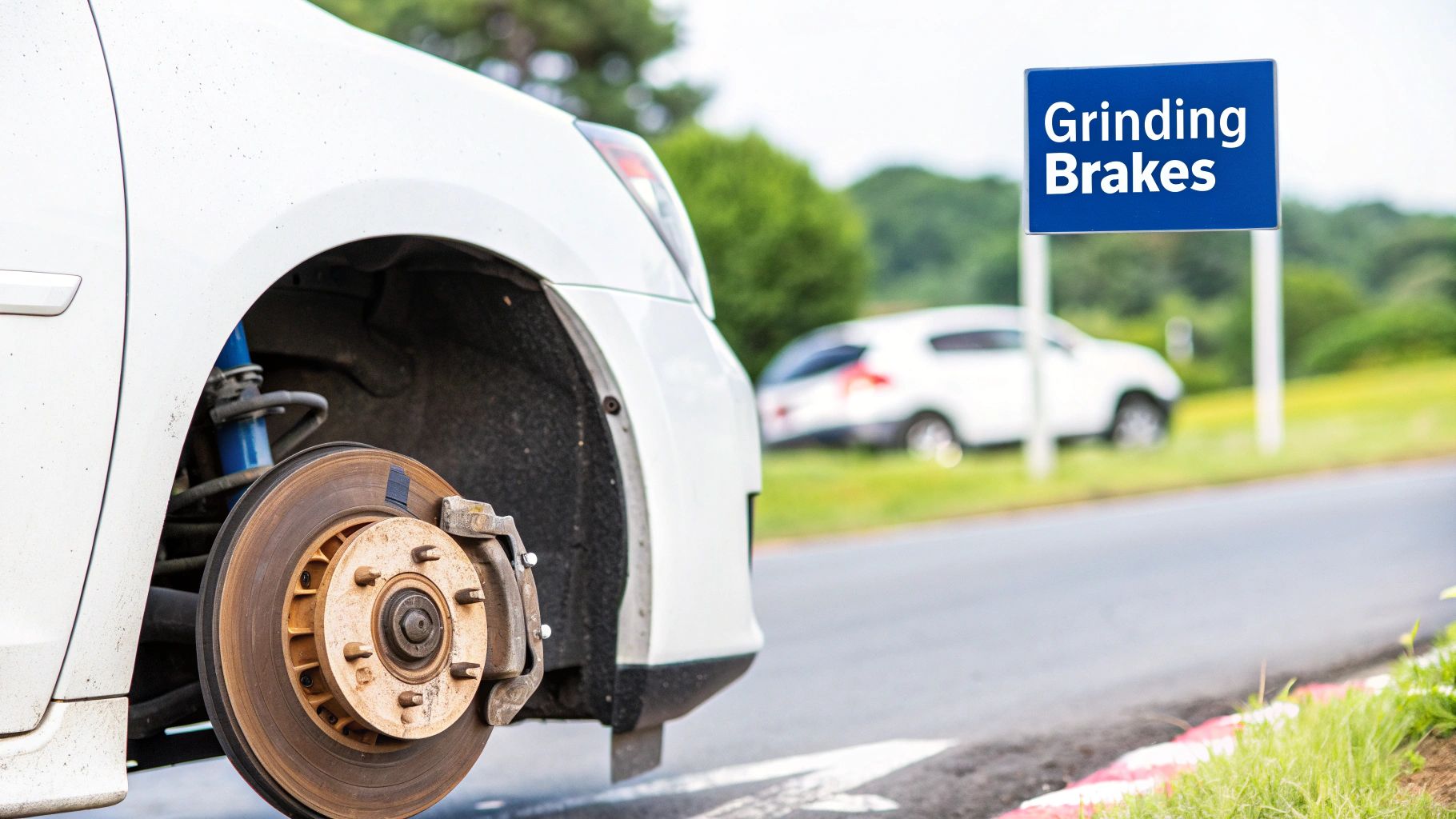
- Completely Worn-Out Brake Pads: This is the big one. The protective friction material has been completely ground away, leaving metal to scrape against metal.
- Damaged or Warped Rotors: If your rotors are uneven, have deep grooves, or are severely rusted, they can create a grinding feel as the pads struggle to grab a smooth surface.
- Debris Stuck in the Caliper: It happens more than you’d think. A small rock or some other road debris can get wedged between the brake pad and rotor, causing a sudden and very loud scraping noise.
- Faulty Caliper Hardware: The caliper is the part that squeezes the pads against the rotor. If it seizes up or its guide pins get stuck, it can cause uneven pressure and lead to grinding.
This guide is meant to replace that feeling of panic with a clear plan. By understanding what’s wrong, you can take the right steps to fix it. If you’re hearing that dreaded grind, getting a professional brake repair in Sun City is the only safe move.
Why Your Brakes Are Grinding: A Deeper Look
To get to the bottom of that awful grinding noise, you have to understand what’s happening inside your wheels. Think of your brake pad’s wear indicator—that high-pitched squeal you might have heard earlier—as the first chirp from a smoke alarm. It’s an early warning. A grinding noise? That’s the full-blown alarm signaling immediate danger.
This section breaks down the four most common culprits behind that sound. Once you know the source, you’ll understand just how serious this is and why quick action is the only safe option on Sun City roads.
Cause 1: Worn-Out Brake Pads
This is, by a long shot, the most frequent reason for a grinding noise when braking. Your brake pads have a thick layer of friction material designed to press against the metal brake rotor (or disc) and slow your car down. Every time you brake, a tiny bit of that material wears away.
Once it’s completely gone, the bare metal backing plate of the pad starts grinding directly against the metal rotor. That harsh, scraping sound you’re hearing isn’t just a noise—it’s the sound of your brake system actively destroying itself with every stop.
The second you hear that metal-on-metal grinding, your car’s ability to stop is severely compromised. Continuing to drive is a huge safety risk, as your braking power becomes unpredictable and dangerously weak.
A grinding noise is a red flag for worn brake pads. Industry data shows brake pads typically last between 30,000 and 70,000 miles, though this can change a lot depending on your driving habits. In the U.S. alone, brake-related work makes up a massive 15% of all vehicle maintenance, and grinding noises are one of the top complaints that bring people into the shop. Ignoring the grind can lead to severe rotor damage, pushing repair costs up by three to five times compared to a simple pad replacement. You can learn more about brake wear indicators in this technical overview.
Cause 2: Damaged or Warped Brake Rotors
Your brake rotors are the large metal discs that the pads clamp onto. For your brakes to work right, these discs need to have a perfectly smooth, flat surface. Over time, though, rotors can get damaged in a few different ways.
- Deep Grooves: If you put off replacing your pads for too long, the metal rivets or the backing plate can carve deep grooves into the rotor’s surface.
- Warping: Intense heat from heavy braking—like driving down a long hill—can cause the metal of the rotor to distort, or “warp,” creating an uneven surface.
- Corrosion: Here in Arizona, rust isn’t as big of a problem as in other places, but it can still happen, especially if a car sits for a long time. Bad rust can create pits on the rotor’s surface.
When pads press against a damaged rotor, that uneven contact creates a grinding sound or a pulsing feeling in the brake pedal. Even if you put on brand-new pads, a damaged rotor will prevent smooth, safe braking. This is just one of the issues we cover in our guide to the top 5 most common brake problems and solutions.
Cause 3: Debris Trapped in the Caliper
Sometimes, the problem isn’t a worn-out part but a foreign object that’s gotten stuck. It’s surprisingly easy for a small rock, gravel, or other road debris to get kicked up and wedge itself between the brake pad and the rotor.
This creates an immediate and often very loud grinding or scraping sound that can be pretty startling. Unlike the grind from worn pads, this noise might come and go, and it can start suddenly even if your brakes are in great shape. While the fix might be as simple as getting the object out, it still needs a professional to take a look and make sure no other parts were damaged in the process.
Cause 4: Faulty Caliper Hardware
The brake caliper is the hydraulic clamp that holds the brake pads and squeezes them against the rotor. For it to work properly, it needs to slide freely on a set of guide pins.
If these pins get rusty or lose their lubrication, the caliper can get stuck.
What happens when a caliper gets stuck?
- Uneven Pad Wear: The caliper might not release its grip, causing one pad to drag constantly against the rotor. This wears that one pad down incredibly fast.
- Overheating: The constant friction creates a massive amount of heat, which can damage the rotor and even boil the brake fluid, leading to total brake failure.
- Grinding Noise: A stuck caliper can force the pad against the rotor at an odd angle, causing a grinding sound as the parts bind up.
A faulty caliper is a serious mechanical failure. It needs immediate attention from a trusted shop that provides expert auto repair in Sun City AZ. If you ignore it, you could lose all braking power on that wheel.
Is It Safe to Drive with Grinding Brakes?
This is the most important question we get, and the answer is a firm, unequivocal no. Hearing a grinding noise when you brake isn’t just a sign of a future problem; it’s a critical alert that your car’s safety is already compromised. Driving with grinding brakes is a huge gamble with your safety and the safety of others on the road.
Continuing to drive is like trying to walk on a fractured ankle. Sure, you might be able to hobble a short distance, but you’re actively making the injury worse and risking a total collapse. It’s crucial to understand why this is so dangerous.
The Dangers of Driving with a Brake Grind
The moment you hear that awful metal-on-metal sound, your braking system is already in a state of failure. The friction material on your brake pads is completely gone, which means the bare metal backing plate is now scraping directly against your metal brake rotors. This creates three immediate and severe risks.
- Severely Reduced Stopping Power: Your brakes work by creating friction. Without the proper pad material, that friction is drastically reduced. Your stopping distance will increase in a big way, meaning you might not be able to stop in time to avoid a collision—especially with the sudden traffic changes we see on roads like Bell Road.
- Potential for Catastrophic Brake Failure: That constant metal-on-metal grinding generates extreme heat, far more than your brake system is designed to handle. This can cause your brake fluid to boil, creating air bubbles in the lines and leading to a spongy pedal or even a total loss of hydraulic pressure. A failure like this means your brake pedal could go straight to the floor with no effect at all.
- Guaranteed Expensive Damage: Every single time you press that grinding brake pedal, you are actively destroying parts. The metal backing plate carves deep grooves into the rotors, often damaging them beyond repair. This intense friction and heat can also wreck the brake caliper, turning what should have been a straightforward brake pad job into a much more complex and costly full system repair.
What to Do If You’re on the Road
If the grinding starts while you’re already driving, your top priority is to get off the road as safely and quickly as you can. The goal is to move the vehicle the shortest distance possible to a safe location or, if it’s very close, directly to our Sun City shop.
Your immediate objective is to minimize brake use. The less you press that pedal, the better. Your car is no longer safe for normal driving, so treat this as an emergency situation.
If you absolutely have to move the vehicle a short distance, follow these critical safety steps:
- Drive Extremely Slowly: Keep your speed as low as you can to give yourself the maximum amount of reaction time.
- Create a Large Following Distance: Leave several car lengths between you and the vehicle ahead. This allows you to coast to a stop instead of using the compromised brakes.
- Use Your Hazard Lights: Let other drivers know you’re dealing with a mechanical problem.
- Avoid Sudden Braking: Look far ahead, anticipate stops, and slow down gradually by taking your foot off the gas early. Do not slam on the brakes unless it’s an absolute emergency.
Sometimes, a grinding sound can also be tied to other system failures, like a loss of brake fluid. A sudden change in how the pedal feels, combined with a noise, is a major red flag. You can learn more about how to spot a brake fluid leak in our detailed guide. If you suspect any kind of leak, pull over immediately and call for a tow. It is simply not worth the risk.
How We Diagnose and Fix Grinding Brakes in Sun City
Hearing that awful, metallic grinding sound when you hit the brakes is more than just unsettling—it’s a clear sign your car needs immediate attention. But knowing what happens next can bring some peace of mind. Here at Pete Nelson Automotive, we believe in being completely upfront. We want to pull back the curtain on our professional repair process so you know exactly what to expect when you bring your vehicle to our Sun City shop.
Our entire approach is built on a methodical, step-by-step diagnosis. There’s absolutely no room for guesswork in brake repair; your safety hinges on precision and real-world experience.
Our Comprehensive Brake System Inspection
When you bring your car in, our ASE-certified technicians don’t just glance at the part making the noise. We perform a complete inspection of the entire braking system to pinpoint the root cause and any related issues that might be hiding. This isn’t an add-on service; it’s our standard procedure for every single brake concern.
Our detailed inspection includes checking:
- Brake Pads: We’ll measure the thickness of your brake pads to confirm if they’re worn down to the metal backing plate—the most common source of grinding.
- Brake Rotors: We carefully examine the rotors for deep grooves, scoring, hotspots, or warping caused by that metal-on-metal friction.
- Calipers and Hardware: We make sure the calipers can move freely and aren’t seized up, and we’ll check the condition of all the slide pins and mounting hardware that hold everything together.
- Brake Lines and Hoses: Our team looks for any signs of leaks, cracks, or corrosion that could compromise the hydraulic system and your ability to stop.
- Brake Fluid: We check the fluid level and its condition. Old, contaminated fluid doesn’t just hurt performance; it can damage other expensive components.
This thorough evaluation ensures we fix the problem correctly the first time, giving you confidence that your vehicle is safe to be back on the road.
Identifying Less Obvious Causes of Grinding
While worn-out pads are the usual suspect, that grinding noise can sometimes stem from less obvious issues. For example, vibrations can travel through a vehicle’s frame, making a noise sound like it’s coming from the brakes when the real source is somewhere else entirely.
Our technicians’ deep experience allows them to consider all possibilities. We’re not just here to treat a symptom—we’re here to find and fix the underlying problem for good.
Common Repair Paths Explained
Once we’ve finished our diagnosis, we’ll sit down and explain our findings in plain English. The right fix depends entirely on what we find.
Our Promise: We will never recommend a service you don’t need. We’ll show you exactly what we found and clearly explain your options, so you can make an informed decision about your vehicle.
Here are the most common repair scenarios we see for a grinding brake issue:
- Brake Pad and Rotor Replacement: This is the most frequent outcome. Because grinding means metal is scraping against metal, the rotors are almost always damaged beyond safe use. Installing fresh pads and new rotors together is the only way to restore your braking system to factory-spec for maximum safety and performance.
- Rotor Resurfacing vs. Replacement: In very rare cases, if the grinding was caught the moment it started and rotor damage is minimal, resurfacing (or “machining”) might be an option. This process shaves a thin layer off the rotor to create a smooth surface again. However, for the safety of our Sun City customers, we almost always recommend replacement if grinding has occurred. Rotors have a minimum safe thickness, and we won’t compromise on that. We can help you understand more about brake pad vs. rotor replacement in Sun City so you can see why this is so critical.
- Caliper Repair or Replacement: If our inspection reveals a seized caliper, that has to be addressed. A stuck caliper will immediately destroy your new pads and rotors. The fix might be as simple as cleaning and lubricating the slide pins or, if the caliper piston itself is damaged, replacing the whole unit.
At Pete Nelson Automotive, our goal is to take the mystery out of auto repair. By walking you through our diagnostic methods and explaining the necessary repairs, we build the trust and confidence you deserve from your local experts.
Proactive Brake Care to Prevent Future Problems
Hearing a grinding sound from your brakes is a terrible feeling, but the best repair is always the one you never have to make in the first place. Adopting a proactive mindset toward brake maintenance is the single best way to save money, avoid those nasty surprise repair bills, and keep your vehicle safe for every trip around Sun City.
Think of it like preventative medicine for your car. A little attention now goes a long way in preventing that dreaded metal-on-metal scream later on. It’s all about making brake care a regular part of your car’s health routine, not just a reaction to a problem.
Schedule Regular Brake Inspections
The most effective way to sidestep major brake issues is to have them inspected regularly by a professional. Catching wear and tear early is the difference between a simple, affordable fix and a costly, complex repair that leaves you without a car.
We recommend a complete brake system check-up at least once a year or every 12,000 miles. During this service, our ASE-certified technicians will measure your brake pad life, check your rotor condition, inspect the calipers for proper function, and test your brake fluid.
This annual check lets us spot thinning pads long before they start to grind, making sure you replace them at just the right time. Here in Arizona, the brutal summer heat can be especially tough on brake components. You can learn more about the impact of Arizona’s heat on your brakes in our dedicated guide.
Consider Your Driving Style
How you drive has a massive impact on how long your brakes last. Not all miles are created equal, and understanding your daily driving habits can help you anticipate when your car might need service.
- City vs. Highway Driving: Stop-and-go city traffic is much harder on your brakes than cruising at a steady speed on the highway. Every stop creates friction and wears down your pads just a little bit more.
- Heavy Loads: If you frequently haul heavy cargo or tow a trailer, your brakes have to work overtime to slow down all that extra weight. This means a shorter lifespan for your pads and rotors.
- Aggressive Braking: Slamming on the brakes at the last minute generates a ton of heat and wears down brake components way faster than gentle, gradual braking.
Being mindful of these factors can help you adjust your driving to extend the life of your brakes and plan for more frequent inspections if your daily commute is a grind.
Listen for Early Warning Signs
Your brakes will almost always give you a heads-up before they start grinding. That first sign is usually a high-pitched squeal when you press the pedal.
Think of a brake squeal as the “low battery” chirp from a smoke detector. It’s an audible alert designed to get your attention before the situation becomes an emergency. The grinding sound is the full-blown alarm going off.
This squealing is caused by a tiny metal tab called a wear indicator. When your brake pads get thin, this tab makes contact with the rotor and creates that distinct, annoying noise. If you hear it, don’t ignore it—schedule an inspection. Addressing the squeal is a simple fix; ignoring it is a direct path to grinding and much more expensive damage.
Don’t Overlook Your Brake Fluid
Brake fluid is the lifeblood of your braking system. It’s a hydraulic fluid, meaning it’s what translates the force from your foot on the pedal into the power that clamps the brake pads against the rotors.
Over time, brake fluid absorbs moisture from the air. This contamination lowers its boiling point and can cause rust and corrosion inside your brake lines and calipers. Old, contaminated fluid often leads to a spongy-feeling brake pedal and less effective stopping power. We recommend a brake fluid flush every two to three years to keep the entire system healthy, clean, and responsive.
Frequently Asked Questions About Brake Noises
At Pete Nelson Automotive, we understand that strange car noises can be stressful. Here are some of the most common questions Sun City drivers ask us about their brakes, with clear, straightforward answers from our expert team.
Why do my brakes only grind sometimes?
If the grinding noise is intermittent, it could be a few things. A common cause is a small rock or piece of debris stuck between the brake pad and rotor, which might shift around and only make noise occasionally. Another possibility is a sticking brake caliper that doesn’t always release properly. In either case, it’s a sign that something isn’t right and needs a professional inspection.
How much does it cost to fix grinding brakes in Sun City?
The cost to fix grinding brakes depends entirely on the extent of the damage. Once you hear that metal-on-metal sound, it almost always means both the brake pads and rotors need to be replaced. If the problem was ignored, the calipers might be damaged too, which increases the cost. For an accurate, no-nonsense quote for your specific vehicle, bring it to our shop for a thorough inspection. You can always check our website for any current Specials that might apply.
What is the difference between brake squealing and grinding?
Think of it as a two-stage warning. A high-pitched squeal is the early alert, caused by a small metal wear indicator telling you the pads are getting low. A loud, harsh grind is the critical, final warning. It means the pad material is completely gone, and the metal backing plate is now destroying your rotor. A squeal means “schedule service soon,” while a grind means “stop driving now.”
How often should I get my brakes checked?
We recommend a comprehensive brake inspection at least once a year or every 12,000 miles. For drivers in Sun City, an inspection before the summer heat hits is also a great idea. Regular checks allow our technicians to catch worn parts early, saving you from the danger and expense of a major failure like a grinding noise when braking. If you have any questions, please feel free to Contact our friendly team.
Trust Pete Nelson Automotive for Your Brake Repair in Sun City, AZ
That awful grinding sound is your vehicle’s way of telling you it needs help from a trusted professional. The most important takeaway is this: never ignore your brakes. Listening to the early warning signs and acting quickly is the best way to ensure your safety and avoid a much larger, more expensive repair down the road.
Your brakes are the most important safety system on your car. Don’t take chances. At Pete Nelson Automotive, our ASE-certified technicians are dedicated to providing honest diagnostics and expert brake services in Sun City. We’ll find the source of that grinding noise when braking and get you back on the road with complete confidence.
Call 623-974-4723 or visit petenelsonautorepair.com to schedule your appointment today.
Pete Nelson Automotive
This Offer Will Expire 12-31-2026
Pete Nelson Automotive is pleased to offer you
"Get Ready for the Holidays"
A $215.00 Value for Only $159.95 (+tax)
Lube, Oil, & Filter Change, Up to 5 quarts of Engine oil
Inspect and top off all fluid levels, Includes up to 5 Quarts of 5w30 synthetic blend oil, additional charge for synthetic oil.
Travel Evaluation
Set Air Pressures and Tire Rotation if needed.
Battery, Alternator and Starter Electrical Test
Load test battery, Alternator output and Starting amps.
Full Brake Evaluation
Includes check brake system on four wheels, checking and testing brake fluid condition.
So Call 623-974-4723 today and make an appointment for this exclusive Special!
*Most Cars, Vans, Motor homes, 4×4’s, Diesels, and some foreign cars may be higher. You must bring this letter at time of service and allow 2 hours to complete.



