
Are you noticing your car pulling slightly to one side on the straight roads around Sun City? Or maybe you’ve heard that tire rotation is important, but you’re not sure how often it really needs to be done, especially with our punishing Arizona heat. You’re not alone—it’s one of the most common questions we hear.
Here’s the straight answer you’re looking for: you should rotate your tires every 5,000 to 7,500 miles. For most of us here in Sun City, AZ, this simple schedule lines up perfectly with a regular oil change in Sun City, AZ, which makes it incredibly easy to remember.
Sticking to this routine is the single best thing you can do to make sure your tires wear evenly, last longer, and keep you safe on our scorching local roads.
A Quick Guide to Tire Rotation Frequency
Wondering when to schedule a tire rotation can feel like a guessing game, but it’s one of the simplest and most effective maintenance tasks you can do for your vehicle.
Think of it like rotating the mattress on your bed—you do it to stop one side from getting a permanent sag. Your tires need a change of scenery for the same reason: to prevent uneven wear that cuts their life short and messes with your car’s handling.
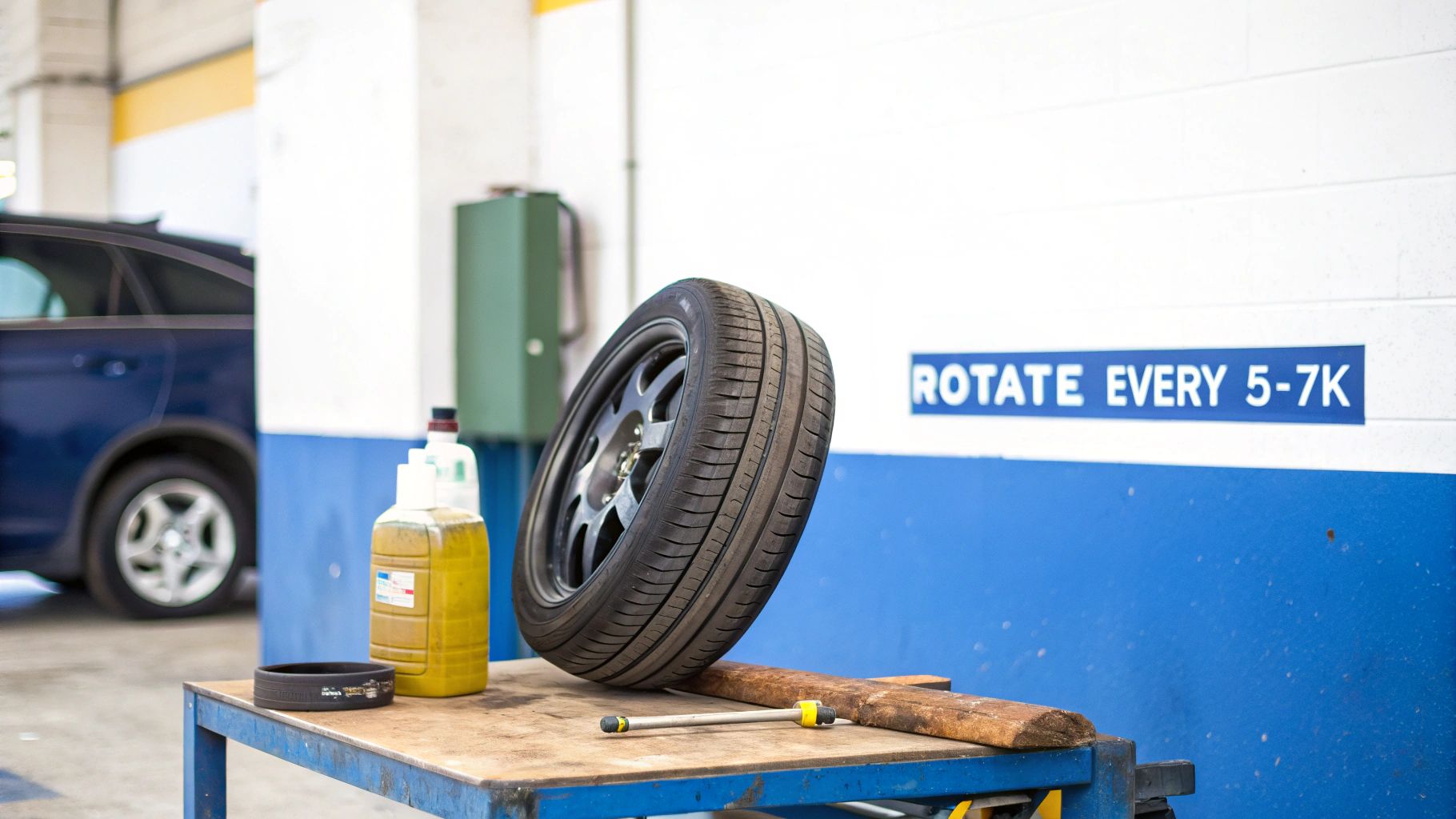
For most passenger cars, the rule of thumb is every 5,000 to 7,500 miles, which usually works out to every six to eight months. This schedule is all about balancing the wear across all four tires. This is especially true for front-wheel-drive cars, where the front tires get hammered by the forces of steering, braking, and acceleration. You can get a deeper dive into tire wear patterns at 66nissan.com.
Factors That Influence Your Rotation Schedule
While that 5,000-mile rule is a great starting point, it’s not set in stone. Your own driving habits and the type of vehicle you own play a huge role. Here are a few things that might mean you need rotations more often:
- Your Driving Style: Let’s be honest, aggressive driving with hard stops and sharp turns puts a ton of extra stress on your front tires, wearing them down much faster.
- Your Daily Commute: Regularly driving on rough or unpaved roads around the West Valley will also speed up wear and tear.
- Your Vehicle’s Drivetrain: All-wheel drive (AWD) systems, for instance, often need more frequent rotations to keep the complex drivetrain balanced and working correctly.
The goal is simple: maximize your tire investment and maintain predictable handling. By moving your tires to different positions, you give each one a chance to work under different loads, promoting uniform tread depth across the board.
For a general idea, here’s a quick look at common rotation schedules for different vehicle types.
Recommended Tire Rotation Intervals by Vehicle Type
This table provides a quick overview of suggested tire rotation schedules for different types of vehicles to help you maintain optimal tire health.
| Vehicle Type | Recommended Rotation Interval (Miles) |
|---|---|
| Front-Wheel Drive (FWD) | 5,000 – 7,500 |
| Rear-Wheel Drive (RWD) | 5,000 – 7,500 |
| All-Wheel Drive (AWD) | 3,000 – 5,000 |
| Four-Wheel Drive (4WD) | 5,000 – 7,000 |
Keep in mind that these are just guidelines. Your vehicle’s manual is always the best source for manufacturer-specific recommendations. Ultimately, the best way to know for sure is to check your owner’s manual. Or, even better, bring your car to a trusted local pro. Here at Pete Nelson Automotive, we can do a quick inspection and let you know if it’s time for a rotation.
Why Tire Rotation Is Essential for Sun City Drivers
Tire rotation is one of those maintenance items that’s easy to overlook, but it’s way more than just a routine suggestion from your mechanic. Think of it as a fundamental part of keeping your car safe and your wallet happy. Especially here in Sun City, where our roads can go from sun-baked asphalt to monsoon-slick streets in an instant, the condition of your tires is everything.
Imagine your front tires are the lead runners in a marathon. They’re doing most of the heavy lifting—carrying the engine’s weight and handling the stress of steering and braking. This means they wear down much faster than the tires in the back. Regular rotation simply swaps them, giving the front tires a much-needed break and ensuring the whole “team” wears out at an even rate.
Extend the Life of Your Tires and Save Money
The most immediate benefit you’ll notice from regular tire rotation is the money it saves you. By making sure the tread wears down evenly, you can significantly extend the life of your tires. A new set of quality tires is a major investment, and pushing off that expense for as long as possible can save you hundreds of dollars.
Even wear isn’t just about making your tires last longer—it’s about how they perform. When your tires wear uniformly, your vehicle maintains better traction and more predictable handling, which is a huge factor in staying safe on the road.
On top of that, properly maintained tires can even give your fuel efficiency a little boost. When tires are worn unevenly, it creates more rolling resistance, forcing your engine to work harder and burn more gas just to move the car forward. A simple rotation service helps keep everything running smoothly.
Improve Safety and Performance on Arizona Roads
Beyond the financial perks, the safety benefits are probably the most compelling reason to stick to a tire rotation schedule. For Sun City drivers, this is non-negotiable.
Balanced tire wear leads directly to:
- Better Grip and Traction: This is absolutely critical during our summer monsoon season. Evenly worn tires are much better at channeling water away, which dramatically reduces the risk of hydroplaning on slick roads.
- More Responsive Handling: When all four tires have similar tread depth, your car just feels more predictable. It responds exactly how you expect it to, whether you’re navigating a busy intersection or cruising down the highway.
- Shorter Braking Distances: Consistent tread means maximum contact with the pavement. In an emergency, that can be the difference between stopping safely and getting into an accident.
Our extreme Arizona heat also puts an incredible amount of stress on your tires. You can learn more about protecting your vehicle by reading our guide on how Arizona heat affects your vehicle. Investing in a simple tire rotation is one of the smartest, most proactive things you can do to make sure your car is ready for whatever our local climate throws at it. It’s a small service that delivers huge returns in safety, performance, and peace of mind.
The Science Behind Uneven Tire Wear
Ever taken a close look at your tires and noticed the front ones look a bit more haggard than the ones in the back? You’re not imagining things. There’s a good reason for it, and it comes down to a simple concept: workload.
Think of your car’s tires as a four-person team. Some members are always going to be doing more of the heavy lifting. This imbalance is exactly why tire rotation is so critical for drivers in Sun City, AZ.
For the vast majority of cars on the road, the heavy engine is positioned right over the front axle. That means your front tires are already carrying a huge amount of weight before you even start the car. Once you turn the key, their job gets even tougher. They’re responsible for steering, absorbing most of the force when you brake, and—on front-wheel-drive cars—they also handle all the power that pulls you forward. It’s a tough gig.
How Your Drivetrain Changes Everything
The way your car sends power to its wheels, called the drivetrain, is the single biggest factor in how your tires wear out. Each type of drivetrain puts unique stress on different tires.
- Front-Wheel Drive (FWD): This is the most common setup you’ll find in cars and SUVs today. The front tires are doing it all: steering, braking, and accelerating. With that kind of triple-duty, they’re guaranteed to wear out much faster than the rear tires, which are basically just along for the ride.
- Rear-Wheel Drive (RWD): Common in trucks and performance cars, this system spreads the work around a bit more. The front tires still handle steering and braking, but the rear tires get the job of pushing the vehicle forward. The wear is more balanced than in an FWD car, but it’s still uneven.
- All-Wheel Drive (AWD): These sophisticated systems send power to all four wheels, often adjusting it on the fly. To keep the complex drivetrain running smoothly, it’s absolutely critical that all four tires wear down at the exact same rate. Even tiny differences in tread depth can put a serious strain on the whole system, making frequent rotations a must.
Your Driving Habits Play a Role Too
Beyond the mechanics of your car, your own driving habits create specific wear patterns. Uneven tire wear isn’t random; it’s a direct result of how weight and force are distributed.
For instance, if your daily commute involves a lot of right-hand turns, the outer edge of your left front tire will wear down faster simply because it has to travel a greater distance on every turn. If you want to dive deeper, you can explore the physics of tire rotation on Wikipedia.
Understanding this science makes it clear: tire rotation isn’t just about shuffling tires around. It’s a calculated strategy to counteract the natural forces that cause uneven wear, ensuring every tire shares the workload equally over its lifetime.
This simple maintenance keeps your vehicle feeling balanced, predictable, and safer on the road. The whole point is to achieve a uniform tread depth across all four tires, which maximizes their lifespan and performance. Here at Pete Nelson Automotive, we see firsthand how this proactive service helps Sun City drivers get every last mile out of their tire investment. We offer a full range of auto repair services in Sun City, AZ to keep your vehicle in top condition.
Matching Rotation Patterns to Your Vehicle
When it comes to tire rotation, there’s no such thing as a one-size-fits-all approach. The right method is all about your vehicle’s drivetrain and the specific tires you’re running. Using the wrong pattern can be just as pointless as not rotating them at all.
Think of it like a sports team—you wouldn’t put every player in the same position and expect to win. Your tires need to be moved to specific spots to counteract the unique forces they face every time you drive. Getting this pattern right is the secret to getting the maximum life and performance out of them.
That heavy engine up front puts constant stress on the front tires, causing them to wear down much quicker than the ones in the back.
Common Rotation Patterns for Sun City Drivers
To make sure your tires wear evenly, our technicians at Pete Nelson Automotive use specific, proven patterns designed for your exact vehicle. Here are the most common ones you’ll see in our shop:
- Forward Cross: This is the go-to pattern for most front-wheel-drive (FWD) cars and SUVs. The front tires move straight back, while the rear tires cross over to opposite sides up front. This simple switch gives those overworked front tires a much-needed break in a less demanding position.
- Rearward Cross (or X-Pattern): For rear-wheel-drive (RWD) and four-wheel-drive (4WD) vehicles, this is usually the best bet. The rear tires come straight to the front, and the front tires cross over to the opposite rear corners. A full “X-Pattern,” where all four tires swap diagonally, is another highly effective option for these drivetrains.
- Front-to-Rear: This straightforward pattern is reserved for vehicles with directional tires—tires designed to spin in only one direction. The front and rear tires are simply swapped on the same side of the vehicle.
Special Considerations for Your Vehicle
Of course, sometimes the standard patterns don’t apply. Some performance cars, for instance, roll on different-sized tires on the front and back axles. In those cases, the tires can only be swapped from side to side (as long as they aren’t directional).
It’s also worth remembering that a proper rotation can sometimes bring underlying problems to light. It might reveal uneven wear that points to a bigger issue, which is why it’s so important to understand how often your vehicle needs a wheel alignment.
According to top manufacturers, rotating tires can restore balanced tread wear because the tires on the drive axle wear out much faster from the engine’s power and torque. Getting the pattern right is key to achieving this balance and protecting your investment.
Warning Signs That Your Tires Need Rotation
Sticking to that 5,000 to 7,500-mile rule is a great habit, but your car has its own way of telling you it’s time for a tire rotation—even if you haven’t hit that mileage marker yet. Learning to spot these signals is the key to proactive car care.
Think of it like this: your car communicates through what you see, hear, and feel. Paying attention to these clues lets you catch issues early, preventing bigger problems down the road and keeping your ride safe and predictable.
What to Look and Listen For
These signs are your car’s way of asking for a little help. Catching them early is the best way to keep your vehicle performing at its peak. Here are the most common indicators that your tires are wearing unevenly and need to be rotated:
- Uneven Tread Wear: This is the most obvious sign. Take a quick walk around your car and look at the tires. If the tread on your front tires looks way more worn down than the rear, it’s a dead giveaway. You might also notice the wear is heavier on just the inner or outer edges.
- Vibration at High Speeds: Ever feel a weird vibration in your steering wheel or through the seat when you’re cruising on the highway? That’s often caused by unevenly worn front tires. The imbalance creates a shimmy that becomes much more noticeable the faster you go.
- A Humming or Whirring Noise: If you hear a steady humming sound that changes pitch as you speed up or slow down, your tires might be the culprit. This noise is often caused by an irregular tread pattern hitting the pavement.
A sudden drop in tire pressure can also point to a bigger issue. If one of your tires is losing air, it’s smart to figure out why. We have a helpful article that explains what to do when your tire pressure warning light comes on.
Ignoring these warnings isn’t just about having to buy new tires sooner; it’s a real safety issue. Uneven wear reduces your vehicle’s traction and messes with its handling, especially when you need to react quickly. If you notice any of these signs, it’s a good idea to bring your car in for a professional inspection.
Complete Tire Care for Arizona Driving Conditions
Tire rotation is a critical part of keeping your car healthy, but it’s really just one piece of the puzzle. To truly protect your investment from the extreme heat and rough roads we have here in Arizona, you need a complete tire care strategy.
Think of rotation as the foundation. A few other key services build on it to ensure your tires last longer and keep you safe on the road. Taking this well-rounded approach is the only way to prepare your vehicle for whatever our climate throws at it, from scorching summer asphalt to sudden monsoon downpours.
Mastering Tire Pressure in the Arizona Heat
One of the most important—and frankly, most overlooked—parts of tire care is maintaining the correct tire pressure. Our intense summer heat plays a huge role here, causing the air inside your tires to expand significantly.
For every 10°F rise in the outside temperature, your tire pressure can jump by about 1 PSI (pound per square inch). That might not sound like much, but it means a tire that was perfectly inflated in the cool morning can become dangerously overinflated by the afternoon. This leads to a harsh ride, less traction, and a much higher risk of a blowout.
Checking your tire pressure at least once a month is a simple, five-minute task that can save you a world of hurt. Always do it when the tires are cold, and inflate them to the pressure recommended on the sticker inside your driver’s side door jamb—not the number molded into the tire itself.
The Importance of Wheel Alignment and Balancing
While rotation is great for ensuring even tread wear, it can’t fix underlying issues with your vehicle’s suspension or wheel assembly. That’s where alignment and balancing come in.
- Wheel Alignment: This isn’t about the tires themselves, but about adjusting your car’s suspension. It ensures the tires meet the road at the perfect angle. When your car is out of alignment, your tires will wear down unevenly and way too fast, no matter how often you rotate them.
- Tire Balancing: This service makes sure the weight of your tire and wheel combo is distributed evenly. If it’s not, you’ll feel vibrations, especially at highway speeds. Those vibrations aren’t just annoying; they can damage your suspension and cause choppy, uneven tire wear.
A complete maintenance plan that includes all these services is the key to getting the most life out of your tires. To help you stay on top of everything, we’ve put together a handy guide you can find in our tire maintenance checklist. Sometimes, uneven wear patterns are an early heads-up that you might need a new set of tires soon. You can learn more in our guide on the top signs your tires need replacing.
Frequently Asked Questions About Tire Rotation
Working as an auto repair expert in Sun City, AZ, we field a lot of great questions about tire care. We want you to feel confident about your vehicle’s maintenance, so we’ve put together some straightforward answers to the questions we hear most often.
How do I know if my tires need to be rotated?
The easiest way is to stick to a schedule of every 5,000-7,500 miles. However, you should also look for visual cues like your front tires appearing more worn than your rear tires. Another key sign is feeling a new vibration through your steering wheel, especially at highway speeds, which often points to uneven wear.
Does rotating tires improve gas mileage?
Yes, it can! When tires wear unevenly, they create more rolling resistance, which forces your engine to work harder and burn more fuel. By keeping the tread wear balanced across all four tires, a regular rotation helps your vehicle roll more smoothly and efficiently, leading to slightly better gas mileage over time.
Why do my front tires wear out faster?
In most cars, the heavy engine sits over the front axle, putting constant weight on the front tires. They also handle the stress of steering and most of the braking force. If you have a front-wheel-drive vehicle, they do the extra work of pulling the car forward, causing them to wear out significantly faster than the rear tires.
Is tire rotation really necessary?
Absolutely. It is one of the most effective and affordable ways to extend the life of your tires, saving you money in the long run. More importantly, it ensures your vehicle maintains predictable handling, proper traction, and safe braking performance, which is essential for driving safely in Sun City’s varied conditions.
Your safety and your vehicle’s reliability are our top priorities. At Pete Nelson Automotive, we provide clear, honest advice to help you make the best decisions for your car.
Call 623-974-4723 or visit petenelsonautorepair.com to schedule your appointment today.
Pete Nelson Automotive
This Offer Will Expire 12-31-2026
Pete Nelson Automotive is pleased to offer you
"Get Ready for the Holidays"
A $215.00 Value for Only $159.95 (+tax)
Lube, Oil, & Filter Change, Up to 5 quarts of Engine oil
Inspect and top off all fluid levels, Includes up to 5 Quarts of 5w30 synthetic blend oil, additional charge for synthetic oil.
Travel Evaluation
Set Air Pressures and Tire Rotation if needed.
Battery, Alternator and Starter Electrical Test
Load test battery, Alternator output and Starting amps.
Full Brake Evaluation
Includes check brake system on four wheels, checking and testing brake fluid condition.
So Call 623-974-4723 today and make an appointment for this exclusive Special!
*Most Cars, Vans, Motor homes, 4×4’s, Diesels, and some foreign cars may be higher. You must bring this letter at time of service and allow 2 hours to complete.



