
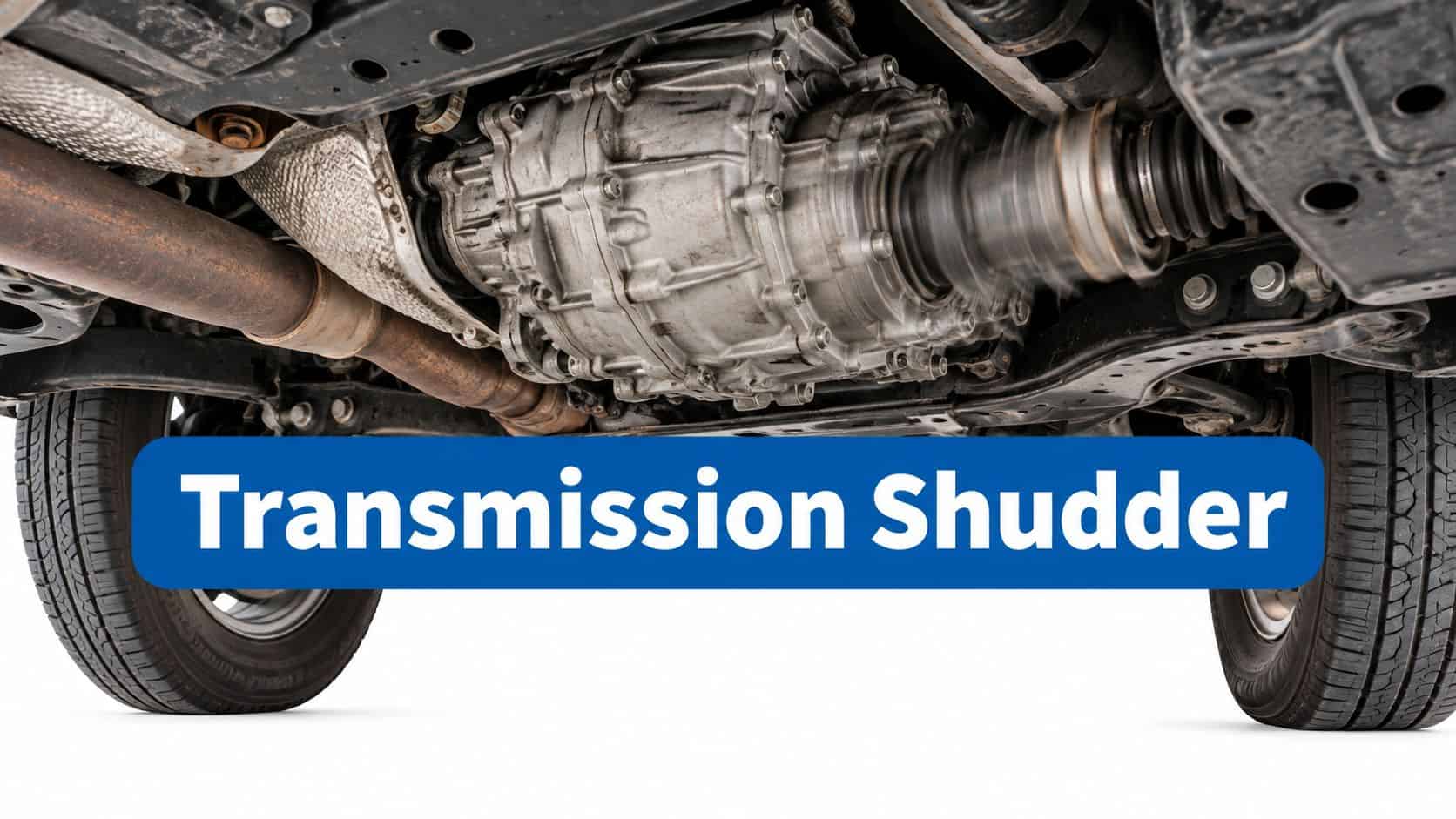
What Causes Transmission Shudder in Sun City AZ
You’re easing away from a stoplight, the car settles into a steady cruise, and a rapid rumble rolls through the seat and floor. It’s not one hard shift. It feels more like brief rumble strips on smooth pavement. If that sounds familiar, understanding what causes transmission shudder can help you ask better questions before you authorize a fluid service, a converter, or any other repair. The key point is simple. Shudder is a symptom, not a diagnosis, and the same vibration can come from several different places.
What Transmission Shudder Feels Like on Sun City Roads
A Sun City driver pulls away from a light on Grand Avenue, lightly presses the accelerator, and feels a shaking that wasn’t there last week. The engine sounds normal. The car still moves. Yet at a steady speed, a low, repeated vibration appears, then fades when the driver accelerates harder or lifts off the pedal.
That’s the pattern many drivers describe to a shop that handles auto repair in Sun City AZ. Transmission shudder usually isn’t a single bang or jerk. It’s a repeating rumble during light acceleration or cruising, often when the torque converter is trying to lock up. Learning how that differs from other sounds in our guide to transmission noises and what they may mean can help you describe it clearly.
Five Places the Vibration Can Start
- Torque-converter clutch problems: The clutch grabs and releases instead of engaging smoothly.
- Worn internal clutch packs: Friction material inside the transmission no longer applies evenly.
- Degraded transmission fluid: Old or overheated fluid changes how the clutches slip.
- Worn engine or transmission mounts: Excess movement lets normal vibration reach the cabin.
- Driveline or tire faults: Worn joints, axles, or imbalanced tires can mimic a transmission fault.
Don’t judge the source by feel alone. A vibration at light throttle is a clue, not proof.
The useful question isn’t, “Does my transmission need replacement?” It’s, “What evidence connects this vibration to the transmission?” That question protects you from paying for the wrong repair.
How the Torque-Converter Clutch Creates Shudder
Think of the torque-converter clutch, or TCC, as a clutch plate inside a sealed, fluid-filled housing between the engine and transmission. At lower speeds, the converter allows slip so the engine doesn’t stall and the car pulls away smoothly. During steady cruising, the TCC applies and reduces that slip. Less slip means less wasted energy and better fuel efficiency.
Modern transmissions don’t always lock this clutch completely. They may command a small amount of controlled slip. That slip has to stay smooth and predictable. If the friction material grips differently as sliding speed changes, the clutch can stick, release, stick, and release again.
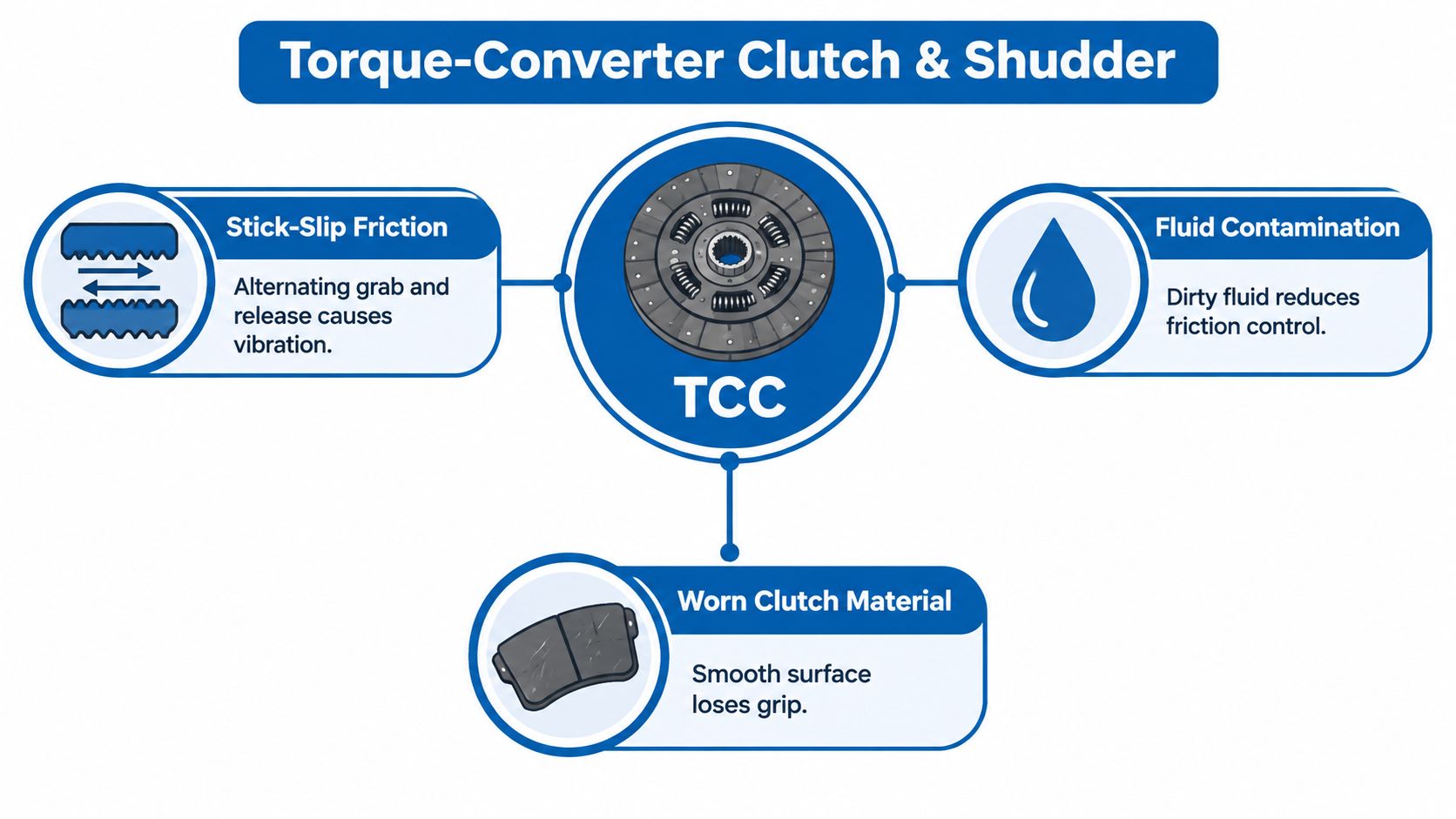
Stick-Slip in Plain English
Stick-slip works like dragging a damp fingertip across glass. It doesn’t glide evenly. It catches, jumps, catches, and jumps. Inside the converter, that repeated cycle sends vibration through the driveline. Technical material describes this type of shudder as a low-frequency vibration mainly occurring between 20 and 30 hertz, or roughly 20 to 30 cycles per second, in a peer-reviewed discussion of velocity-dependent friction in wet clutches.
That’s why shudder feels rapid rather than like one poor shift. You’re feeling many small grabs and releases. The cause may be unsuitable friction characteristics, incorrect clutch apply pressure, degraded fluid, or unstable controlled slip. In short, TCC shudder is usually a friction-control problem, not a broken gear. Diagnosis has to show whether the friction problem comes from the fluid, the control system, the clutch material, or something outside the transmission entirely.
Five Common Causes and How to Tell Them Apart
Drivers often assume every shudder starts inside the transmission. It doesn’t. An engine misfire, a soft mount, a worn CV axle, and a TCC fault can all become noticeable under light throttle. Timing, speed, temperature, and scan data help separate them.
A manufacturer bulletin describes possible TCC shudder as shaking during light-throttle acceleration at steady speeds from 25 to 80 mph, while also recommending scan or oscilloscope monitoring because it can feel like a misfire, as explained in manufacturer guidance on diagnosing TCC shudder. A different bulletin tied lock-up clutch judder between 20 and 60 mph to deteriorated fluid that had degraded after repeated high-heat exposure, according to service guidance on fluid-related lock-up judder.
Matching Shudder Symptoms to Likely Causes
| Likely cause | When it shows up | What it feels like | Typical repair direction |
|---|---|---|---|
| TCC friction problem | Light throttle, steady cruise | Rapid rumble that may stop with more throttle | Confirm TCC slip, then address fluid, control, or converter |
| Worn clutch packs | During or after gear changes | Shudder with slipping, flare, or delayed engagement | Internal inspection and possible rebuild |
| Degraded fluid | Often after warm-up or heat exposure | Judder during converter lockup | Correct specified fluid service if no damage is found |
| Worn mounts | Acceleration, stopping, or shifting into gear | Thump, movement, or vibration through the body | Replace failed mount and inspect nearby parts |
| Driveline or tire fault | Speed-related, turns, or load changes | Hum, wobble, click, or repeating vibration | Repair axle, joint, wheel, or tire problem |
Worn clutch packs deserve extra attention. If shudder comes with slipping or trouble selecting a gear, a driver may also notice problems covered in our explanation of why a car may not shift gears properly. Mounts and driveline parts produce different evidence. A technician can see excessive engine movement, torn rubber, loose joints, damaged boots, or tire imbalance. None of those findings requires opening the transmission.
A useful rule: The repair should match a confirmed source, not just the moment when the vibration appears.
How Technicians Diagnose the Real Cause
A good diagnostic visit starts with your description. Tell the technician the speed, road, engine temperature, throttle position, and whether tapping the brake or accelerating changes the feeling. Those details help the shop reproduce the event instead of guessing from a short drive around the block.
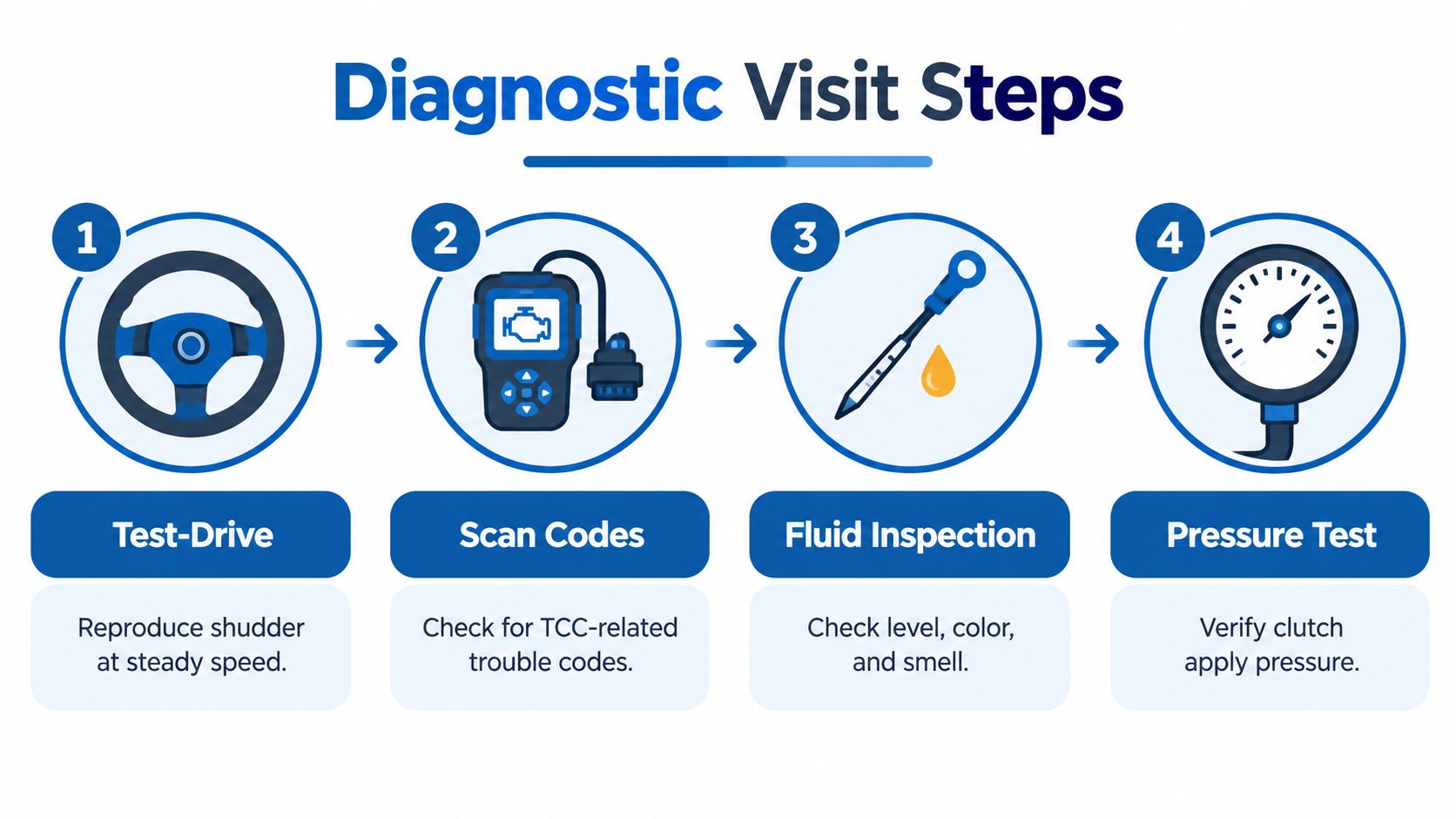
What the Evidence Should Show
- Reproduce the shudder: The technician drives under conditions similar to yours and notes when the vibration starts and stops.
- Record live data: Engine speed, input and output speed, misfire counters, and TCC slip show whether the vibration lines up with converter operation.
- Inspect the fluid: Color, odor, level, debris, and contamination help distinguish a service issue from internal damage.
- Check the mimics: Tires, wheels, axles, joints, mounts, and engine performance all need attention before condemning the converter.
Some manufacturer confirmation testing uses a transmission temperature of 122 to 158°F, engine speed of 1,100 to 1,500 rpm, and engine torque of 150 to 250 Nm to reproduce TCC shudder reliably, as specified in an NHTSA-hosted manufacturer service bulletin. Another diagnostic procedure calls for checking TCC data during steady driving in a 30-to-50-mph range and watching for input-speed oscillation, as described in manufacturer diagnostic guidance for driveline disturbance.
That data-driven approach is the value of proper auto repair in Sun City AZ, especially when a shop uses automotive computer diagnostics to interpret live vehicle data. You’re paying for evidence that separates a fluid or control fault from mechanical converter damage.
Why Delaying a Shudder Repair Usually Costs More
A mild shudder can feel easy to postpone. The car still starts, shifts, and gets you to appointments. But repeated stick-slip isn’t harmless. Each grab-and-release cycle adds heat and stress to the TCC friction surface. Hot fluid loses the stable friction behavior the clutch needs, so the shudder can become more frequent and harder to control.
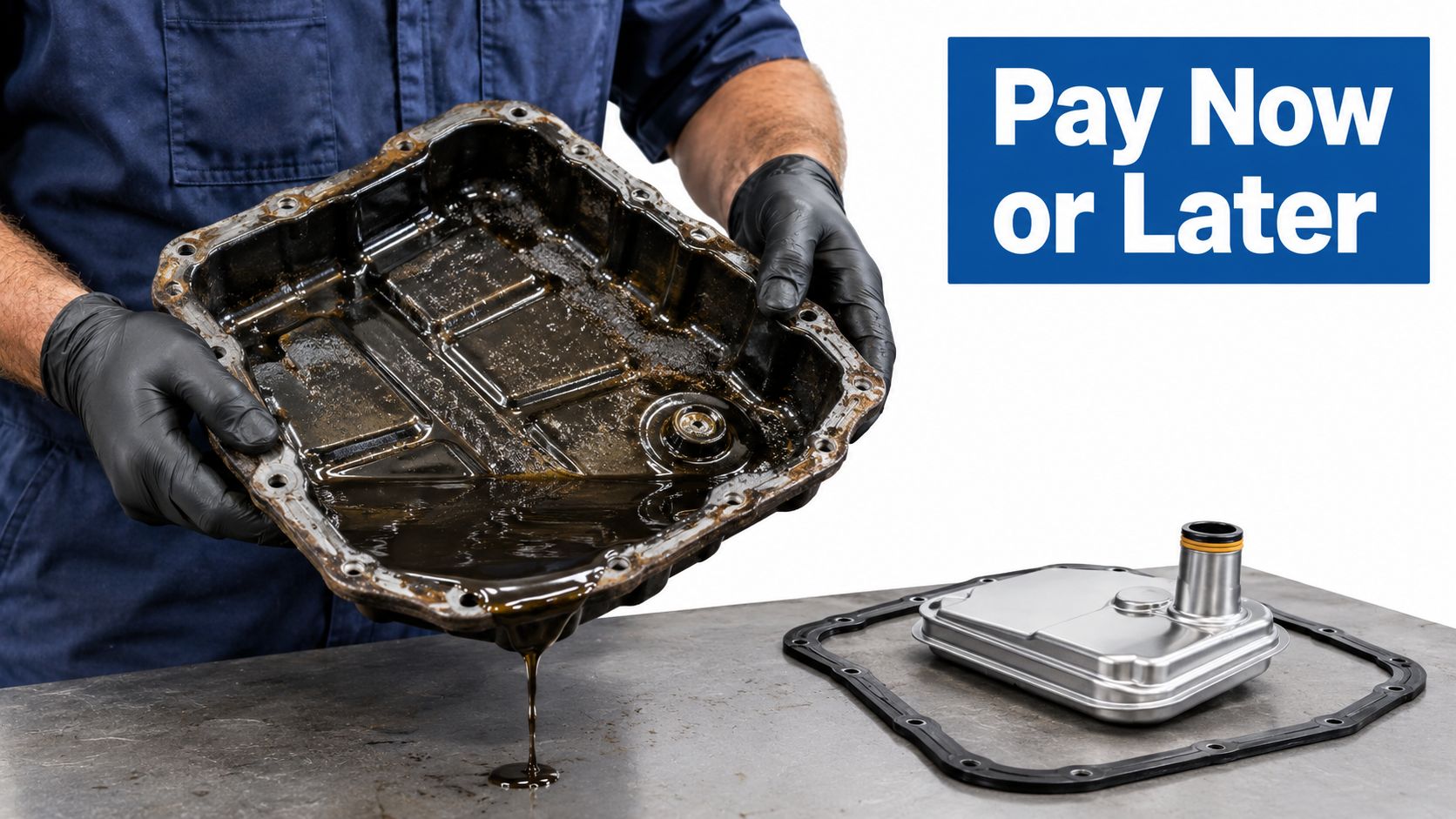
Delay can also let a non-transmission problem grow. A collapsed mount allows extra powertrain movement, which can strain exhaust parts, hoses, and wiring. A worn CV axle or joint can progress from vibration to a breakdown. If the underlying cause is a misfire, continued driving can stress other engine and exhaust components. Waiting doesn’t preserve options. It often removes the simplest one.
Signs You Should Not Wait
- Persistent shudder after warm-up: It returns during ordinary cruising, not just once.
- Burnt smell: The fluid may be overheated or contaminated.
- Very dark fluid: Color alone isn’t a complete diagnosis, but it deserves inspection with symptoms.
- Worsening behavior: The vibration grows stronger or begins occurring at more speeds.
- Shift changes: Slipping, delay, harsh engagement, or hesitation joins the shudder.
Highway distraction matters too. A driver on Loop 101 shouldn’t have to wonder whether the car will shake during a lane change or merge. Early diagnosis gives you a clearer choice while the problem is still limited, whether the answer is fluid service, a mount, a driveline part, or converter work.
Typical Repair and Service Options That Actually Match the Cause
A fluid drain-and-fill can help when testing shows a degraded but controllable TCC condition and the fluid has no clutch debris, hardware damage, or coolant or water contamination. One manufacturer procedure then requires at least 200 miles of driving to verify the result, according to GM service guidance distinguishing degraded from damaged TCC operation. If monitoring instead shows damage, converter replacement is the directed repair.
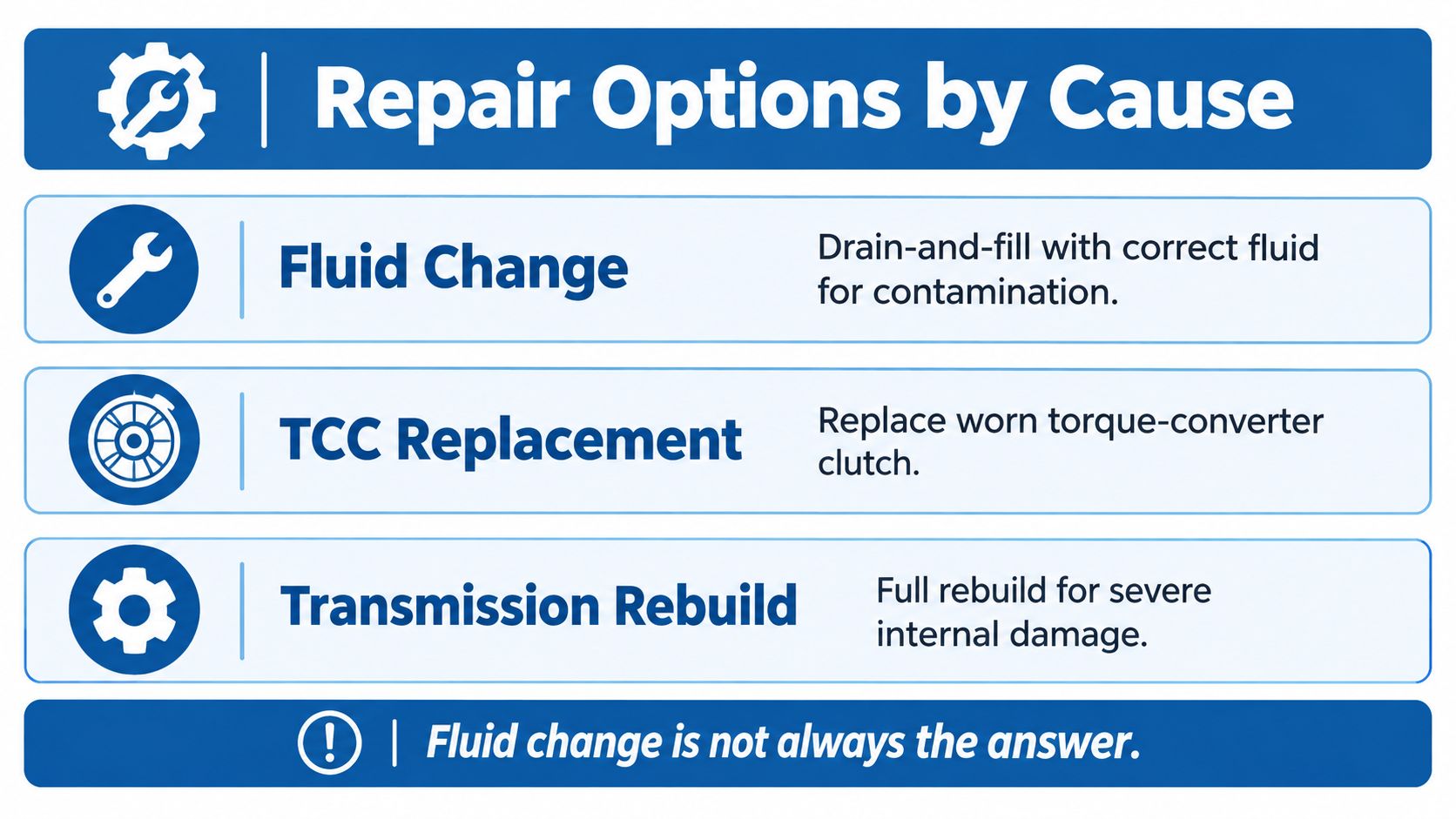
The correct specification matters. For vehicles that require it, DEXRON VI isn’t interchangeable with a generic fluid chosen only by price. Software calibration may also be part of the repair when the manufacturer requires updated TCC control. Mount or driveline replacement solves a different problem and shouldn’t be sold as transmission service. Pete Nelson Automotive provides transmission diagnosis and service as one local option for drivers who need that evidence gathered, and our overview of common transmission problems and matching repairs explains related symptoms.
For commercial-vehicle readers comparing component sourcing, Daf Marketplace Ltd lists used gearboxes for DAF trucks, although passenger-car shudder still requires model-specific diagnosis. A rebuild becomes reasonable only when inspection shows broader internal damage.
Shudder Questions Sun City Drivers Ask and Next Steps
Can shudder happen with no warning light
Yes. Manufacturer guidance on shudder complaints with no trouble codes means a code scan alone can’t clear or confirm the transmission. Live data still matters.
Will new fluid always fix it
No. Fluid helps some degraded TCC conditions, but damaged friction material needs repair. Explore our Sun City transmission services before deciding.
Where can I compare general car questions
General ownership resources such as Nairobi dealership FAQs can help, but your next step should be a vehicle-specific inspection.
If your car rumbles during light acceleration or steady cruising, Pete Nelson Automotive can reproduce the concern, check TCC and driveline data, inspect the fluid, and explain which repair matches the evidence. Call 623-974-4723 or visit Pete Nelson Automotive to schedule your appointment today.
Pete Nelson Automotive
This Offer Will Expire 12-31-2026
Pete Nelson Automotive is pleased to offer you

"Get Ready for the Holidays"
A $215.00 Value for Only $159.95 (+tax)
Lube, Oil, & Filter Change, Up to 5 quarts of Engine oil
Inspect and top off all fluid levels, Includes up to 5 Quarts of 5w30 synthetic blend oil, additional charge for synthetic oil.
Travel Evaluation
Set Air Pressures and Tire Rotation if needed.
Battery, Alternator and Starter Electrical Test
Load test battery, Alternator output and Starting amps.
Full Brake Evaluation
Includes check brake system on four wheels, checking and testing brake fluid condition.
So Call 623-974-4723 today and make an appointment for this exclusive Special!
*Most Cars, Vans, Motor homes, 4×4’s, Diesels, and some foreign cars may be higher. You must bring this letter at time of service and allow 2 hours to complete.



