Picture this: you’re cruising down Grand Avenue on a sunny Sun City afternoon when a small, bright light suddenly pops up on your dashboard. It’s the brake system warning light, and that little knot of worry you feel is completely normal. This light is your car’s way of telling you that its most critical safety system needs your immediate attention. It’s not a suggestion; it’s a direct message signaling a potential problem that needs to be checked out, and fast.
Understanding what that light is trying to tell you is the first step toward staying safe on Arizona roads.
Decoding the Brake Warning Light on Your Dashboard
Think of this light as your car’s built-in safety inspector. It flashes on for a second when you start your car, which is just the system doing a quick self-check. But if that light stays on, it’s raising a red flag about a problem that could be anything from minor to serious.
This infographic breaks down the common symbols you might encounter.
Getting familiar with these icons is key, as each one points to a different part of your braking system.
Understanding the Common Symbols
Different lights on your dashboard give you specific information, just like the tire pressure warning light tells you when your tires are low on air. When it comes to brakes, the symbols are just as clear-cut.
- The ‘BRAKE’ Light: This is your primary warning. It often points to an issue with the hydraulic system, like low brake fluid. On the other hand, it could be something as simple as your parking brake still being engaged.
- The ABS Light: This one is all about your Anti-lock Braking System. If it’s on, your regular brakes will probably still work, but that crucial anti-skid feature that helps you in a hard stop might be offline.
To help Sun City drivers quickly figure out what’s going on, here’s a simple table that breaks down the most common symbols and what to do when you see them.
Brake Warning Light Symbols and What They Mean
| Light Symbol | Common Color | What It Typically Means | Immediate Action |
|---|---|---|---|
| (!) or BRAKE | Red | A serious issue with the hydraulic system (like low fluid) or the parking brake is engaged. | Pull over safely. Check parking brake. If it’s off, call for service. Do not drive. |
| ABS | Amber/Yellow | There’s a fault in the Anti-lock Braking System. | Your standard brakes should still work, but schedule a professional inspection soon. |
| Brake Pad Symbol | Amber/Yellow | The brake pads are worn down and need to be replaced soon. | Schedule a service appointment to have your brake pads inspected and replaced. |
This table is a great starting point, but remember that every car is a little different. Your owner’s manual will always have the most specific information for your vehicle. Ignoring any brake system warning light is a gamble you don’t want to take. Tackling the issue right away keeps your car safe and reliable, giving you peace of mind on the road.
Common Reasons Your Brake Warning Light Is On
So, you know which light is on. Now, let’s get into the “why.” Seeing that light pop up doesn’t always spell disaster, but it is absolutely a call to action. The causes can range from simple to complex, but they all circle back to the health of your braking system. Knowing the usual suspects will help you understand the urgency and have a more informed conversation with your mechanic.
Low Brake Fluid: The Hydraulic Lifeline
One of the most common culprits behind that pesky brake light is low brake fluid. Think of brake fluid as the muscle behind your brakes. When you press the pedal, this fluid transfers the force from your foot to the wheels, creating the hydraulic pressure needed to slow down.
If the fluid level gets too low, there isn’t enough pressure to make the brakes work effectively, which is a major safety problem. Low fluid is usually a symptom of another issue, such as:
- A Leak in the System: Hoses and connections can become old and brittle, especially in our Arizona heat, allowing fluid to seep out.
- Worn Brake Pads: As your pads wear down, the brake calipers have to push out further to make contact. That extra space gets filled with more fluid from the reservoir.
Worn-Out Brake Pads and Rotors
Your brake pads are designed to wear down over time. These pads squeeze against the rotors (the shiny metal discs inside your wheels) to create the friction that stops your car. With every stop, a tiny bit of that friction material wears away.
Many modern cars have a small sensor built into the brake pad. When the pad gets thin enough, the sensor trips, and the brake system warning light comes on. If you ignore it, you’ll eventually hear a nasty grinding sound, which means you’re damaging the rotors and turning a routine fix into a more expensive repair. We dive deeper into this in our guide on the top 5 most common brake problems and their solutions.
A Faulty ABS Sensor
If it’s the ABS light that’s on, the issue is with your Anti-lock Braking System. This technology prevents your wheels from locking up during a sudden, hard stop, allowing you to maintain steering control. Each wheel has a speed sensor that communicates with the main ABS computer.
If one of those sensors gets caked with dirt, damaged, or fails, it can’t send the right signals, triggering the warning light. Your regular brakes will likely still work, but that critical anti-lock safety feature is offline until you get it fixed. As cars get safer, these systems are becoming more common—the global automotive brake system market is projected to hit $30.10 billion by 2028, largely because of the demand for tech like ABS.
Knowing When to Pull Over Immediately
Not every brake system warning light is a five-alarm fire, but some warnings demand immediate action. For every driver here in Sun City, it’s vital to know the difference between a “get this checked soon” reminder and a full-blown “stop driving now” emergency. Your safety, and the safety of everyone else on the road, depends on it.

If the red “BRAKE” warning light comes on and stays on while you’re driving, that’s a huge red flag. It often points directly to a loss of hydraulic pressure—the very force that stops your car.
Red Flags That Mean Stop Now
Your car is pretty good at giving you physical clues when something is seriously wrong. Pay close attention to how your brake pedal feels and any strange sounds you hear when you press it. These are urgent signals of a potentially catastrophic failure.
Here are the critical signs that mean you need to get off the road immediately:
- A Spongy or Soft Brake Pedal: Does your brake pedal feel mushy or sink toward the floor with little resistance? This likely means you have a brake fluid leak or air in the lines. Your brakes could fail at any second.
- Loud Grinding or Squealing Noises: A high-pitched squeal is the wear indicator on your brake pads telling you it’s time for a change. But a deep, metallic grinding noise means your brake pads are completely gone, and you now have metal-on-metal contact, which will destroy your rotors and drastically reduce your stopping power.
- The Car Pulls to One Side: If your car dives to the left or right when you brake, it could be a seized caliper or a collapsed brake hose. This creates uneven braking force that can cause you to lose control.
- Vibrations or Shaking: A pulsing or vibrating feeling in the brake pedal or steering wheel is a classic sign of warped rotors. Severe vibrations can seriously compromise your braking effectiveness, especially at higher speeds.
When any of these symptoms appear, safely navigate to the shoulder, turn on your hazard lights, and call for professional help from a shop you trust, like Pete Nelson Automotive. Don’t risk your safety—call for a tow.
Simple Checks You Can Safely Perform Yourself
When the brake system warning light appears, it’s natural to feel concerned. While most brake issues need a professional eye, there are a couple of quick, safe checks you can do yourself. This isn’t about fixing the problem but about gathering clues and possibly ruling out the simplest culprits.
Check the Parking Brake First
Before you pop the hood, start with the most common—and thankfully, easiest—fix. A partially engaged parking brake is a frequent offender. It’s surprisingly easy to overlook, especially if you’re in a hurry.
Make sure the parking brake lever or pedal is fully disengaged. Sometimes it can feel like it’s off but might still be caught just enough to trigger the sensor. Give it a firm push down or pull the release completely. If the light vanishes, problem solved!
Safely Inspect Your Brake Fluid Level
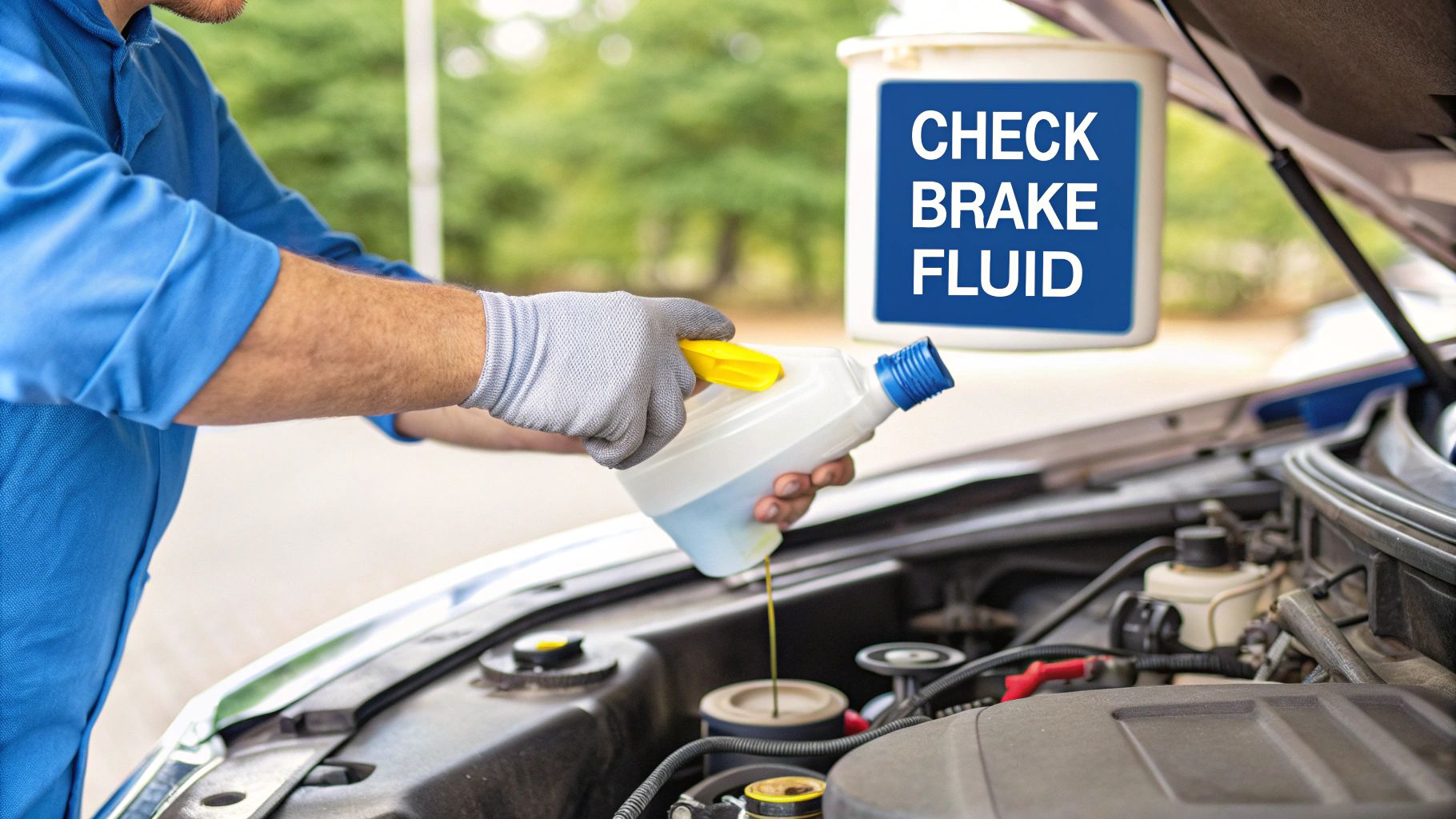
If the parking brake wasn’t the issue, the next step is to check your brake fluid. This is a quick visual inspection—if you find the fluid is low, do not just top it off. Low fluid is almost always a symptom of a larger problem, like worn-out brake pads or a leak.
Here’s how to safely check the level:
- Park on a level surface and pop the hood.
- Locate the brake fluid reservoir. It’s usually a small, translucent plastic container near the back of the engine bay on the driver’s side.
- Check the fluid level. You can see the fluid through the side of the container. There will be “MIN” (minimum) and “MAX” (maximum) lines etched into the plastic.
- Assess the level. The fluid should be close to the “MAX” line. If it’s at or below the “MIN” line, you’ve likely found why your light is on.
A low fluid level is a serious red flag that requires immediate professional attention from our team to ensure your vehicle is safe to drive.
Why Professional Brake Service Is Non-Negotiable
When that brake system warning light comes on, it’s tempting to search online for a quick fix. But when it comes to modern brake systems, guessing isn’t an option. Today’s vehicles are complex networks of computers and sensors working in perfect harmony.
The Complexity of Modern Brake Systems
Your car’s brakes are now deeply integrated with other critical safety features. Systems like the Anti-lock Braking System (ABS) and Electronic Stability Control (ESC) are standard on most cars for good reason. They do more than just stop you; they keep you in control during a sudden swerve or on a wet road.
- Anti-lock Braking System (ABS): Prevents your wheels from locking up during a hard stop, allowing you to steer around an obstacle.
- Electronic Stability Control (ESC): Can automatically apply individual brakes to prevent your car from skidding or spinning out during a sharp turn.
A warning light could mean a fault in one of these electronic systems. A simple visual check won’t uncover a failing wheel speed sensor or a glitch in the ABS control module. A DIY repair could easily make the problem worse or disable these life-saving features.
The Right Tools for an Accurate Diagnosis
Here at Pete Nelson Automotive, our ASE-certified technicians don’t guess with your safety. We use advanced diagnostic scanning tools that plug into your car’s computer to read the specific trouble codes, pinpointing the exact component causing the issue. This precision ensures we fix the root cause correctly the first time.
DIY Checks vs. Professional Brake Service
| Task | DIY Action (Safe to Check) | Professional Service (Required for Repair/Diagnosis) |
|---|---|---|
| Brake Fluid | Visually check the fluid level in the reservoir. Note the color. | Diagnose and repair leaks. Perform a full fluid flush. Test for contamination. |
| Brake Pads | Listen for squealing or grinding. Look for excessive brake dust. | Measure pad thickness. Inspect for uneven wear. Replace pads and hardware. |
| Rotors | Look for visible grooves, scoring, or signs of rust. | Measure rotor thickness and check for warping (runout). Resurface or replace rotors. |
| Warning Lights | Note which light is on (Brake, ABS, etc.) and when it appears. | Use diagnostic scan tools to read specific error codes from the car’s computer. |
| Electronic Systems | N/A – These are too complex for visual inspection. | Diagnose and repair issues with ABS, ESC, wheel speed sensors, and control modules. |
For truly reliable diagnostics and repairs, you need professional brake services Sun City. Opting for professional service is about ensuring the total integrity and safety of your vehicle. As part of our brake repair service, our technicians perform a complete inspection, giving you confidence on every drive.
Your Trusted Brake Repair Experts in Sun City, AZ
When your brake system warning light comes on, it’s a direct message from your car about its most important safety feature. Ignoring it is a gamble you can’t afford to take. At Pete Nelson Automotive, we take the worry off your plate and replace it with confidence. Whether it’s a straightforward fix or a complex electronic diagnosis, our ASE-certified technicians have the expertise to get it done right.
Your Peace of Mind Is Our Priority
We provide honest, top-tier auto repair Sun City AZ, ensuring your car is both safe and dependable. Braking technology is always evolving, with innovations like adaptive brake lights becoming more common. You can learn more about these innovations in automotive lighting here.
This growing complexity is why our team stays current with the latest training and tools. We don’t just patch up symptoms; we ensure the entire system works as designed. For a deeper look at our approach, check out our posts on brake repair in Sun City.
Frequently Asked Questions
How often should I get my brakes checked?
We recommend a professional brake inspection at least once a year or every 12,000 miles. The intense Arizona heat can cause brake components to wear out faster, so regular checks are crucial for catching issues early and staying safe on Sun City roads.
Can I drive with my brake light on?
It’s not recommended. If the red “BRAKE” light is on, or if you notice any unusual sounds or a spongy pedal, you should pull over safely and call for a tow. Your safety is not worth the risk of a potential brake failure.
What’s the difference between the BRAKE light and the ABS light?
The “BRAKE” light typically indicates an issue with the base hydraulic system, like low brake fluid or an engaged parking brake. The “ABS” light points specifically to a problem with your Anti-lock Braking System, which helps prevent skidding during hard stops. Either light means it’s time for a professional diagnosis.
How much does brake service cost in Sun City?
Costs vary based on your vehicle and the specific repairs needed. We believe in transparency and will always provide a clear, detailed estimate before any work begins. Check out our website for our latest service specials or give us a call for more information. Local businesses like ours rely on strategies like local SEO strategies specifically for auto repair shops to connect with drivers like you.
Don’t let a warning light leave you guessing. Trust the experts at Pete Nelson Automotive to provide the clarity and service you need to drive safely.
Call 623-974-4723 or visit petenelsonautorepair.com to schedule your appointment today.
Pete Nelson Automotive
This Offer Will Expire 12-31-2026
Pete Nelson Automotive is pleased to offer you
"Get Ready for the Holidays"
A $215.00 Value for Only $159.95 (+tax)
Lube, Oil, & Filter Change, Up to 5 quarts of Engine oil
Inspect and top off all fluid levels, Includes up to 5 Quarts of 5w30 synthetic blend oil, additional charge for synthetic oil.
Travel Evaluation
Set Air Pressures and Tire Rotation if needed.
Battery, Alternator and Starter Electrical Test
Load test battery, Alternator output and Starting amps.
Full Brake Evaluation
Includes check brake system on four wheels, checking and testing brake fluid condition.
So Call 623-974-4723 today and make an appointment for this exclusive Special!
*Most Cars, Vans, Motor homes, 4×4’s, Diesels, and some foreign cars may be higher. You must bring this letter at time of service and allow 2 hours to complete.



