
Tire Balance vs Alignment: Which Service Your Car Needs
You just dropped a wheel into a pothole on the way home, and the steering wheel shakes once you reach highway speed. Do you book a balance, an alignment, or both? That choice comes up often for drivers around Sun City, where heat and rough pavement are hard on tires. Tire balance vs alignment is a spin-versus-direction question. One service smooths a heavy spot. The other points the wheels straight.
Tire Balance and Wheel Alignment at a Glance
Tire balancing corrects uneven weight in a wheel-and-tire assembly so it spins smoothly. Wheel alignment sets toe, camber, and caster so the car tracks straight and the tread wears evenly. They are not interchangeable. Balancing can’t stop a pull, and alignment can’t erase a vibration from a heavy spot.
| Factor | Tire Balancing | Wheel Alignment |
|---|---|---|
| What it corrects | Uneven weight in the wheel and tire assembly | Wheel angles (toe, camber, caster) relative to the car |
| Main symptom | Vibration that changes with speed, often at highway speed | Pulling to one side, off-center steering wheel |
| Typical wear pattern | Cupping or scalloped tread | Inner or outer edge wear, feathering |
| What it cannot fix | Pulling or edge wear caused by wrong angles | Vibration caused by a heavy spot or damaged tire |
Balancing fixes how the wheel spins. Alignment fixes where the wheel points.
The National Highway Traffic Safety Administration says new tires should be balanced when installed, while alignment helps prevent drifting on a straight, level road and helps tires last. Our tire maintenance checklist shows how both jobs fit regular care.
Symptoms That Point to Balance or Alignment
Match the feel of the car to the first check before you book.
| Symptom | Likely Cause | First Check |
|---|---|---|
| Vibration in steering wheel at highway speed | Wheel and tire imbalance | Verify tire pressure, then dynamic balance |
| Pull to one side on a level road | Alignment angles out of range | Equalize pressures, then alignment check |
| Steering wheel off center while driving straight | Toe or alignment | Alignment check |
| Feathered or one-edge tread wear | Toe or camber | Alignment check and tread inspection |
| Cupped or scalloped tread | Imbalance or worn shocks | Balance check and suspension inspection |
| Vibration only while braking | Brake system | Brake inspection, not balance or alignment |
| Vibration that rises with engine speed | Drivetrain or engine | Drivetrain inspection |
Michelin describes highway shake as a resonance that shows up when an uneven assembly hits a specific rotation speed. You may feel it in the wheel, seat, or floor, and cupped tread can follow. A pull after pressures are equal, an off-center wheel, or inner and outer edge wear points to alignment, because the tires scrub sideways each turn.
Timing is the separator. Imbalance usually appears inside a narrow speed band. Alignment trouble feels steady on a level road. A pull only while braking belongs to the brakes, which is why our page on steering wheel vibration starts with where and when you feel it. A mixed list often means both services.
When One Service Cannot Fix the Problem
A pothole, curb strike, suspension repair, or new set of tires can knock balance and alignment off together. Michelin notes that a hard impact can misalign the wheels and damage a tire at the same time. The hit may bend a rim, shift weight, or change suspension geometry.
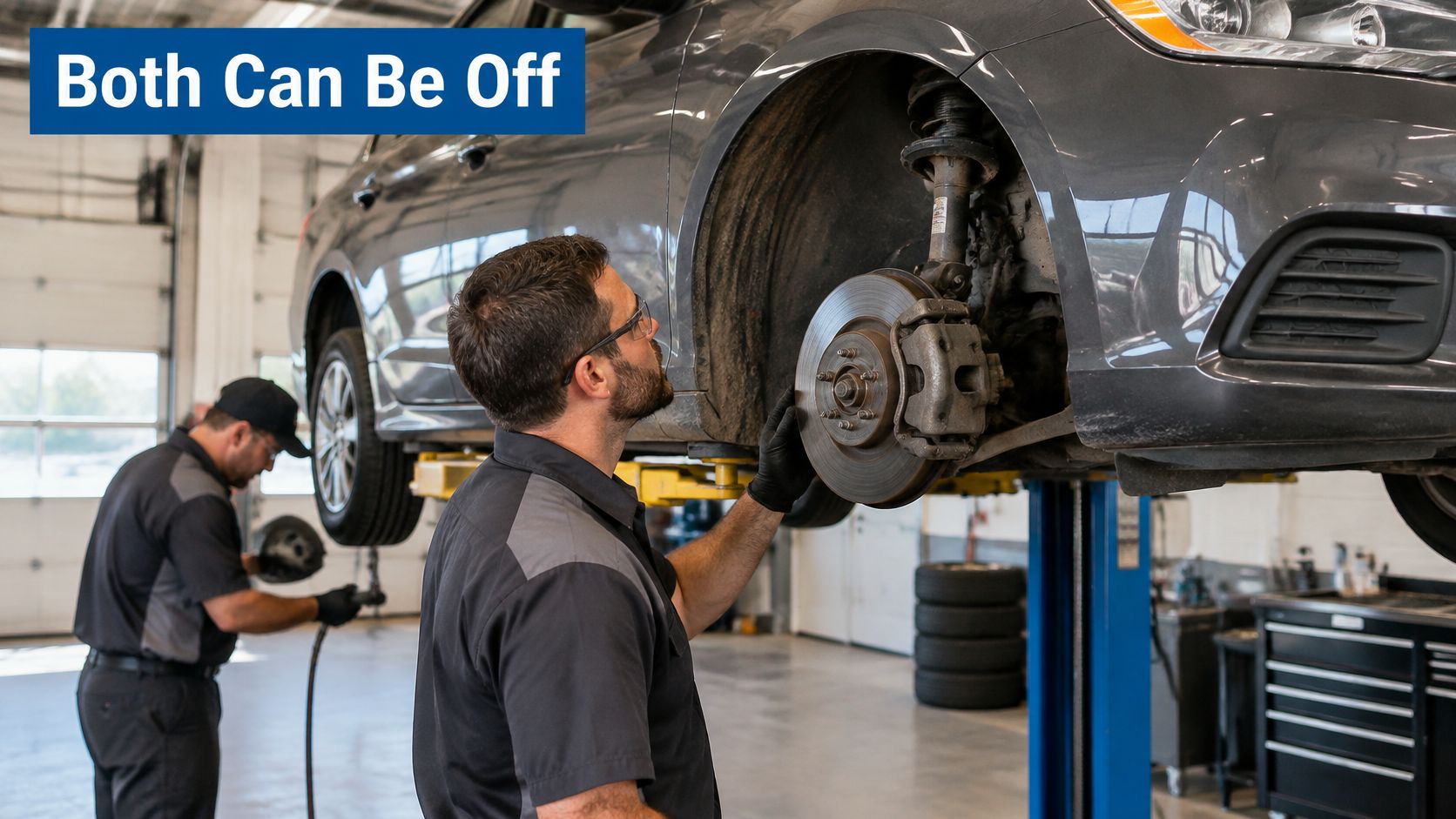
Shake doesn’t automatically mean you need weights. Runout, a tire seated wrong, damage, mud packed in the wheel, and uneven tread depth can all vibrate. A pull isn’t automatic proof of bad angles either. Pressure, road crown, crosswind, brake drag, spring sag, ride height, and how the car is loaded can each tug the wheel. Radial force variation is a stiffness problem in the tire, and ordinary balancing may not clear it.
A careful visit follows one order:
- Pressures and condition: Set the air and look for cuts, bulges, and odd wear.
- Dynamic balance: Spin each assembly and correct heavy spots.
- Road force or runout: Measure these if the shake remains.
- Alignment: Measure and correct it when the car pulls, the wheel sits off center, or the tread is abnormal.
If it still shakes after a balance, or still pulls after an alignment, inspect the wheels, tires, and suspension instead of repeating the same job.
Our guide on a car that pulls to one side walks through that post-impact look.
How Each Service Is Performed Step by Step
Both jobs start with tire pressure. Wrong air distorts the readings, so we set it before any machine is trusted.
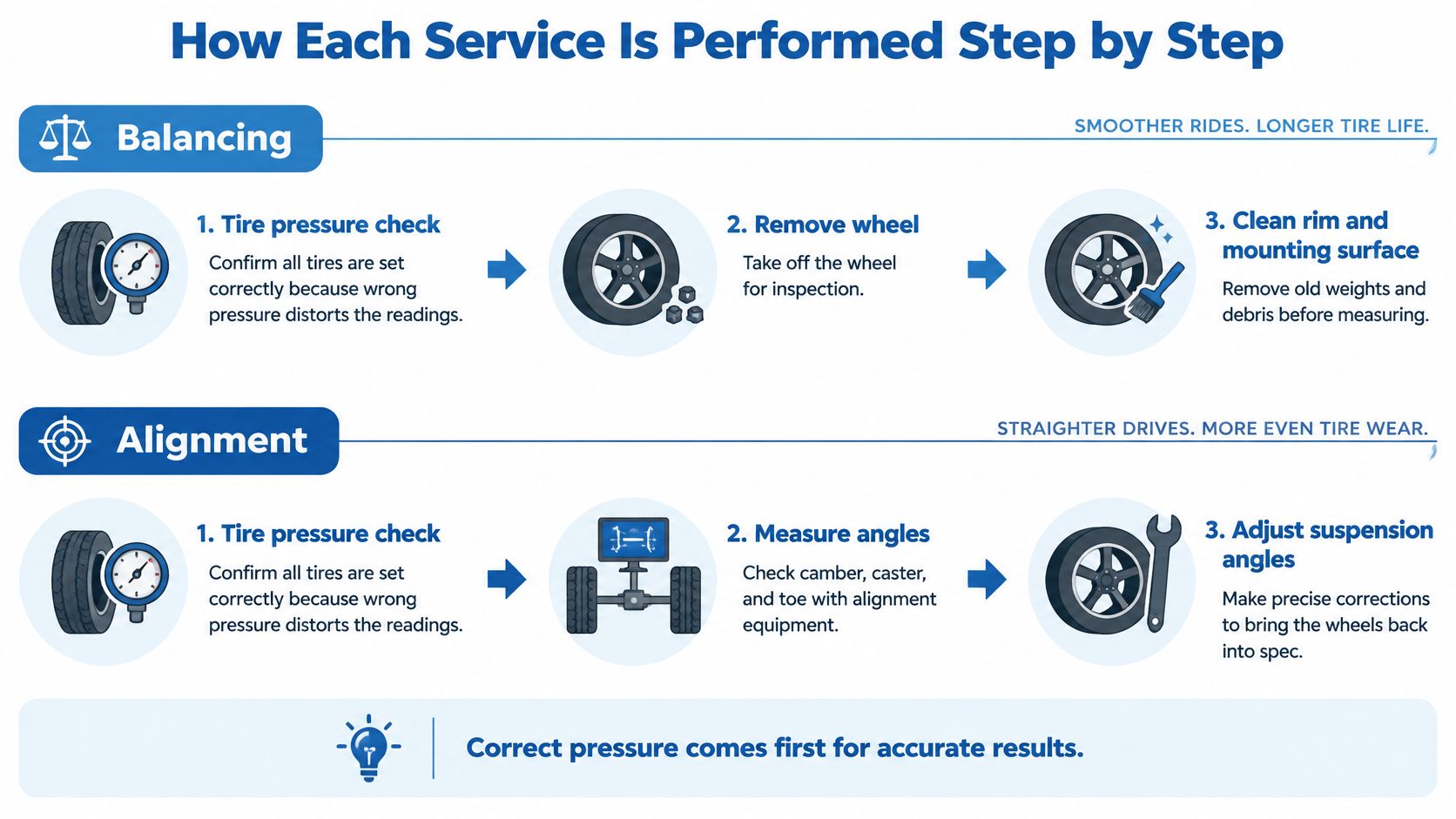
Balancing
- Remove the wheel and clean the rim and mounting surface of old weights and mud, so debris isn’t read as imbalance.
- Mount it on the balancer and spin it to find the heavy spots.
- Add clip-on or adhesive weights where the machine indicates, inner and outer.
- Spin again to confirm the assembly is in tolerance, then reinstall and torque the lug nuts.
Alignment
- Inspect tie rods, ball joints, bushings, and tires first. Worn parts make the settings slip again.
- Drive onto the rack and attach sensors or targets to each wheel.
- Measure toe, camber, and caster against the manufacturer’s specification.
- Adjust tie rods and related parts until each angle is in range.
- Road test, then review the printed before-and-after sheet with you.
Balancing four wheels usually takes about 30 minutes. Alignment usually takes about an hour. Either runs longer if worn parts must be replaced first. We offer brake repair, computer diagnostics, transmissions, alignment, air conditioning, and tires, and our technicians are ASE-certified.
Typical Costs and Time for Each Service
A curb strike on a hot Arizona afternoon leaves the wheel buzzing and the steering slightly off. Cost and time are the first two questions.
Balancing is usually priced per tire, so a four-tire visit costs more than a single wheel, and the exact rate depends on the shop and your wheel type. Alignment averaged $121.46 in Q3 2024, up 14.4% from $106.19 in the first half of 2024, according to Automotive Fleet.
| Service | Typical Cost | Typical Time | What Changes the Price |
|---|---|---|---|
| Tire balancing | Priced per tire; a set costs more than one wheel | About 30 minutes for four wheels | Wheel size, weight type, and number of tires |
| Wheel alignment | $121.46 average in Q3 2024 | About 1 hour | Vehicle type, number of adjustments, worn parts |
Balance works like a washing machine with one heavy spot. The shake shows up at speed, and each wheel is billed on its own. Alignment aims the wheels so the car tracks straight. The vehicle, the number of angles, and worn parts that must be replaced first all change the price.
A bent wheel after a pothole or curb strike may need repair or replacement before either job is worth doing. Heat can swing tire pressure and mimic a vibration, so a post-impact inspection checks balance, alignment, tires, and suspension together. Ask for the printed alignment readings and a written parts list. These figures are typical. The quote for your car is the final number.
Service Intervals Arizona Drivers Should Follow
Heat, dust, and potholes shorten tire life here, so mileage alone isn’t a safe clock. The U.S. Tire Manufacturers Association states that proper maintenance, including rotation, balance, and alignment, can extend average tire life by 4,700 miles. That’s a combined estimate, not a promise for either service alone.
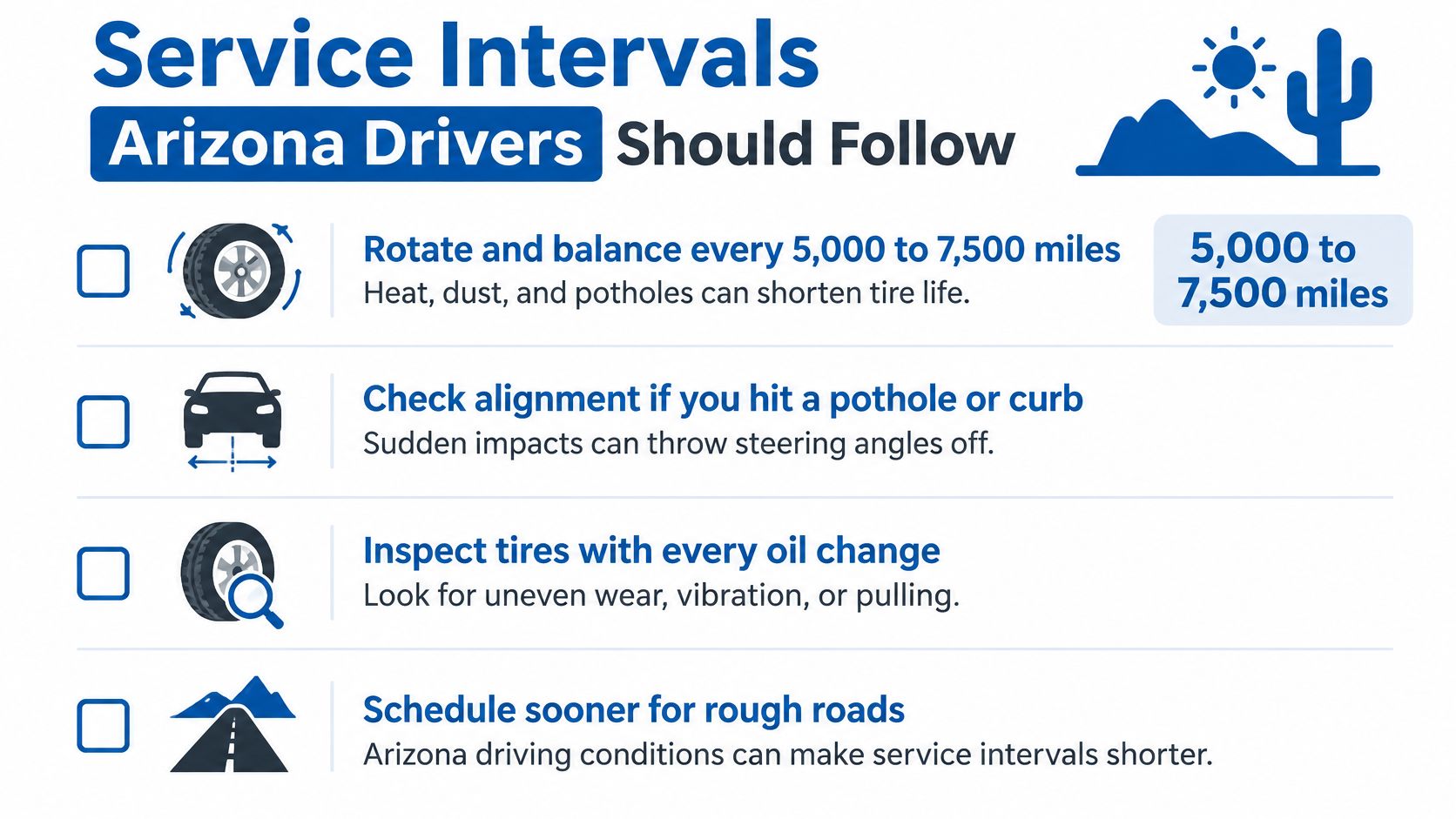
| Service | Check When | Sign to Act On |
|---|---|---|
| Tire rotation and balance | Every 5,000 to 7,500 miles | Vibration at highway speed |
| Wheel alignment check | Once a year and after any pothole or curb hit | Pull or off-center steering wheel |
| Tire balance on new tires | Each time new tires are mounted | Vibration soon after installation |
| Tire replacement | At 2/32 inch tread depth | Bulges, cuts, or cupped tread |
Electric vehicles and heavy SUVs often wear tires faster because they put more torque through the tread, so shorten the interval. Check pressure monthly. Arizona heat changes it and can hide or mimic a fault. Between visits, watch for shake above 50 mph, an off-center wheel, uneven tread, or a pull that starts after a pothole. Timing for rotation is covered in how often to rotate tires.
Confirm Which Service Your Car Needs Before You Book
You come off a rough West Valley stretch, the car starts to misbehave, and the appointment form asks for a service you are not sure you need. Match the booking to the symptom first.
Balancing fixes the rotating assembly. Alignment fixes direction and the wheel angles. Many cars need both after an impact or new tires.
A shake at speed, with the car still tracking straight, starts with balancing. A pull, or a steering wheel that sits off center on a straight road, starts with alignment. After a pothole, a curb strike, or suspension work, ask for a full inspection before you pick one service. Heat-driven pressure swings can mimic either fault, so check the pressures, then tell the shop when the problem started, the speed, any recent hit, and the age of the tires.
Pete Nelson Automotive is at 9000 N 103rd Ave in Sun City. The shop serves the West Valley, works on old and new cars, and its technicians are ASE-certified. Weekday hours are 8:00 am to 5:00 pm, a courtesy shuttle is available, and the Smooth Ride Special includes a four-tire balance and rotation. Clear notes after a visit matter, and customer follow-ups for auto repair from Dial Milo show one way shops keep that conversation going. If the hit also felt like a thud, read whether your suspension is ready for Arizona roads. Bring those notes when you schedule during weekday hours.
Balance and Alignment Questions Drivers Ask
How often should I get my tires balanced?
Balance new tires when they’re mounted, and again whenever highway shake shows up. Many shops balance with each rotation, every 5,000 to 7,500 miles. Don’t wait for a loud vibration if the tread is already cupping.
Can an alignment fix a vibration?
Usually not. Alignment corrects angles that cause pulling and uneven wear. A shake from a heavy spot or a damaged tire needs a balance or a tire inspection. If the shake remains, look at the wheel and the suspension.
Should I get an alignment after hitting a pothole?
Yes, if the car pulls, the wheel sits off center, or the tread wears unevenly. Have the wheels, tires, and suspension inspected too. One impact can bend a rim and shift the angles together.
Which costs more, balancing or alignment?
Alignment usually costs more. Balancing is priced per tire, so a four-wheel visit is still often the smaller bill. Ask for a quote on your vehicle before you book, and ask which worn parts would have to be replaced first.
We balance tires, align wheels, and inspect suspension for Sun City and West Valley drivers who want a smooth, straight ride. Bring the speed where the shake starts, or the side the car pulls, and we’ll match the service to the symptom. Visit Pete Nelson Automotive or call 623-974-4723 to schedule your appointment today.
Pete Nelson Automotive
This Offer Will Expire 12-31-2026
Pete Nelson Automotive is pleased to offer you

"Get Ready for the Holidays"
A $215.00 Value for Only $159.95 (+tax)
Lube, Oil, & Filter Change, Up to 5 quarts of Engine oil
Inspect and top off all fluid levels, Includes up to 5 Quarts of 5w30 synthetic blend oil, additional charge for synthetic oil.
Travel Evaluation
Set Air Pressures and Tire Rotation if needed.
Battery, Alternator and Starter Electrical Test
Load test battery, Alternator output and Starting amps.
Full Brake Evaluation
Includes check brake system on four wheels, checking and testing brake fluid condition.
So Call 623-974-4723 today and make an appointment for this exclusive Special!
*Most Cars, Vans, Motor homes, 4×4’s, Diesels, and some foreign cars may be higher. You must bring this letter at time of service and allow 2 hours to complete.



